
Exporting an Exchange mailbox to a PST file
Export an Exchange mailbox to a PST archive from the OVHcloud Control Panel or the OVHcloud API, then check and open the archive
Objective
Exporting a mailbox to a Personal Storage Table (PST) file gives you a local copy of its data. Use this copy to archive a mailbox before deleting the account, hand the data over when an employee leaves, move it to another email service, or meet a retention obligation. Microsoft Exchange at OVHcloud can export a mailbox server-side: you request the export, OVHcloud builds it, then you download a ZIP archive containing one or more .pst files, readme.md and checksum.txt. The export does not go through Outlook: the OVHcloud Control Panel and the OVHcloud API each cover the whole operation.
This feature is available for Hosted Exchange, Private Exchange and Trusted Exchange. It applies to individual mailboxes: groups, shared accounts and resource accounts cannot be exported.
This guide explains how to export an Exchange mailbox to a PST archive from the OVHcloud Control Panel or the OVHcloud API.
Requirements
- A Hosted Exchange, Private Exchange or Trusted Exchange service
- Administration rights on the service in the
- Enough free local disk space for the ZIP archive and its extracted contents
- For the API method: API credentials created on the , with at least the
GET,POSTandDELETErights on/email/exchange/*
One export per mailbox per 24 hours. After you request an export for an email address, the next one is accepted 24 hours later at the earliest. Plan for it before exporting several mailboxes in a row.
OVHcloud Control Panel Access
- Direct link:
- Navigation path:
Web Cloud>Exchange> Select your platform
Instructions
Exporting from the OVHcloud Control Panel
-
Open the
Email accountstab. -
On the row of the mailbox to export, click
..., thenExport in PST format.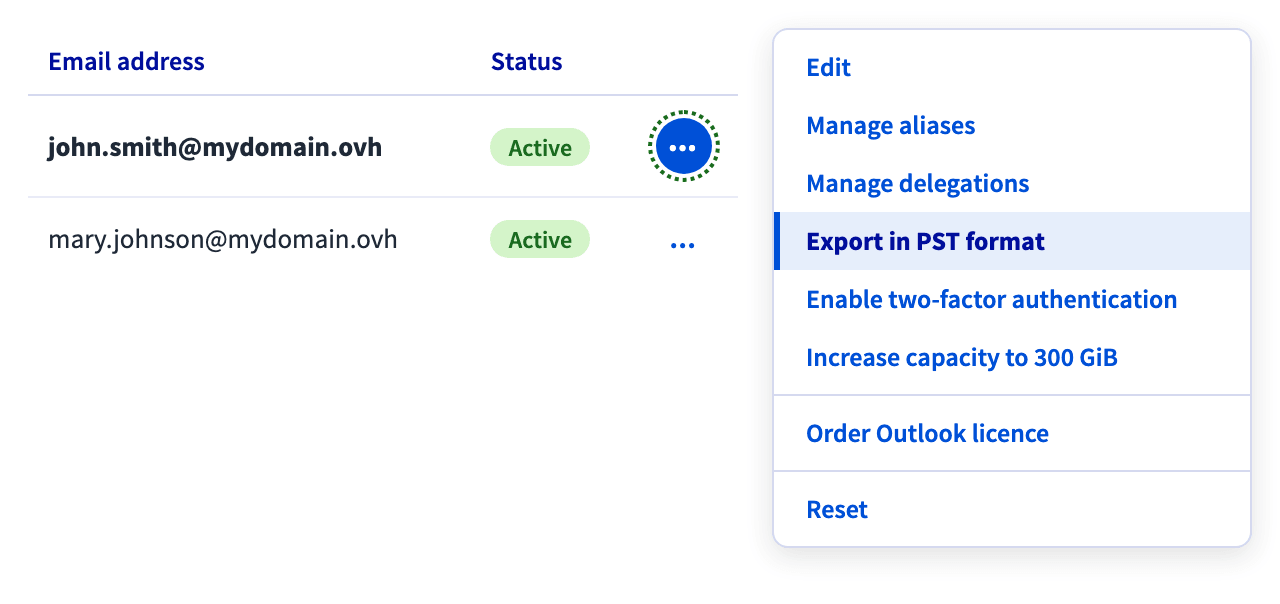
-
In the Export in .pst format window, click
Downloadto start the export. It runs in the background and takes between a few minutes and several hours depending on the mailbox size. You can close the window and leave the page: reopen the window at any time to see the progress, shown as a percentage.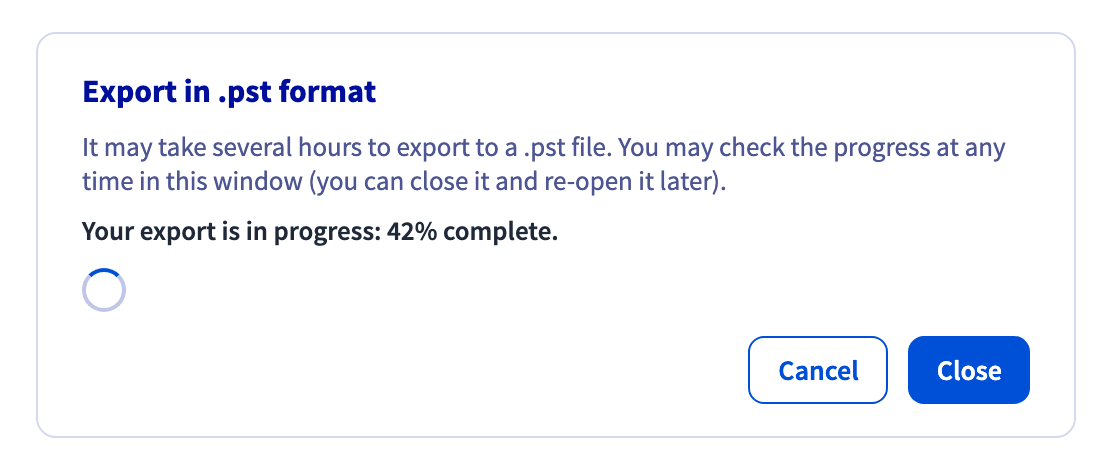
-
Once the export is complete, open the same
...menu and clickExport in PST formatagain. The download link is generated automatically, which takes 2 to 3 minutes.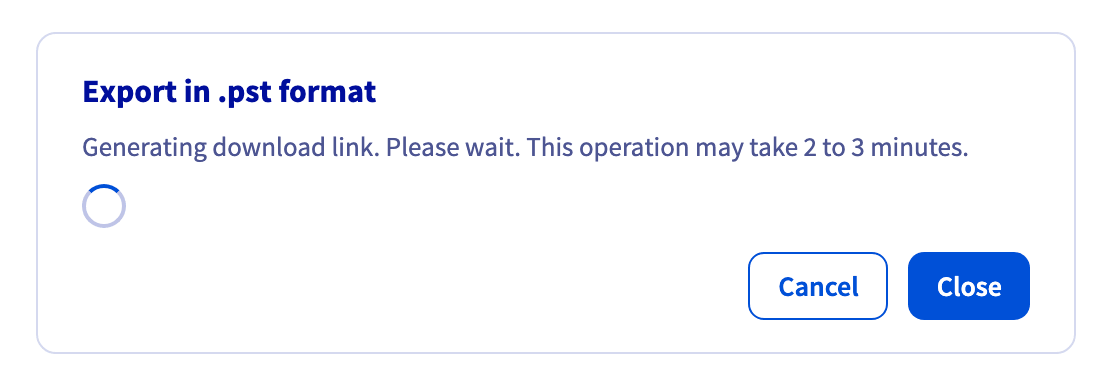
-
When the link is ready, the window confirms that the mailbox is available in
.pstformat. ClickDownloadto retrieve the ZIP archive, then extract and check it (see the Checking and opening the archive section).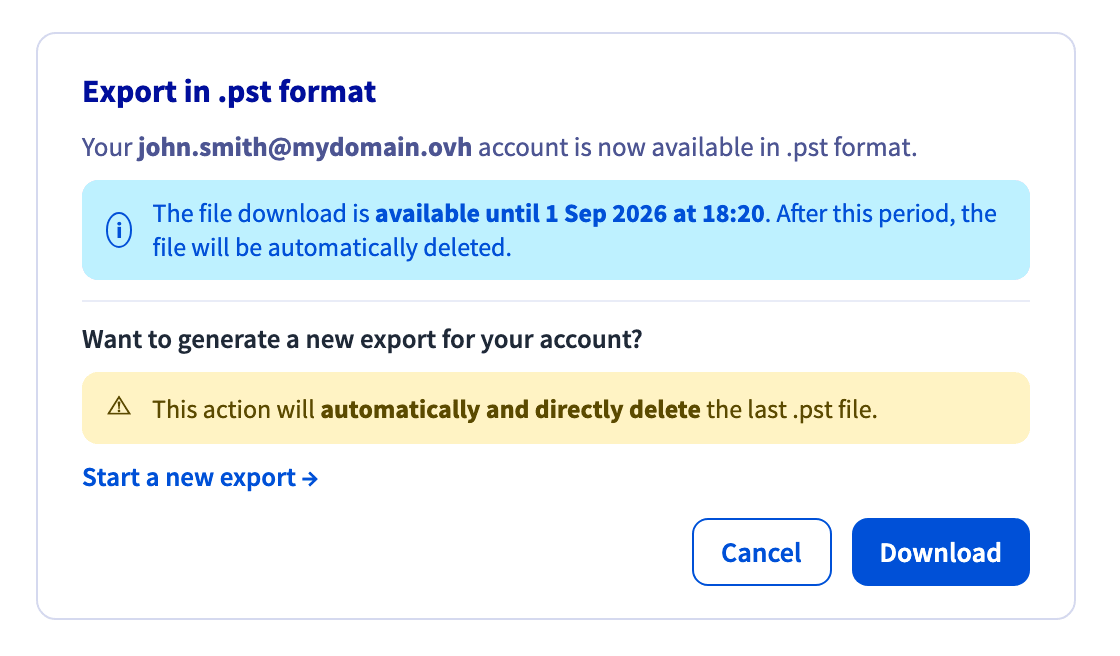
The download link is temporary: the window shows the date until which the file stays available. After that date, the archive is deleted and you have to request a new export. The same window lets you click Start a new export, which deletes the previous archive immediately.
Exporting with the OVHcloud API
The whole flow uses 2 objects: export builds the archive and reports its progress, and exportURL provides a temporary download URL. All the calls below belong to the of the OVHcloud API.
Finding the path parameters
Every call needs 3 values: the organisation name, the service name and the mailbox address. The first 2 are internal names, such as ab12345-ovh, not the labels shown in the OVHcloud Control Panel. Retrieve them in order, each call feeding the next.
1. Organisation (organizationName)
List the Exchange organisations of your account with the API call below:
2. Service (exchangeService)
List the Exchange services of the organisation with the API call below:
3. Mailbox (primaryEmailAddress)
List the email accounts of the service with the API call below:
Each call returns a list of strings. If the mailbox address contains non-URL-safe characters, percent-encode them in the path (+ becomes %2B, and so on).
Requesting the export
Request the export of the mailbox with the API call below:
The call takes no body parameter and returns a task confirming only that OVHcloud registered the request:
A task carries one of the statuses todo, doing, done, error or cancelled, and its function is addExportPstRequest, deleteExportPstRequest or generatePstUrl.
Following the progress
Read the export request to follow its progress:
Repeat this call until percentComplete reaches 100, polling at most once a minute. A 404 error means no export request exists for this mailbox: either it was never created, or it has already been removed.
Getting the download URL
The export object never returns a download URL: unlike the OVHcloud Control Panel, which generates the link for you, the API takes 2 calls.
1. Generate the URL
Create the download link, which registers a generatePstUrl task, with the API call below:
2. Read the URL
Once the task is complete, read the generated link with the API call below:
The URL is already signed: download the archive directly from it, without an authentication header. A 404 error on the GET call means the URL has not been generated yet (the generatePstUrl task is still running) or has expired.
The URL has a limited validity. Rely on expiration rather than on a fixed duration, and generate the URL only when you are ready to download. Once it has expired, call POST on exportURL again for a fresh link: as long as the archive still exists, you do not need to redo the export.
Removing the export request
Remove the export request with the API call below:
Use it to cancel a running export, or to remove the request after downloading the archive so you can request a new one — still subject to the 24-hour limit. The call also deletes the archive on the OVHcloud side: download it first.
Checking and opening the archive
Whichever method you used, the ZIP archive contains:
Extract the archive, then compare the PST files with the hashes in checksum.txt before importing them: a truncated download produces a PST file that Outlook either refuses to open, or opens with missing data. The commands below assume a <hash> <filename> layout, one line per file.
On Windows, with PowerShell:
On Linux or macOS:
If a hash does not match, download the archive again. If it still fails, request a new export.
To open the PST files in classic Outlook for Windows, go to File > Open & Export > Open Outlook Data File, then select each extracted .pst file. At the time of writing, the new Outlook for Windows does not open .pst files.
Limitations
- The export time scales with the mailbox size: minutes for a small mailbox, several hours for a large one. There is no way to speed it up.
- A mailbox holds a single export request, and a new one is only accepted 24 hours after the previous request for the same email address.
- The export applies to individual mailboxes only: groups, shared accounts and resource accounts are not covered.
Go further
Manually migrate your email address
Hosted Exchange - Responsibility model
Private Exchange - Backing up your email accounts with Veeam Backup for Microsoft 365
Join our community of users.