
How to create a subdomain
Find out how to define a subdomain and how to create one at OVHcloud
Objective
As you use your domain name, you will need to create and configure subdomains. Subdomains are the third level (Third Level Domain) of a domain name. The most well-known subdomain of Internet users is, to date, the subdomain World Wide Web (www). Indeed, many websites still use this subdomain to be consulted on the Internet.
For example, www.ovhcloud.com is a subdomain of the domain name ovhcloud.com.
You can create an infinite number of subdomains from a single domain name.
This guide explains how to create a subdomain by adding its DNS records to the active DNS zone of the domain name it depends on. This is the most common case.
If you want your subdomain to have its own DNS zone, separate from that of the domain name it depends on, please refer directly to our guide on "Create an OVHcloud DNS zone for a subdomain".
Find out more about subdomains and how to create one with OVHcloud.
Requirements
- You have at least one domain name.
- You have an active DNS zone for your domain name. If you need further guidance, please refer to our guide on "Creating an OVHcloud DNS zone".
- You have sufficient rights to all of the services concerned. You can find more information in our guide Managing contacts for your services.
OVHcloud Control Panel Access
- Direct link:
- Navigation path:
Web Cloud>Domain names> Select your domain name
Instructions
Content overview
- Introduction
- How do I create a subdomain?
- Associate, authorize and configure your subdomain with an OVHcloud service
Introduction
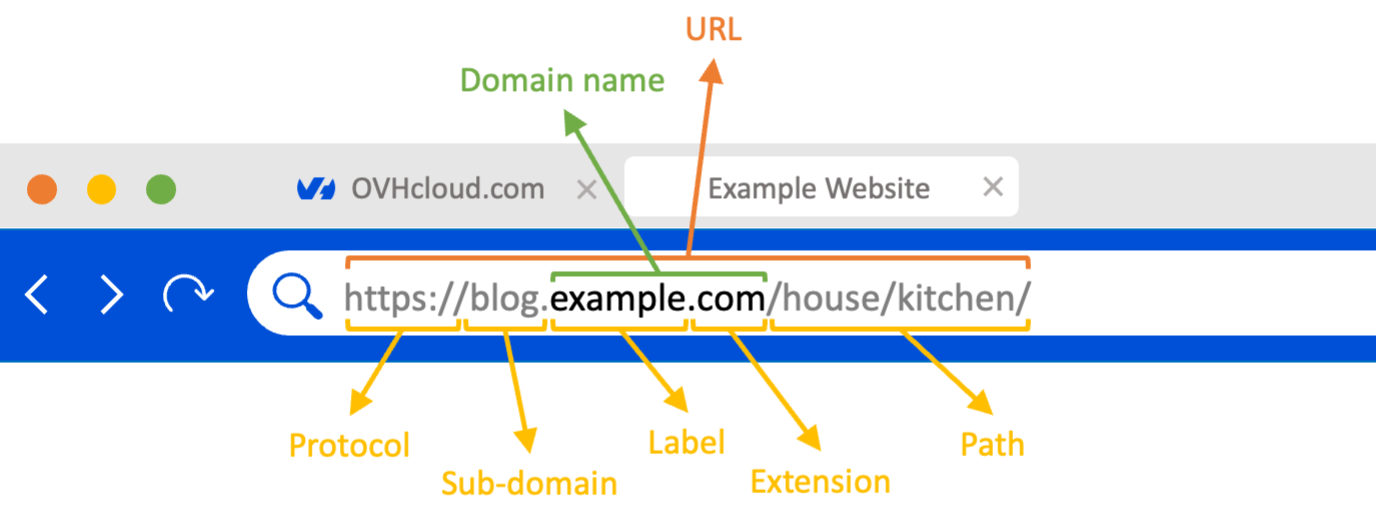
Click on the two questions below to see the explanations.
What is the composition of a domain name?
A domain name is made up of levels. These levels are usually separated by a . (with the exception of some extensions of the first level such as the .co.uk, .gouv.fr or .notaires.fr):
-
Top Level Domain (TLD): Represents the top level domains. We call them extensions. There are currently 4 types of top level domains:
- The country code Top Level Domains (ccTLDs): Composed of two characters, they correspond to the different countries of the world. For example, the extensions .ie, .es, .it or .pl are ccTLDs.
- The generic Top Level Domains (gTLDs): Consisting of at least three characters, they represent more general themes or business areas. For example, the extensions .com, .net, .org or .info are gTLDs.
- The new generic Top Level Domains (new gTLDs): New extensions created in 2012 by the Internet Corporation for Assigned Names and Numbers (ICANN) in order to meet the sharp increase in domain name applications. They can correspond to generic themes, brands, regions or cities. For example, the extensions .love, .ovh or .paris are new gTLDs.
- The Corporation Top Level Domains (CorpTLDs): This is actually a subcategory of the new gTLDs. Upon request to the ICANN, companies or organizations can request the creation of their own TLD. For example, the .ovh extension is a CorpTLD created by OVHcloud a few years ago.
-
Second Level Domain (SLD): Represents second level domains. We call them labels. When you order a domain name, you can freely set the label (provided that it has not already been registered by another user on the same extension and within the limit of 63 characters). For example, ovhcloud corresponds to the domain name label ovhcloud.com.
-
Third Level Domain (subdomain): Labels from this third level on are called subdomain. In this guide, we will describe its definition, and explain how you can implement it with your various services.
What is a subdomain?
A domain name can be associated with several types of services (email, website, etc.).
A domain name can only be associated with one website at a time.
However, some users or organizations need to segment their websites or email services while keeping the same domain name.
Subdomains (sometimes called prefixes) meet the need to segment a domain name. They offer the holder the ability to choose from several subcategories of web services associated with their domain name, without having to sign up to a new domain name.
In other words, subdomains make it easy to structure all of the web services (DNS servers, website, intranet, email, etc.) associated with the same domain name.
As mentioned above, subdomains are the third level (Third Level Domain) of a domain name. The most well-known subdomain of the Internet is World Wide Web (www). Indeed, many websites still use this subdomain on the Internet.
For example, www.ovhcloud.com is a subdomain of the ovhcloud.com domain name.
For example, if you have the domain name example.com, you can create the following subdomains:
- dns1.example.com and dns2.example.com to customize your DNS servers using GLUE records
- www.example.com to display your website
- preprod.example.com to test your website in new versions. This will not affect your users' access to your current website
- intranet.example.com so that your employees can talk to each other on your internal website
- forum.example.com or community.example.com so that your community of users can exchange and share their experience
- app.example.com to access your online application or download it directly
- recruitment.example.com to allow job seekers to apply on your own recruitment interface
- sav.example.com, sales.example.com, legal.example.com to enable your customers to contact different internal structures within your company or to prioritize your employees according to the internal services to which they belong
- etc.
Beyond the third level of domain, these are also considered subdomains. To use one of the examples above, you can create the subdomain preprod.app.example.com to test the new version of your web application. This will not interrupt access to the current version of your application on app.example.com.
How do I create a subdomain?
Domain names all need a DNS zone to work which is a domain name's configuration file. It consists of DNS records that map the domain name to various services and functions.
For more details on DNS zones, please read our guides "Creating an OVHcloud DNS zone" and "Editing an OVHcloud DNS zone".
All subdomains are configured in the domain name's active DNS zone. You can do this by adding DNS records.
1 - Identify where your domain name's active DNS zone is located
There are two possible scenarios:
- Your domain name's active DNS zone is managed at OVHcloud.
- Your domain name's active DNS zone is hosted elsewhere.
The active DNS zone for your domain name is not necessarily managed by the same provider as your domain name.
1: To identify the location of the active DNS zone for a domain name registered with OVHcloud, you can use our guide "Modifying the DNS servers for an OVHcloud domain name".
2: If your domain name is not registered with OVHcloud, contact your domain name's current registrar to find out where the active DNS zone is hosted. Please note that you can use our guide on Transferring a domain name to OVHcloud if you would like to perform this action.
If the DNS servers declared for your domain name have one of the following two forms:
dnsXX.ovh.netandnsXX.ovh.net(where each of the "X" represents a number)dnsXX.ovh.caandnsXX.ovh.ca(where each of the "X" represents a number)dns200.anycast.meandns200.anycast.me
This means that your domain name's active DNS zone is active with OVHcloud.
Otherwise contact your DNS provider to create subdomains with your domain name.
2 - Create the DNS records for your subdomains
To add your subdomains to your domain name's active DNS zone, please read our guide on "Editing an OVHcloud DNS zone".
For example, you can add:
- The IP address (DNS records of type A and AAAA) of your web hosting plan to display one of your websites with a subdomain.
- The email servers (DNS records of type MX) to which your subdomain must redirect the emails it receives. This allows you to view them on your custom email address(es) with your subdomain.
- Information related to the security/authentication of your services (web hosting, web server, email, etc.) associated with one of your subdomains (DNS records of type SPF, DKIM, DMARC, etc.).
Modifying a DNS zone associated with a domain name will take between 4 and 24 hours to propagate fully.
In addition, creating a DNS record for a subdomain (or domain name) is generally not enough to make it work with the target service you have defined for it in the DNS record.
For security reasons, you will also need to authorize the subdomain to access the target service (web hosting plan, email address, etc.).
In the next part, find out how to authorize a subdomain to access the various services in the Web Cloud universe (Web Hosting, Exchange server, etc.) offered by OVHcloud.
If you would like to configure a subdomain for a service hosted elsewhere than with OVHcloud, we will not be able to provide you with assistance on this subject. Please contact your external service provider to continue configuring your service.
Associate, authorize and configure your subdomain with an OVHcloud service
Several services from the Web Cloud universe can be used with a subdomain. The association procedures are similar to those you would need to perform with a domain name. We will only cover the most common cases.
For services that are not mentioned, please refer to the documentation for the service concerned. This is to identify if the domain can be used with a subdomain.
Case 1: Display a website on my OVHcloud web hosting plan with a subdomain
As with a domain name, to authorise a subdomain to display the content of a "target" folder declared for a website on a web hosting plan, log in to the and select Web Cloud. Click on Hosting plans in the left-hand column, select the hosting plan concerned where your website is located, then select the My sites tab.
This is where you authorise your subdomain to access your website on your web hosting plan.
For more details on configuring a domain or subdomain on a web hosting plan, please refer to our guide "How to associate a domain name with an existing website?". The procedure is the same for both domain names and subdomains.
Adding a domain name or subdomain to one of the websites on your web hosting may require setting up a validation token. For a subdomain, the same token is not taken into account and must be added not for the subdomain but for the domain name. In this case, you can add the token as a TXT record for the domain name in your domain name's active DNS zone.
Case 2 - Create Exchange email addresses with a subdomain
To enable the creation of custom Exchange email addresses with a subdomain, log in to your and select Web Cloud. Click Microsoft in the left-hand column, then Exchange. Then select the Exchange platform you want to use with your subdomain. On the page that pops up, go to the Associated domains tab, then click the Add a domain button on the right.
You can then declare your subdomain on your Exchange platform.
For more details on configuring an Exchange platform, please refer to the following guides:
- Getting started with the Hosted Exchange service
- Adding a domain name on an email platform
- Adding a CNAME record to validate your domain on your email solution
Case 3 - Create Email Pro addresses with a subdomain
To enable the creation of custom Email Pro addresses with a subdomain, log in to your and select Web Cloud. Click Professional emails, then select the Email Pro platform you want to use with your subdomain. On the page that pops up, go to the Associated domains tab, then click the Add a domain button on the right.
You can then declare your subdomain on your Email Pro platform.
For more details on configuring an Email Pro platform, please refer to the following guides:
- Getting started with the Email Pro solution
- Adding a domain name on an email platform
- Adding a CNAME record to validate your domain on your email solution
Go further
Modifying the DNS servers of an OVHcloud domain name
Hosting multiple websites on your web hosting plan
Getting started with the Hosted Exchange service
Getting started with the Email Pro solution
Adding a domain name on an email platform
Adding a CNAME record to validate your domain name on your email solution
For specialised services (SEO, development, etc.), contact OVHcloud partners.
If you would like assistance using and configuring your OVHcloud solutions, please refer to our support offers.
Join our community of users.