
Installing Etherpad on your Cloud Web hosting plan
Install the Etherpad text editor on your Cloud Web hosting plan and make it accessible through your domain name
Objective
Etherpad is a collaborative online text editor that works in real time. It allows several people to write text files simultaneously through a web interface. Etherpad is written in JavaScript and uses Node.js, a software platform for building your websites and APIs in server-side JavaScript.
OVHcloud Cloud Web hosting allows you to use Node.js as a runtime engine for your websites, and therefore to install Etherpad or any other application designed for Node.js.
In this tutorial, we will install an Etherpad server on an OVHcloud Cloud Web hosting plan and make it available through your domain name.
Requirements
- A OVHcloud Cloud Web hosting plan.
- Node.js enabled as a runtime engine.
- The relevant domain name added as a multisite, with Node.js set as its runtime engine.
- Access to your , in the
Web Cloudsection. - What you should know:
- The basics of the Node.js ecosystem.
- How to connect via SSH.
Instructions
Step 1: enabling Node.js as a runtime engine
To access the runtime engines of your Cloud Web hosting plan, log in to your . Click Hosting in the services bar on the left, then choose the name of the relevant Cloud Web hosting plan. Finally, go to the Runtime engines tab.
The table that appears displays the runtime engines currently added. Make sure that the Node.js runtime engine is enabled. If it is, proceed to Step 2 "Associating Node.js with a multisite".
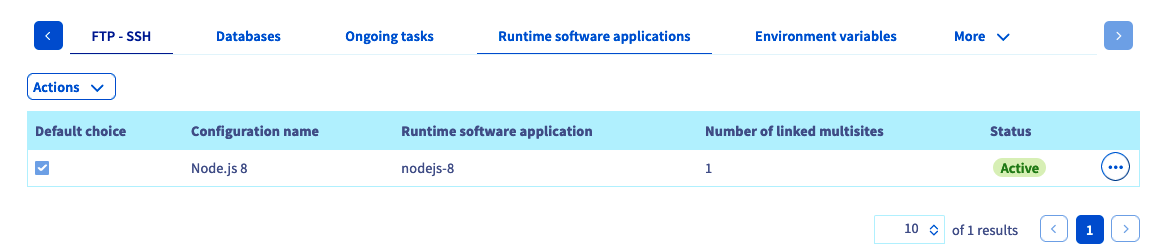
If it is not, add a new one (if your plan allows it) or modify the existing runtime engine.
- If you want to add an engine: click
Actionsabove the table, thenAdd a runtime engine. - If you want to modify an engine: click the
...button to the right of the relevant engine, thenEdit.
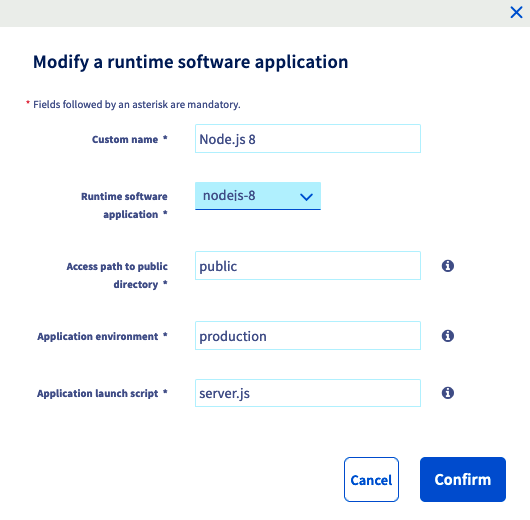
In the window that appears, fill in the requested information with the following values from our example, or adapt them to your own situation:
Once the information is filled in, click Confirm. If you would like more information about managing runtime engines, refer to our guide "Managing the runtime engines of Cloud Web".
Step 2: associating Node.js with a multisite
Now that Node.js is enabled as a runtime engine, you must associate it with one of your multisites. To do this, go to the Multisite tab. The table that appears contains all the domain names that have been added as a multisite. Two columns should draw your attention.
In the table, check that the Node.js runtime engine is properly linked to the relevant domains and that the root folder is correct. If it is, proceed to Step 3 "Connecting to your Cloud Web via SSH".
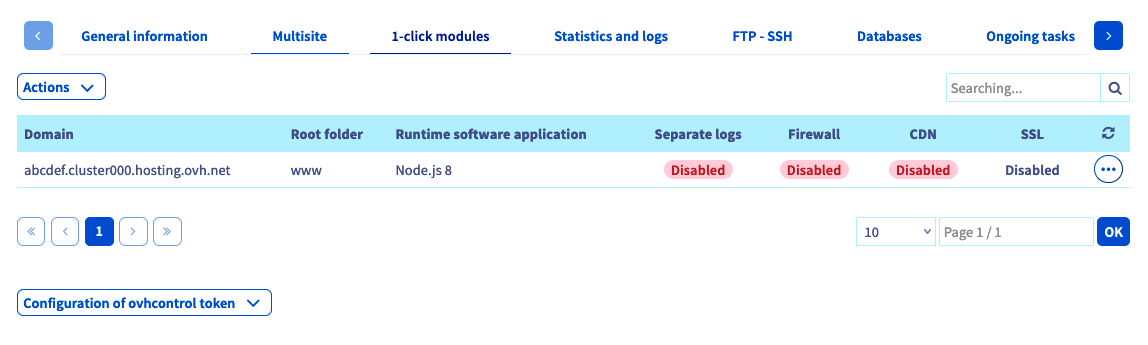
If it is not, add a new multisite or modify the existing one.
- If you want to add a multisite: click
Add a domain or subdomainto the right of the table. - If you want to modify a multisite: click the
...button to the right of the relevant domain, thenEdit.
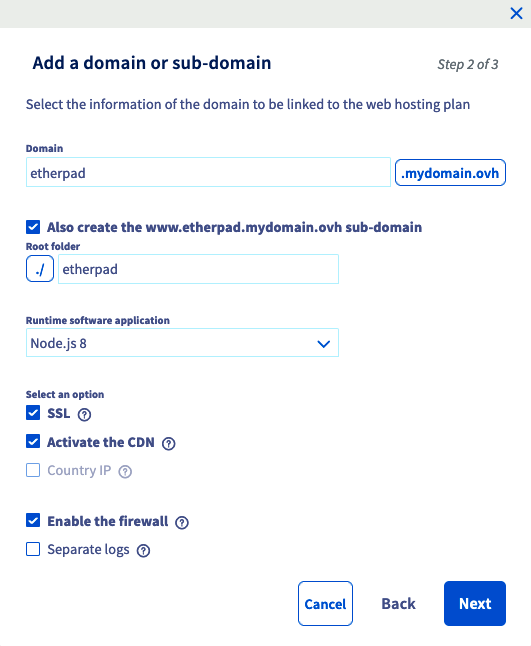
In the window that appears, fill in the requested information according to your own situation. Here are the values we used for this tutorial:
As for the additional options, choose the ones you want to enable. Once the information is filled in, click Next, then finalise the operation. This addition can take up to one hour. However, the change to the DNS configuration can take up to 24 hours to become fully effective. If you would like more information about managing multisites, refer to our guide "Sharing your hosting plan between several websites".
Step 3: connecting to your Cloud Web via SSH
Start by retrieving the information you need to connect. To do this, go to the FTP - SSH tab. If it does not appear in the list, first click the button with three bars. The information related to your storage space then appears. Locate the details listed next to the following items:
If you no longer know the password of the SSH user, click the ... button to the right of the relevant user in the table, then Change password.
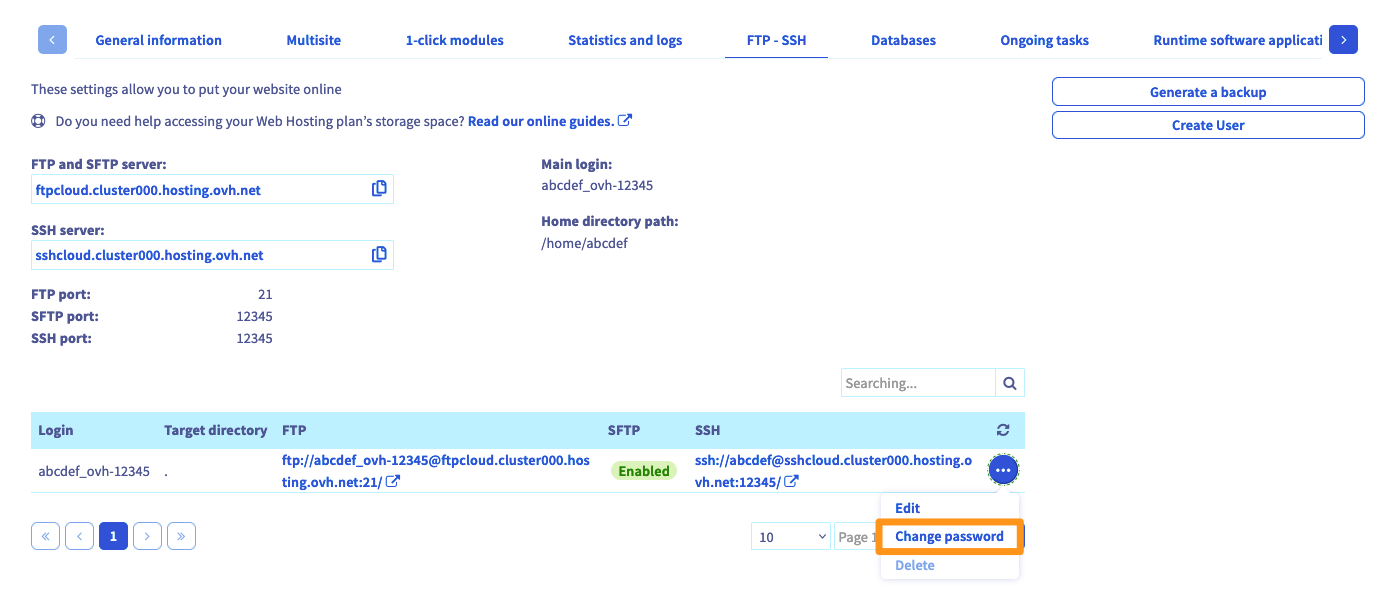
Now, to connect via SSH, you need to use a terminal. This tool is installed by default on macOS and Linux. A Windows environment will require the installation of software such as PuTTY or the addition of the "OpenSSH" feature. As this procedure is specific to the operating system you use, we cannot detail it in this documentation.
Here is an example of a command line you can use. Replace the "sshlogin", "sshserver" and "connectionport" elements with the ones matching your own situation. Once the command is sent, you will be prompted to enter the password of the SSH user.
Step 4: installing Etherpad
Start by moving into the root folder you specified in Step 2. In our tutorial, this is the "etherpad" directory. You can then retrieve the application code there.
Now install Etherpad's dependencies:
For Etherpad, the dependencies are installed by a Bash script. In general, for Node.js applications, these dependencies are installed using the "npm-node8 install" command.
The configuration set up in Node.js expects to find a "server.js" file in the root folder of your multisite (which you configured in Step 1). We will therefore create a symbolic link to point "server.js" to Etherpad's file of the same name.
Step 5: restarting the Node.js daemon
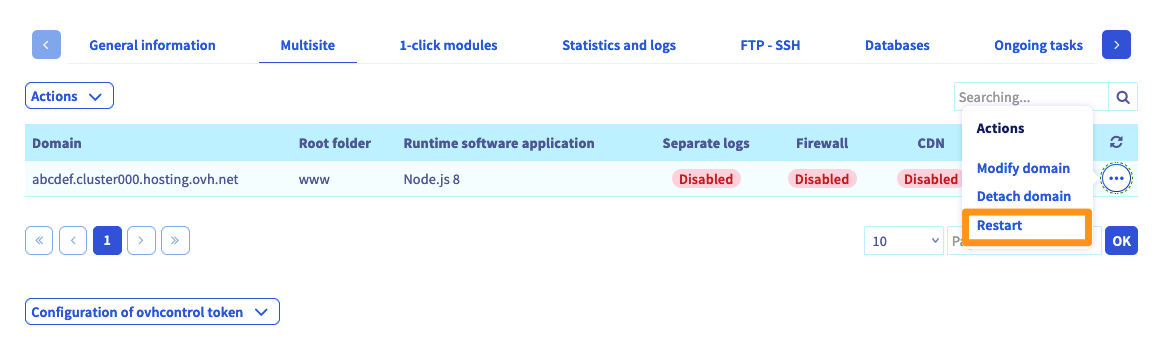
To restart the Node.js daemon, go back to your . Go to the Multisite tab, click the ... button to the right of the relevant domain name, then click Restart.
Once this is done, the application will be accessible through the domain name chosen in your multisite configuration.
Conclusion
We have seen how to install a Node.js application on a Cloud Web hosting plan by following the various steps. All that is left is to use Etherpad and collaborate together!
Go further
Migrating my website to OVHcloud
Installing your website with 1-click modules
Sharing your hosting plan between several websites
For specialised services (SEO, development, etc.), contact the OVHcloud partners.
If you would like assistance using and configuring your OVHcloud solutions, we invite you to consult our various support offers.
Join our community of users.