
Troubleshooting common database errors
Find out how to diagnose the most common cases of database errors
Objective
Your database usage may result in anomalies on your website or error messages in the , as well as on the phpMyAdmin interface.
Find out how to troubleshoot database errors with OVHcloud Web Hosting plans.
Information regarding OVHcloud service administration and how to find appropriate assistance
When using OVHcloud guides, please be aware of the following conditions:
- User instructions aim to provide as many details as possible but cannot cover individual use cases. You might need to adapt the pertinent actions to your requirements.
- The OVHcloud ecosystem is built for flexibility and freedom of choice. Customers are therefore responsible for the secure and proper configuration of their services. To prevent data loss, we strongly recommend to apply backup strategies to all your important data.
- Our guides and tutorials may reference third-party software or services in combination with OVHcloud solutions. The technical support provided by OVHcloud does not include the configuration of systems or products outside of our responsibility. This includes but is not limited to:
- Operating systems and user interfaces (Windows, Debian, Plesk, etc.).
- Any other third-party software (FTP clients, email software, etc.).
- Services offered by other providers (DNS, APIs, user interfaces, etc.).
To receive the appropriate assistance for any issues you might experience, follow these guidelines:
- You seek personalized advice or you would like to discuss a topic that is not covered in detail by our documentation?
Join the OVHcloud Community to search for your topic and reach out to other users. - You need to report an incident regarding your OVHcloud service or you are experiencing difficulties in the OVHcloud Control Panel?
Create a support request in our Help Centre. - You require professional assistance for your project or you need help with tasks outside our support scope?
Visit our partner portal to search for experts who are familiar with OVHcloud solutions. - You are looking for more detailed information regarding our support levels and Professional Services?
Please visit our web pages for OVHcloud support levels and OVHcloud Professional Services.
You can participate in improving our documentation:
- You would like to share feedback to improve a guide page or you want to report insufficient information on a specific page?
Use the "Was this page helpful?" buttons at the bottom of the page to let us know. - You would like to propose a specific documentation update?
Use the "Edit this page" function, available at the bottom of the page and in the sidebar.
Requirements
- An OVHcloud Web Hosting plan.
- An OVHcloud database service: Start SQL or Web Cloud Databases.
OVHcloud Control Panel Access
Hosting plans:
- Direct link:
- Navigation path:
Web Cloud>Hosting plans> Select your web hosting plan
Web Cloud Databases:
- Direct link:
- Navigation path:
Web Cloud>Web Cloud Databases> Select your database service
Instructions
"Error establishing a database connection"

Check ongoing incidents
First, check on the Web Cloud Status page whether your datacentre, your web hosting cluster, your Web Cloud Databases server, or your database is not affected by an incident on the OVHcloud infrastructure.
Click on the information you are looking for to view the content.
Find the datacentre of your web hosting plan
Click on the tabs below to view each of the 2 steps in succession.
Go to the page, then select the relevant web hosting plan.
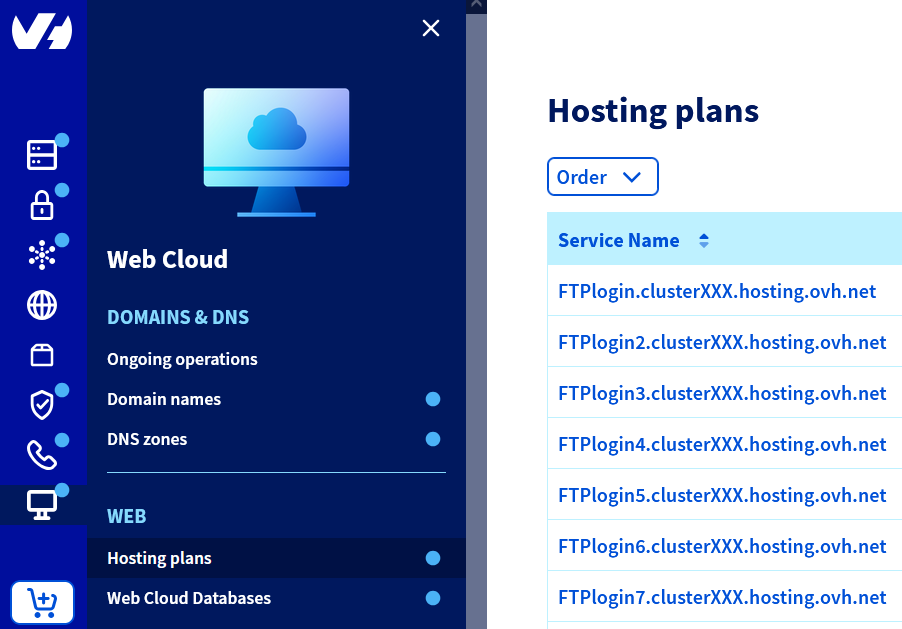
Find the cluster and filer of your web hosting plan
Refer to our guide "Finding out the cluster and filer of your web hosting plan".
Find the Web Cloud Databases server name
Click on the tabs below to view each of the 2 steps in succession.
Go to the page, then select the solution concerned.
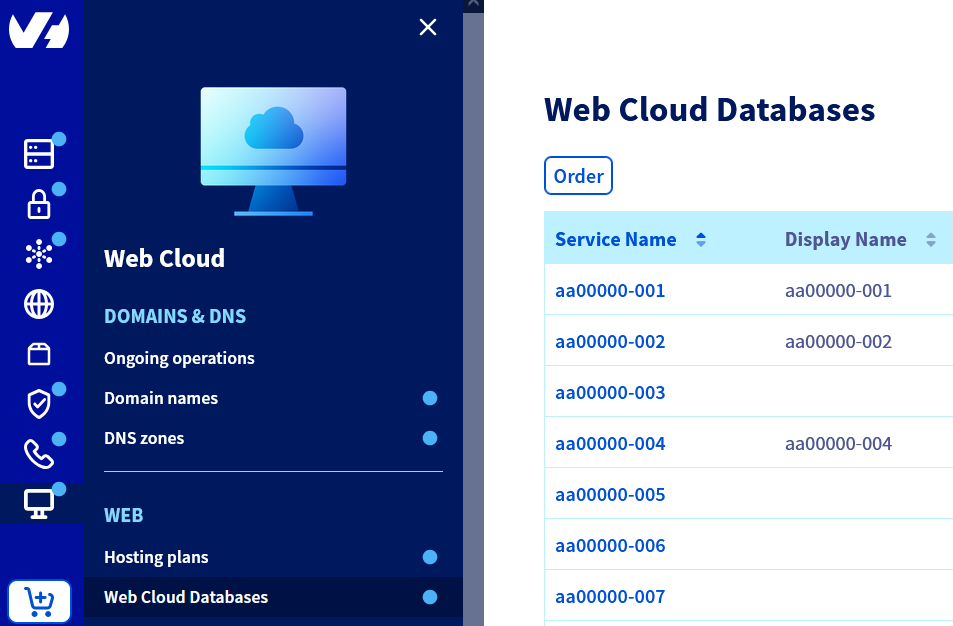
Find your web hosting database server
Refer to our guide "Finding your database server".
Verify login credentials for your database
Log in to the file storage space of your Web Hosting plan by FTP and find your website's configuration file (for example, a WordPress website will have a wp-config.php file located in the folder containing your website).
The name and content of the file relevant for database connection information depends on the CMS used for the website. This does not lie in the scope of responsibility of OVHcloud.
We recommend that you contact the publisher of the CMS concerned or a specialised service provider if necessary. We will not be able to assist you with this.
Then check the exact match between the login details for phpMyAdmin and the login details for your website's configuration file.
If necessary, change your database password.
Example for WordPress
If your website displays an "Error establishing a database connection" message and your hosting cluster is not affected by an incident, log in to the FTP storage space of your hosting and open the directory containing your website (by default, this is the www folder).
If this is a WordPress site, open the file wp-config.php.
Click on the tabs below to view each of the 2 steps in succession.
Go to the page, then select the relevant web hosting plan.
If you are unable to restore access to your website as a result of these changes, back up your database then restore it to an earlier date from your .
Contact a specialised service provider if necessary. We will not be able to assist you with this.
You have exceeded the authorised quota
You have received an email notification stating that the amount of data on your database exceeds the authorised limit. Your database has therefore been switched to read-only mode. This will prevent your website from being modified.

There are three ways you can unblock your database in this situation.
Method 1: Upgrade your subscription
If you have a Starter or Personal Web Hosting plan, we recommend that you switch to the high-performance offer. This subscription change will increase the size of your database which will automatically reopen it. This method is the simplest and does not require any particular technical expertise.
The increase of the size of your database may be linked to a malfunction in your website's internal code.
In this case, changing your Web Hosting plan would be ineffective, as your database will continue to fill up.
If you notice a sudden increase in the size of your database, or if you have a "blog" type site that normally does not use much data, we advise you to contact a specialised service provider as soon as possible. We will not be able to provide you with support on this matter.
To upgrade your subscription, click on the tabs below to view each of the 3 steps in succession.
Go to the page, then select the relevant web hosting plan.
If you are already subscribing to a Performance offer, refer to method 2.
Method 2: Migrate your data to a larger database
You can also migrate your data to a new database:
- Order a larger database service if necessary, then create the new database;
- Duplicate the content of the old database to the new database or perform an export of your data, then import your data in the new database;
- Integrate the credentials of the new database into the configuration file of your site.
If you have a Performance, Agency, Agency Plus or Agency Max Web Hosting plan, you can also activate a free Web Cloud Databases service.
Method 3: Delete unnecessary data
Once you have made a database backup, log in to your phpMyAdmin interface to delete any unnecessary data using the Drop, Delete and Truncate commands.
To recalculate the quota, click on the tabs below to view each of the 3 steps in succession.
Go to the page, then select the relevant web hosting plan.
This operation requires advanced technical knowledge. We recommend contacting a specialised service provider if you need to use this method. We will not be able to assist you with this.
Method 4: Optimise your database
To optimise your database, follow the instructions in our guide "Configuring your database server".
To recalculate the quota, click on the tabs below to view each of the 3 steps in succession.
Go to the page, then select the relevant web hosting plan.
If the advice on how to optimise your database is not sufficient to unblock the access to your website, we recommend you to contact our community or OVHcloud partners. We will not be able to assist you in this regard.
RAM overflows (Web Cloud Databases only)
The following message indicates that your Web Cloud Databases server has consumed too much resources on the OVHcloud infrastructure:
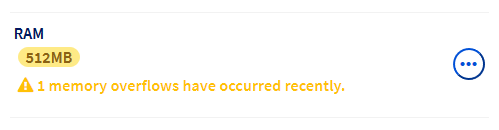
To increase the amount of RAM, click on the tabs below to view each of the 3 steps in succession.
Go to the page, then select the solution concerned.
To increase the amount of RAM, the database needs to be a standalone service and not one of those included with a Performance, Agency, Agency Plus or Agency Max web hosting plan. If you want to increase the amount of RAM of a database included in these web hosting offers, you first need to detach it.
To detach the database, refer to our guide "Detaching a Web Cloud Databases from your web hosting plan".
You can also optimise your database by following the instructions of our guide "Configuring your database server".
If you experience any difficulties in decreasing the use of resources on your database server, please contact our community of users or OVHcloud partners. We will not be able to assist you with this.
Database import errors
"Access denied for user to database"
"#1044 - Access denied for user to database"
This error message means that the database you are trying to import contains elements that are not authorised on the OVHcloud shared infrastructure.
First make sure that your database is empty. To do this, click on the tabs below to view each of the 3 steps in succession.
Go to the page, then select the relevant web hosting plan.
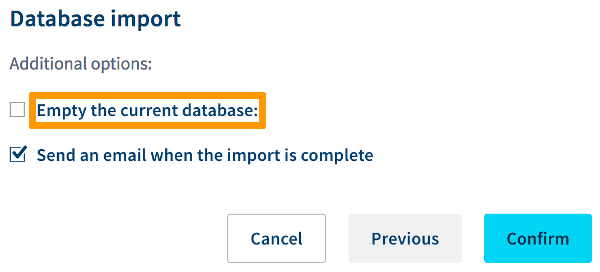
If necessary, contact our user community or a specialised service provider for more information. We will not be able to assist you in correcting this issue.
Which elements in my database import script can cause a "#1044 - Access denied for user to database" error?
You cannot have a "trigger" in your database's import script on OVHcloud shared hosting servers. In this situation, import your database to a Web Cloud Databases server.
The following query is also not allowed:
Use this line instead:
Replace Database-Name with the name of the database as displayed in your .
"MySQL server has gone away"
"ERROR 2006: MySQL server has gone away"
This error message appears when importing a database on a Web Cloud Databases server. In most cases, it is caused by the quantity of data to be imported being too large or by non-optimised SQL queries in the import script.
To resolve this issue, you can:
- Increase the amount of RAM. To do this, click on the tabs below to view each of the 3 steps in succession.
Go to the page, then select the solution concerned.
-
Split your database in order to import it through multiple operations instead of one. (For any questions on the necessary steps, contact our community or OVHcloud partners. We will not be able to assist you with this.)
-
Optimise your database, then repeat the export/import operations.
Unable to access phpMyAdmin
"Access denied for user"
"mysqli::real_connect(): (HY000/1045): Access denied for user"
This error message may appear when connecting to your database by phpMyAdmin. It indicates that the credentials entered are incorrect.
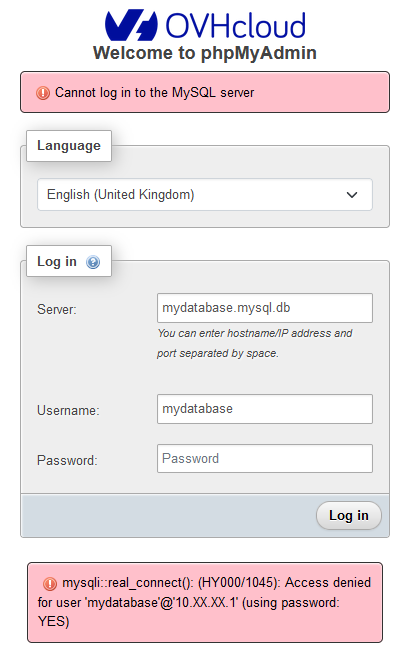
In this situation, check the credentials entered and change your database password if necessary.
"Too many connections"
"mysqli_real_connect(): (HY000/1040): Too many connections"
The maximum number of active connections for databases delivered with a shared hosting (Start SQL) is 30.
This number increases to 200 for the Web Cloud Databases service. (This setting can be modified in the Configuration section of your database service.)
A "Too many connections" error when connecting to phpMyAdmin appears if this maximum number of connections is exceeded.
In this situation, you will need to optimise your databases in order to reduce the number of active connections.
If you have any questions about the changes you need to make in order to reduce the number of active connections to your database, please contact our community or OVHcloud partners. We will not be able to assist you in this regard.
"Name or service not known"
"mysqli::real_connect(): (HY000/2002): php_network_getaddresses: getaddrinfo failed: Name or service not known"
This error message appears when connecting to phpMyAdmin if the server name entered is incorrect.
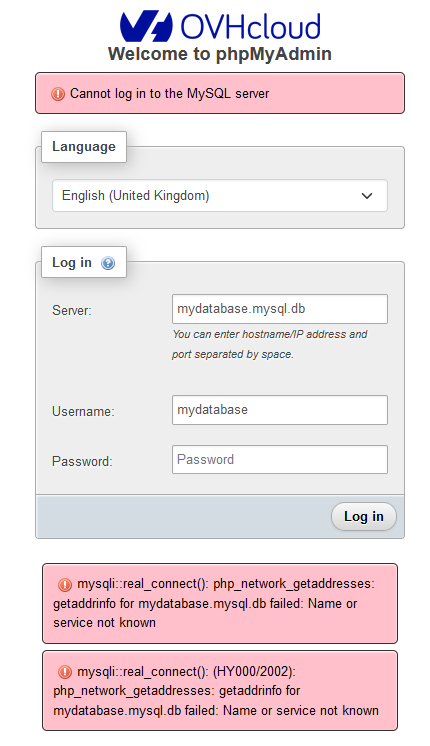
Check the server name for the relevant database service.
Click on the relevant situation to view the content.
Database on a web hosting plan
Click on the tabs below to view each of the 2 steps in succession.
Go to the page, then select the relevant web hosting plan.
Database on a Web Cloud Databases server
Click on the tabs below to view each of the 2 steps in succession.
Go to the page, then select the solution concerned.
Unable to connect to a Cloud Databases database
Having a Web Cloud Databases server allows you to connect to your databases from your computer or a server outside of the OVHcloud infrastructure.
If this connection is not possible, first check that you have authorised your public IP address to connect to the database server.
If this operation has been carried out, contact your ISP or the OVHcloud partners. We will not be able to assist you in this situation.
Go further
Getting started with Web Cloud Databases
For specialised services (SEO, development, etc.), contact OVHcloud partners.
Join our community of users.