
How to add a DNS TXT record for a domain name
Find out how to add a TXT record to an OVHcloud DNS zone for your domain name
Objective
Do you need to validate a verification or security process for your domain name (service association via a validation token, verification key, etc.) using your DNS zone? Want to add a custom text value to your domain name's DNS zone?
To do this, you will need to create a TXT record in your domain name's active DNS zone.
Find out how to add a DNS TXT record to an OVHcloud DNS zone for your domain name.
To modify or delete a TXT record of an OVHcloud DNS zone, follow this guide.
Requirements
- A domain name
- A DNS zone associated with this domain name at OVHcloud
OVHcloud Control Panel Access
- Direct link:
- Navigation path:
Web Cloud>Domain names> select your domain name >DNS zonetab
Instructions
Adding, modifying or deleting DNS records in an active DNS zone can cause service interruptions. If in doubt, contact a specialist provider.
Add a DNS TXT record for a domain name
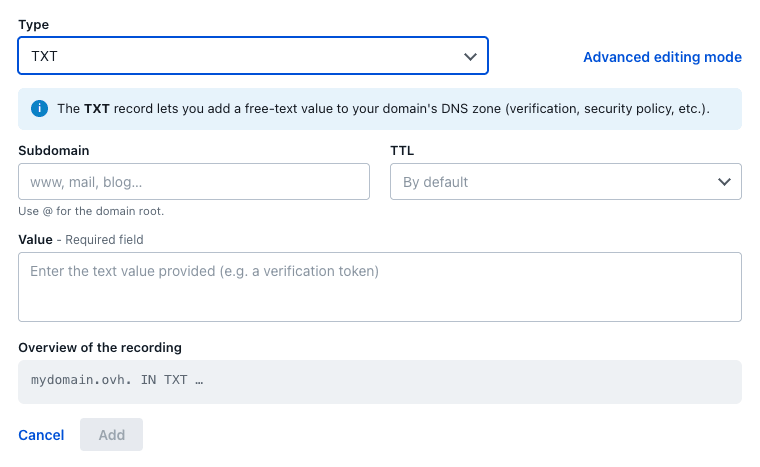
Click Add an entry above the table and select the TXT type. In the Value field, enter the TXT string you want to add (e.g. AbCdE-Value-of-TXT-fGhIjK), then click Add.
It takes up to 24 hours for the change to propagate fully over the DNS network.
Click here for more information.
See our detailed guides:
Add a DNS TXT record for a domain name subdomain
Follow the same steps as above and, in the Subdomain field, enter the subdomain (e.g. www for www.domain.tld) before entering the TXT string in the Value field (e.g. AbCdE-Value-of-TXT-fGhIjK). Then click Add.
Click here for more information.
See our detailed guides:
Go further
Everything you need to know about DNS zones.
Everything you need to know about DNS records
For specialised services (SEO, development, etc.), contact OVHcloud partners.
If you would like assistance using and configuring your OVHcloud solutions, please refer to our support offers.
Join our community of users.