
Monitoring and managing automated emails in your web hosting plan
Find out how to monitor and manage automated emails sent from your OVHcloud web hosting plan
Objective
Automated emails are messages sent via scripts, usually through PHP's mail() function. For example, they are used for your website's contact form, allowing your visitors to send you messages.
This guide mainly applies to emails sent from scripts located on your OVHcloud web hosting plan using the PHP "mail()" function.
If you would like to manage the email accounts included in your MX Plan service or in your OVHcloud web hosting plan, please refer to our MX Plan documentation.
This guide covers sending via the PHP "mail()" function, which is monitored from your OVHcloud Control Panel. You can also send emails from your shared hosting through an authenticated SMTP connection with an email account attached to your domain. To choose between the two methods and configure SMTP sending, refer to the guide Web Hosting - Email sending best practices.
This guide explains how to monitor and manage automated emails sent from your OVHcloud web hosting plan.
Requirements
OVHcloud Control Panel Access
- Direct link:
- Navigation path:
Web Cloud>Hosting plans> Select your web hosting plan
Instructions
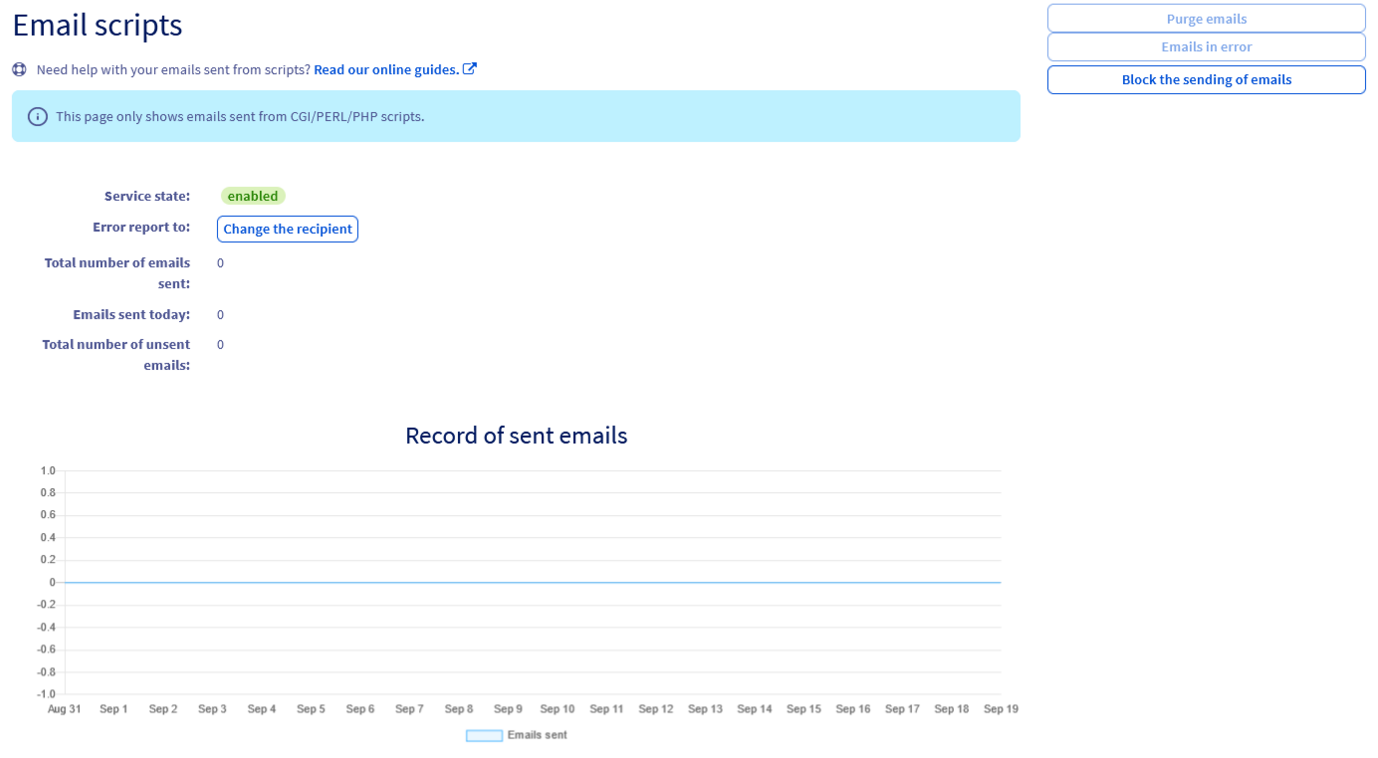
Overview of the "Email scripts" section
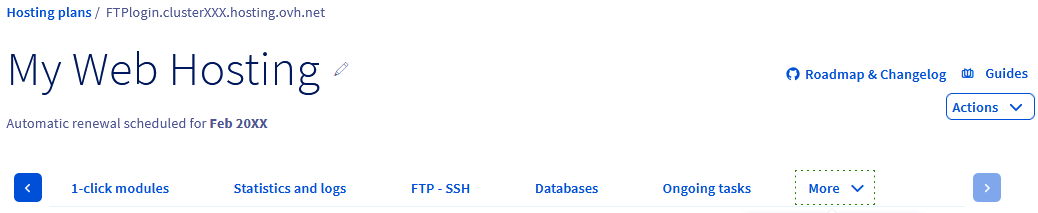
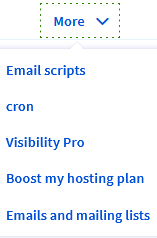
To access the "Email scripts" section, click on the tabs below to view each of the 3 steps.
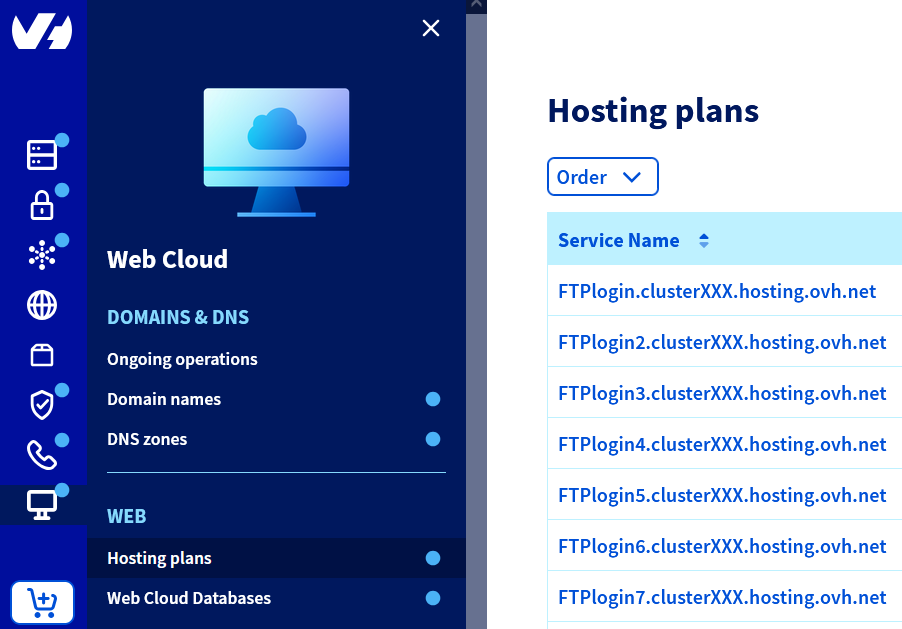
Go to the page, then select the web hosting plan concerned.
To avoid unwanted use of automated emails from your web hosting plan, we strongly recommend setting up a security system, such as including a "Captcha" in the forms on your website that can send emails (a contact form, for example).
If you notice that the emails generated from your scripts are no longer sent, but the service status still allows the emails to be sent ("Enabled" or "Force"), check the following:
-
Check the scripts sending the email: The scripts may not be able to send the emails due to a syntax error. Check the content of your scripts, correct them if necessary, then try again.
-
Check email sending via test script: Create a test script that sends an email to your personal email address using the following code:
For $headers, enter the same sending email address twice.
If you receive the message The email has been sent successfully! on the email address you have defined in the line for $to, this indicates that the scripts sending your emails contain errors.
-
Make sure that your script actually uses the "mail()" function: the checks and statistics on this page only apply to emails sent via "mail()". If your script, or the email settings of your website, specify an SMTP server, the emails go through that server and do not appear here. See the Sending emails using an SMTP script section.
-
Check the total size of your email: The email sent must not exceed the total size of 10 MB (encapsulation and header included). The content of your email must not exceed 7/8 MB.
Managing the "Disabled", "Bounce" and "spam" states
In this section, you will find details on each status that has blocked your email function.
Before detailing each of these statuses, it is important to understand the points that can degrade your domain name's reputation or prevent your emails from being received.
Verify the following upstream:
- The configuration of the SPF record in the domain name's DNS zone.
- The configuration of the DMARC record in the DNS zone of the domain name, only if the destination server requires it.
- Check the reputation of the IP address that sent the email (here the IP of your web hosting plan), using tools such as MXtoolbox or Spamhaus.
- The email does not contain any elements that could be interpreted as spam. You can find a non-exhaustive list of these elements in the "Case 3: Sending legitimate emails classified as spam" section of this guide.
- If there is no blockage on the OVHcloud side, and if the email has not been received or rejected by the recipient, contact the recipient to have them check if the email has been blocked on the receiving server.
The "Disabled" status
This state occurs when:
- Too many emails were sent in quick succession.
- Too many emails are returned in error.
- You have disabled the feature in your .
To resolve this, click on the tabs below to view each of the 3 steps.
Go to the page, then select the web hosting plan concerned.
The "Bounce" status
This state occurs when too many of your emails bounce back with an error.
To resolve this, click on the tabs below to view each of the 3 steps.
Go to the page, then select the web hosting plan concerned.
The "spam" status
This state occurs when spam is sent from your hosting.
Generally, this block is accompanied by the sending of an email titled "Abuse with your domain.tld hosting", generated automatically by our security robots.
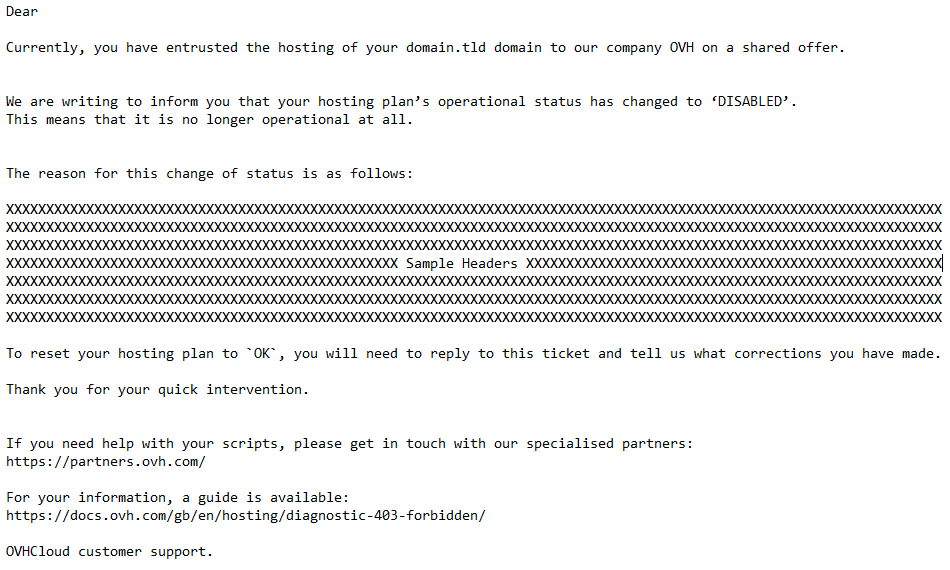
There are three possible scenarios for this situation:
- Case 1: Robot operation on a contact form:
To resolve this issue, secure every script that can send emails from your hosting plan, using a "Captcha" type system.
Then go to the "Email scripts" section of your hosting plan. To do so, click on the tabs below to view each of the 3 steps.
Go to the page, then select the web hosting plan concerned.
- Case 2: Malicious file injected into your hosting system:
To correct this, you must do at least the following:
- Analyse your hosting logs to identify security vulnerabilities and infected files.
- Delete or correct the malicious file(s)/module(s).
- For CMSs (WordPress, Joomla!, PrestaShop, Drupal, etc.), update the CMS, plugin(s) and associated theme.
- Secure your contact forms with a Captcha.
If you are using a CMS, install only "official" plugins and themes. Update the CMS, plugins and associated theme as regularly as possible to avoid this happening again.
Once you have secured your hosting plan, click on the tabs below to view each of the 3 steps.
Go to the page, then select the web hosting plan concerned.
In this case, a purge is required to delete the spam that is waiting to be sent.
If you are the originator of the emails that caused the block, below are some examples of practices to avoid when sending an email (so that it is not immediately considered spam):
- 3 or more words in upper case in the subject of the email.
- Email with empty subject/body.
- The email only contains an image larger than 1 MB and very little text.
- The subject of the email starts with: Hi, FREE, BUY, BUYING, or similar phrasing.
- The email contains more than 70% "white space" (abuse of the "SPACE" or "ENTER" key on the keyboard).
- The font size used to write the email is extremely large.
- The text colour and the background colour are the same.
- The sender IP address (IP of your Internet access point for example) has a negative reputation with spam protection services.
- The header of the sent email does not respect the RFC email standards.
- Links in the email are incorrect.
- A URL in the email is not secure (example: a URL written as
https://, while the actual URL only exists ashttp://). - The email contains terms of a pornographic nature or similar.
- The email contains an executable (EXE, BAT, PIF, XML, XLSX or documents with macros); this applies even if the file is inside a compressed archive (.zip, .rar, etc.).
If your service is still in a "spam" state, reply to the automatic email you received, specifying that you have taken the necessary measures.
Our antispam service will analyse the situation, and our support team will get back to you to explain the unblock procedure.
Sending emails using an "SMTP" script
Information regarding OVHcloud service administration and how to find appropriate assistance
When using OVHcloud guides, please be aware of the following conditions:
- User instructions aim to provide as many details as possible but cannot cover individual use cases. You might need to adapt the pertinent actions to your requirements.
- The OVHcloud ecosystem is built for flexibility and freedom of choice. Customers are therefore responsible for the secure and proper configuration of their services. To prevent data loss, we strongly recommend to apply backup strategies to all your important data.
- Our guides and tutorials may reference third-party software or services in combination with OVHcloud solutions. The technical support provided by OVHcloud does not include the configuration of systems or products outside of our responsibility. This includes but is not limited to:
- Operating systems and user interfaces (Windows, Debian, Plesk, etc.).
- Any other third-party software (FTP clients, email software, etc.).
- Services offered by other providers (DNS, APIs, user interfaces, etc.).
To receive the appropriate assistance for any issues you might experience, follow these guidelines:
- You seek personalized advice or you would like to discuss a topic that is not covered in detail by our documentation?
Join the OVHcloud Community to search for your topic and reach out to other users. - You need to report an incident regarding your OVHcloud service or you are experiencing difficulties in the OVHcloud Control Panel?
Create a support request in our Help Centre. - You require professional assistance for your project or you need help with tasks outside our support scope?
Visit our partner portal to search for experts who are familiar with OVHcloud solutions. - You are looking for more detailed information regarding our support levels and Professional Services?
Please visit our web pages for OVHcloud support levels and OVHcloud Professional Services.
You can participate in improving our documentation:
- You would like to share feedback to improve a guide page or you want to report insufficient information on a specific page?
Use the "Was this page helpful?" buttons at the bottom of the page to let us know. - You would like to propose a specific documentation update?
Use the "Edit this page" function, available at the bottom of the page and in the sidebar.
Shared hosting also allows you to send emails through a script that uses an authenticated SMTP connection with an email account attached to your domain, instead of the "mail()" function. The sending quota then depends on the email account (around 200 emails per hour for an MX Plan account) and on the source IP address (300 emails per hour per IP address, shared with the other websites of your hosting cluster), and the emails are not visible in the Email scripts section of your OVHcloud Control Panel.
To compare the two methods and configure SMTP sending (server, port, PHPMailer example, CMS plugins), refer to the guide Web Hosting - Email sending best practices.
Go further
Web Hosting - Email sending best practices
Fix the 403 Forbidden page on your website
Restore your web hosting plan's FTP storage space
For specialised services (SEO, development, etc.), contact OVHcloud partners.
If you would like assistance using and configuring your OVHcloud solutions, please refer to our support offers.
Join our community of users.