Manage instance states (stop, shelve, pause)
Learn how to shelve, hard stop, suspend or pause a Public Cloud instance to temporarily free resources while keeping your IP address, and understand the billing impact of each option
Objective
As part of the configuration of a high-availability infrastructure, you may need to cut access to your instances to perform different tests. OpenStack allows you to shelve, stop (shutoff), suspend or pause your instance. In each case, your IP is maintained.
In the OVHcloud Console, only Shelve / Unshelve and Hard stop (OpenStack stop, Shut Off in Horizon) are available. Suspend / Resume and Pause / Unpause are available with the OVHcloud API (v2), in Horizon and with the OpenStack API.
This guide explains how to shelve, hard stop, suspend or pause your instance.
Requirements
- An OVHcloud Public Cloud instance on hourly billing
- Access to the Horizon interface
- Knowledge of OpenStack API and OpenStack variables
OVHcloud Console Access
- Direct link:
- Navigation path:
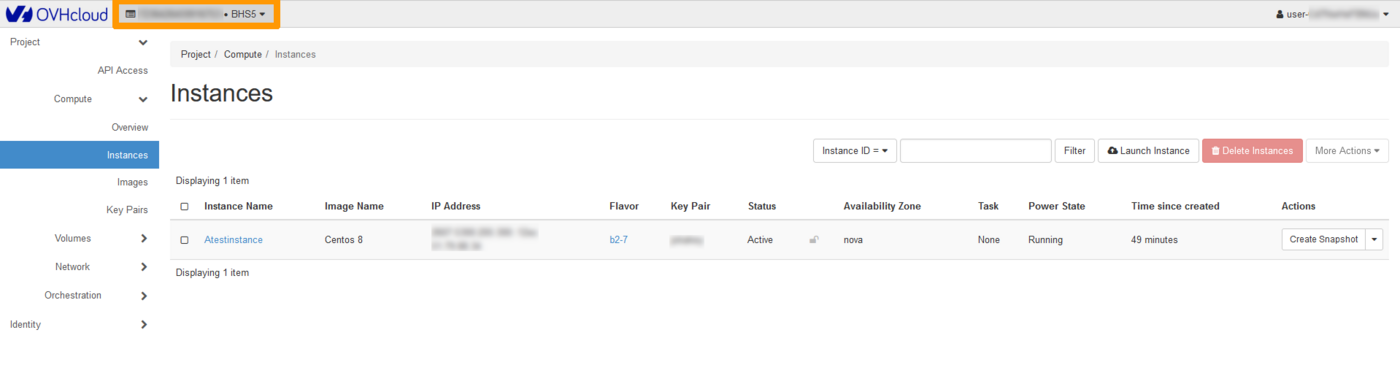
Public Cloud> Select your project >Compute>Instances
Instructions
Scope: This guide applies to all Public Cloud instances, regardless of their billing model (hourly or monthly).
Monthly billing: For instances billed monthly, the monthly price of the instance continues to be billed regardless of the instance status. A shelved monthly instance is billed its monthly price plus the snapshot.
Note: As long as the instance is not deleted, any operation will continue to incur instance charges.
The table below allows you to differentiate the options available on your instances. Click the option of your choice below to continue reading this guide. The OpenStack action is given in brackets.
In each case, the IP address of the instance is maintained.
Content overview
- Shelve an instance
- Unshelve an instance
- Hard stop (stop) an instance
- Suspend an instance
- Pause an instance
Shelve an instance
Please note that shelving an IOPS or T1/T2-180 instance will result in the loss of data on the NVMe passthrough drives.
Shelving this type of instance leads to its decommissioning from the host, and therefore from the disks in passthrough.
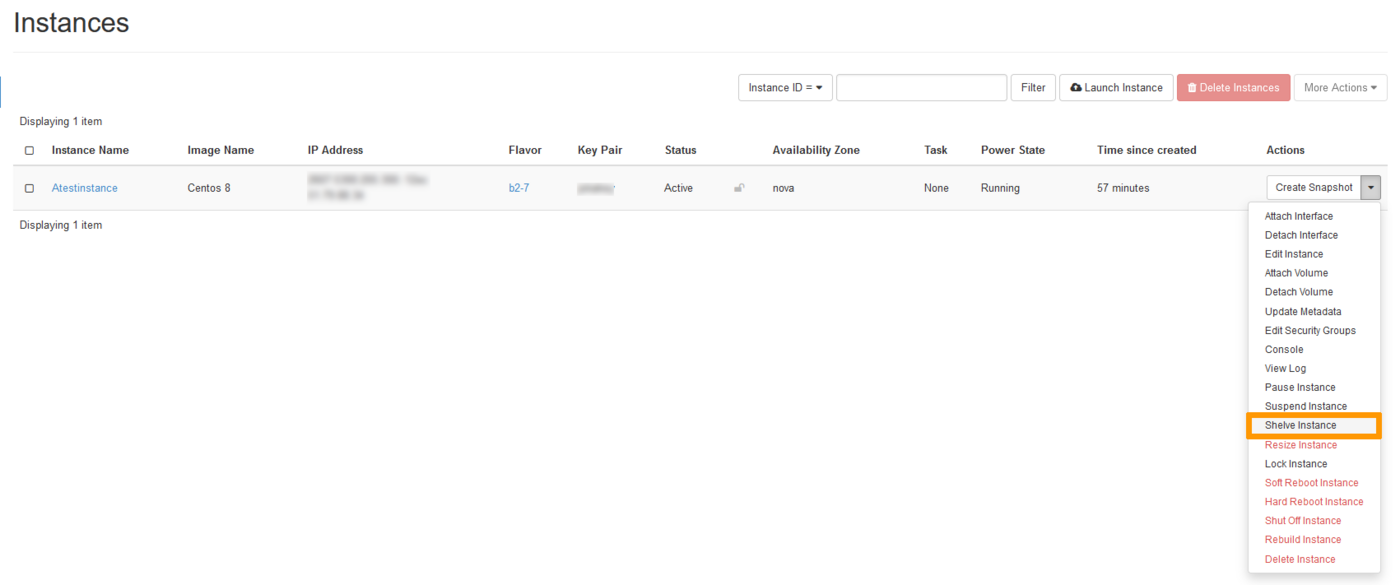
This option releases the resources dedicated to your Public Cloud instance, but the IP address will remain. The data on your local disk will be stored in a snapshot automatically created once the instance is shelved. Data stored in the memory and elsewhere will not be retained.
In the left-hand menu of your Public Cloud project, click Instances under Compute.
Click on the ... button to the right of the instance you want to shelve, then click on Shelve.
In the Shelve your instance window, take note of the message and click on Confirm.
Once the process is completed, the status of your instance will appear as Shelve.
To view the snapshot, click on Instance Snapshot under Compute in the left-hand menu. A snapshot named xxxxx-shelved will now be visible.


Unshelve an instance
This option reactivates your instance so that you can continue using it. Once this is done, regular billing resumes.
Actions on the snapshot
Any actions on the snapshot other than unshelve can be very dangerous for your infrastructure in case of misuse. Once you unshelve an instance, the snapshot is automatically deleted. It is not recommended to deploy a new instance from any snapshot created as a result of shelving an instance.
OVHcloud is providing you with machines that you are responsible for. We have no access to these machines, and therefore cannot manage them. You are responsible for your own software and security management. If you experience any issues or doubts when it comes to managing, using or securing your server, we recommend that you contact a specialist service provider.
In the left-hand menu of your Public Cloud project, click Instances under Compute.
Click on the ... button to the right of the instance, then click on Unshelve.
In the Unshelve your instance window, click on Confirm.
Once the process is completed, the status of your instance will appear as Active.

Hard stop (stop) an instance
This option stops your instance (OpenStack stop action, Shut Off in Horizon). The data on the disk is preserved, but the memory state is lost: the instance reboots when you start it again. The resources dedicated to the instance remain reserved, including the IP address, and you are still billed at the same price.
In the left-hand menu of your Public Cloud project, click Instances under Compute.
Click on the ... button to the right of the instance you want to stop, then click on Hard stop.
In the Hard stop your instance window, take note of the message and click on Confirm.
Once the process is completed, the status of your instance will appear as Hard stop (Shutoff).
To start the instance again, click on the ... button to the right of the instance and select Start, then click on Confirm in the Start your instance window. In some cases, you might need to do a cold reboot.
Once the process is completed, the status of your instance will appear as Active.
Suspend an instance
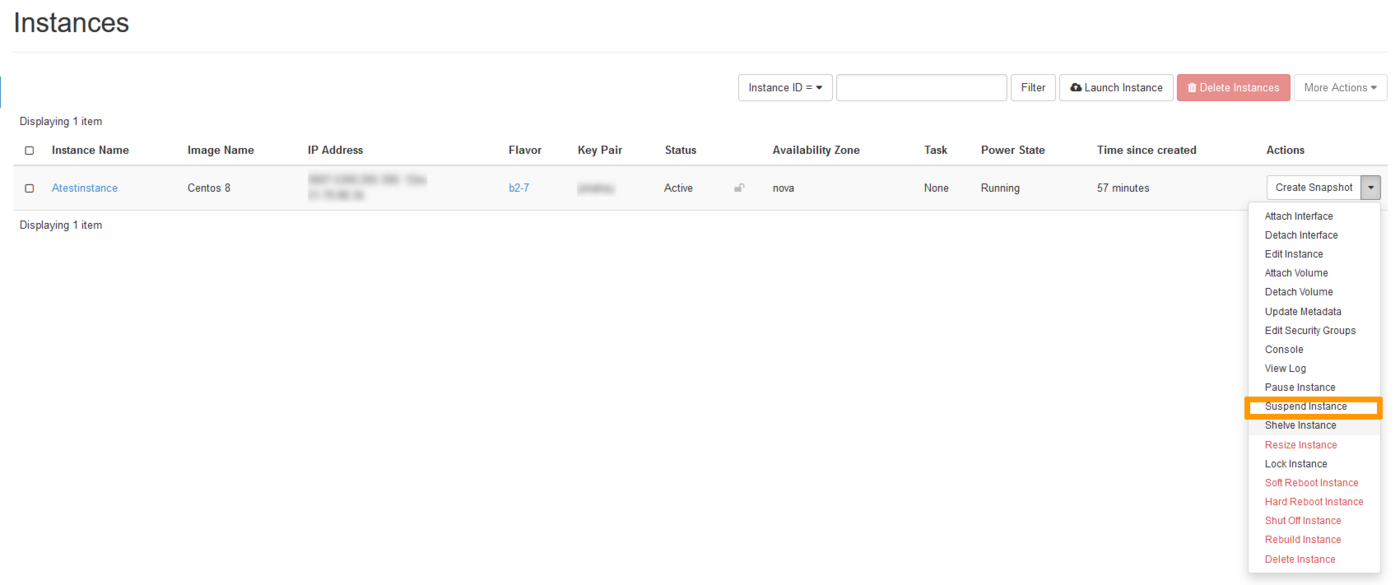
This option suspends your instance: the memory state is written to disk on the host, and the RAM/CPU are freed on the hypervisor while the allocation is kept. When you resume the instance, the saved state is restored, like hibernation. You are billed at the same rate.
This action is not available in the OVHcloud Console: use the OVHcloud API, the Horizon interface or the OpenStack/Nova API.
Use the following API call, where projectId is the ID of your Public Cloud project and instanceId the ID of the instance:
With the following request body:
To resume the instance, use the same call with the RESUME type:
Pause an instance
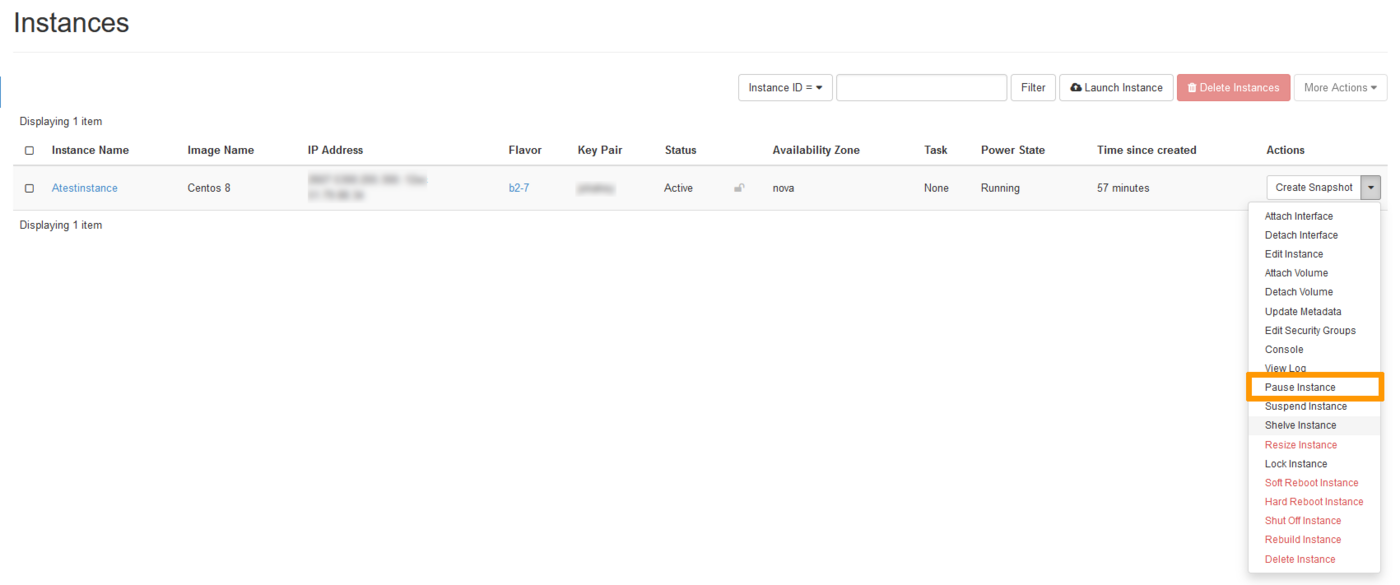
This action is not available in the OVHcloud Console: use the OVHcloud API, the Horizon interface or the OpenStack/Nova API. It allows you to freeze your instance: the memory state is kept in the host RAM, and the instance resumes instantly, exactly where it was.
Use the following API call, where projectId is the ID of your Public Cloud project and instanceId the ID of the instance:
With the following request body:
To resume the instance, use the same call with the UNPAUSE type:
Go further
Join our community of users.