
Import and export keys on OVHcloud KMS using BYOK
Find out how to securely import and export encrypted key material with OVHcloud KMS using asymmetric RSA key wrapping (BYOK)
Objective
Bring Your Own Key (BYOK) lets you import and export cryptographic key material with OVHcloud Key Management Service (KMS) without sending it in plaintext. An RSA transport key pair protects the material in transit: the public key wraps it, and only the holder of the private key can unwrap it.
This guide explains how to import and export a key with OVHcloud KMS using asymmetric RSA key wrapping (BYOK).
Requirements
- An OVHcloud customer account.
- An OVHcloud KMS ordered.
- An authentication method configured for the OKMS data plane (Personal Access Token, service account, or access certificate).
- The ability to apply an IAM policy on your OKMS domain; the BYOK actions required are listed in Configure IAM for BYOK.
- Optional: the OKMS CLI or the Go SDK installed for the tabbed examples.
Instructions
Understand the RSA wrapping ceremony
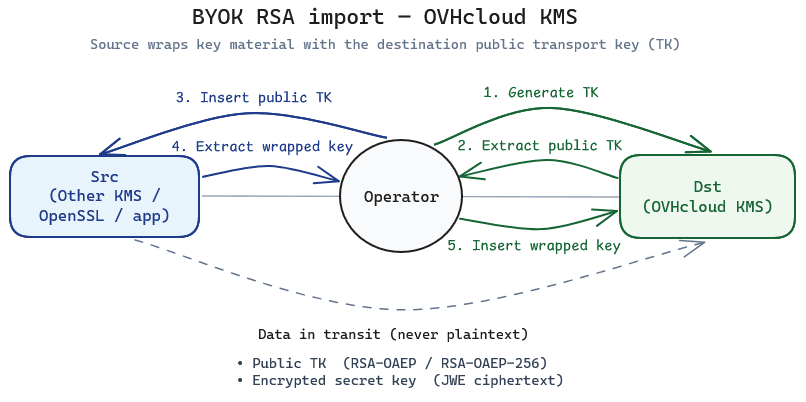
The ceremony involves two environments and an operator:
- Destination (Dst): your OKMS domain, where the imported key will be stored.
- Source (Src): the system that currently holds the key material (another KMS, an application, or a tool such as OpenSSL).
- Operator: the entity with the permissions to access both the OKMS domain and the source of the key to import. This can be a human using the OKMS CLI, or a service acting through the API.
- Generate an RSA transport key pair on the OVHcloud KMS with the
wrapKeyandunwrapKeyoperations. - Export the public transport key from the OVHcloud KMS.
- Import the public transport key in the source environment.
- On the source, export the key material wrapped (encrypted) with the transport key using either
RSA-OAEPorRSA-OAEP-256. - On the destination, import the wrapped key with
POST /api/{okmsId}/v1/servicekeyand awrappedKeyspayload. The KMS unwraps the ciphertext with the private transport key and stores the resulting service key.
Keys imported this way have never_extractable set to false, because the material existed outside the KMS before import. To extract a key later in wrapped form, set extractable to true and follow Export a wrapped key. See Service key sensitivity attributes for the full attribute list.
You need two values from your OKMS domain to follow this guide: its regional endpoint and its okmsId. The REST API calls carry both in the URL, while the OKMS CLI and the Go SDK take them from their configuration. Both are returned by the following API call:
They are also displayed in the General information tab of your .
Prefer this ceremony over plaintext key import whenever the key must remain trusted during transit.
Configure IAM for BYOK
Apply a policy to your OKMS domain resource. Its URN is displayed in the General information tab of your . Replace <identity_urn> and <okms_urn> with your values. Create policies via the OVHcloud Control Panel or the OVHcloud API.
BYOK import — read, create or import service keys, and unwrap with a transport key:
BYOK export — import a public transport key, update extractability, and wrap a key for export:
For import, serviceKey/unwrapKey must be allowed on the RSA transport key referenced by wrappingKeyId. For export, import the destination public transport key first (create / import), then allow serviceKey/wrapKey on that transport key and serviceKey/get on the key being exported. serviceKey/update is required to set extractable before (and after) the export.
Create the RSA transport key on the destination KMS
Create an RSA key dedicated to wrapping. For the import ceremony, set both wrapKey and unwrapKey on this key; they are mutually exclusive with sign and verify.
Supported RSA key sizes: 2048, 3072 or 4096 bits.
SOFTWARE is the default protection level, so you do not need to set it.
Save the returned key id — you need it as wrappingKeyId during import.
Obtain the public transport key
Export the public part of the transport key and provide it to the source environment. Never share the private key — it remains inside the destination KMS.
The response includes the public key material in the keys array (JWK).
Wrap the source key material
On the source environment, encrypt the key material with the destination public RSA key.
This step happens outside OVHcloud KMS: use a JOSE library on the source environment.
Supported wrapping algorithms (RFC 7518):
keyFormatType describes the format of the plaintext key material before wrapping and after unwrapping. The ciphertext is always a JWE Compact Serialization string (the wrapping algorithm is carried in the JWE header).
After wrapping with the destination public key, send the resulting JWE Compact Serialization ciphertext in the import request.
Import the wrapped key
Call POST /api/{okmsId}/v1/servicekey with a wrappedKeys array instead of plaintext keys.
Each wrappedKeys entry:
You can import a public key on its own (class becomes PUBLIC_KEY) or a private key (the KMS reconstructs the public part; class becomes KEY_PAIR). Symmetric material is stored as SECRET_KEY.
IAM actions on this call: okms:apikms:serviceKey/create, okms:apikms:serviceKey/import, and okms:apikms:serviceKey/unwrapKey on the transport key.
keyFormatType values: RAW, JWK, PKCS1, or PKCS8.
Verify the imported key
Confirm that the key exists and matches the expected type and operations.
Check that:
- the key
stateisactive— activate it if your workflow requires it. type,size, andoperationsmatch what you intended.- sensitivity attributes under
attributesreflect an imported key (never_extractableisfalse).
You can then use the key for encrypt, decrypt, sign, or verify as documented in Using OVHcloud Key Management Service (KMS).
Export a wrapped key
Secure export is import in reverse: OVHcloud KMS encrypts the key material with an RSA transport key and returns only a JWE ciphertext. The private transport key must live in the destination environment — here the external system receiving the key, not OVHcloud KMS — so only that environment can unwrap the material.
Understand the export ceremony
- Generate an RSA transport key pair on the destination environment (another KMS or tooling that will receive the key).
- Import the destination public transport key into OVHcloud KMS with the
wrapKeyoperation (SOFTWAREprotection level). This key is thewrappingKeyIdused at export time. - On OVHcloud KMS, set
extractabletotrueon the service key just before export, then export it wrapped by that transport key. Revertextractabletofalseafterwards when possible. - Transfer the ciphertext to the destination and unwrap it with the destination private transport key.
Do not generate the export transport key pair on OVHcloud KMS. If the private transport key stayed in OVHcloud KMS, the destination could not unwrap the ciphertext. Only the public half is imported into OVHcloud KMS for wrapping.
The transport key referenced by wrappingKeyId must be a SOFTWARE RSA key in the same OKMS domain with the wrapKey usage. Sensitive keys (AES/oct and private RSA/EC material) can only be extracted after wrapping; plaintext extraction is not supported for them.
Import the destination public transport key into OVHcloud KMS
Register the destination public key so OVHcloud KMS can wrap the exported key with it. Import it as a public-only RSA key with wrapKey (no private material).
Save the returned key id as wrappingKeyId.
Enable extraction
The key you export must be extractable. Prefer setting extractable to true only for the export operation (via PATCH), then set it back to false afterwards. Keep keys non-extractable at creation whenever possible: making a key extractable permanently sets never_extractable to false.
Enabling extraction reduces the key's protection boundary. Only set extractable to true when you need to migrate the key, and revert it to false afterwards when possible.
IAM action: okms:apikms:serviceKey/update.
After a successful wrapped export (see Export the key wrapped by the transport key), disable extraction again:
Export the key wrapped by the transport key
Call GET /api/{okmsId}/v1/servicekey/{keyId} with the wrapping query parameters below. When these parameters are present, the API returns wrappedKeys instead of plaintext keys.
IAM actions: okms:apikms:serviceKey/get on the exported key, and okms:apikms:serviceKey/wrapKey on the transport key.
Example response shape:
Unwrap the ciphertext on the destination
Transfer the ciphertext to the destination environment. Unwrap it with the destination private transport key (the counterpart of the public key you imported into OVHcloud KMS).
- If the destination is another OKMS domain, import the wrapped material there with
wrappedKeysas in Import the wrapped key, using that domain's transport key ID aswrappingKeyId. - If the destination is an external system, use its native unwrap / import API with the private transport key and the same
keyFormatType/ wrapping algorithm you used at export.
Go further
Using OVHcloud Key Management Service (KMS)
Getting started with OVHcloud Key Management Service (KMS)
Join our community of users.