How to move a database service from a single AZ region to a 3-AZ region
Learn how to move your OVHcloud Public Cloud Database from a single AZ to a 3-AZ region and ensure high availability
Objective
OVHcloud Public Cloud Databases can be deployed with different architectures to meet varied needs for availability and resilience. This guide is specifically designed to walk you through the migration of your existing database service from a single availability zone (1-AZ) configuration to a 3-AZ architecture (three availability zones). You'll discover the detailed steps to perform this transfer, ensuring high availability and improved fault tolerance for your critical applications.
Requirements
- A Public Cloud project in your OVHcloud account
- Access to the
- An existing database service deployed in a single availability zone (1-AZ)
- A 3-AZ region activated within your Public Cloud project
Why move to 3-AZ?
Migrating your database service to a 3-AZ deployment significantly enhances its resilience, high availability, and disaster recovery capabilities. In a 3-AZ setup, provided your service runs on multiple nodes, your data is synchronously replicated across three distinct availability zones within the same region. This architecture ensures that in the event of an outage in one zone, your database service can automatically failover to another operational zone with minimal downtime and no data loss.
For more detailed information on the deployment modes and their technical specifications, please refer to our dedicated guide: Comparison of Public Cloud Databases Deployment Modes - Understanding 3-AZ / 1-AZ.
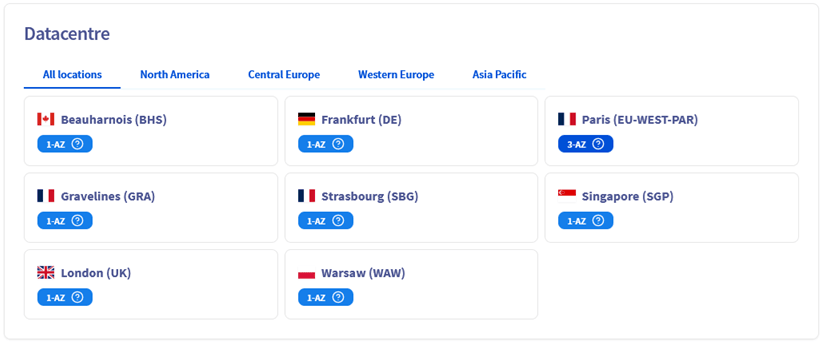
Here is a list of currently supported 1-AZ and 3-AZ regions for database services:
Reversibility
The migration from a Single-AZ region to a Multi-AZ region is reversible — services can be migrated back to a Single-AZ region.
OVHcloud Console Access
- Direct link:
- Navigation path:
Public Cloud> Select your project >Databases
Instructions
Move a database service to 3-AZ
In the left-hand menu of your Public Cloud project, click your engine under Databases, then click the name of your database service. Open the Backups tab.
Click the ... button of the backup from which you wish to fork, then Fork. The Fork a cluster panel opens.
Enter a New cluster name. Under Fork source, keep From a backup and select the backup.
Under New cluster configuration, select a 3-AZ region under Region, a Plan, the Node type that will host the service, the Nodes and the Storage capacity.
The IP restrictions of the origin service are applied to the new service. You can review them once the service is created, in the IP restrictions section of its Configuration tab.
Review the estimated price at the bottom of the panel, then click Create fork.
Validate the deployment
After your new 3-AZ database service has been successfully provisioned, it's crucial to validate its deployment and ensure your applications can connect to it.
- Test the connection to your new service:
- Use a database client (e.g., psql for PostgreSQL, mysql for MySQL) or a simple script to verify that you can connect to the new 3-AZ service's endpoint using its credentials.
- Confirm that your data has been successfully migrated and is accessible.
- Configure your application to use the new service:
- Update your application's configuration files or environment variables to point to the new 3-AZ database service's connection string (host, port, username, password).
- Restart your application to apply the changes.
- Thoroughly test your application's functionality to ensure it operates correctly with the new database endpoint.
Clean up
Once you've fully validated that your application is working correctly with the new 3-AZ database service, and you're confident all data has been transferred and is accessible, you can proceed with deleting the old 1-AZ service.
This step is crucial to avoid unnecessary costs and maintain a clean infrastructure.
Follow these instructions to delete the old 1-AZ service:
Open the old service, then its Configuration tab. In the Danger zone section, click Delete, type TERMINATE to confirm, then click Delete. If deletion protection is enabled, disable it first in the Configuration section of the same tab.
We want your feedback!
We would love to help answer questions and appreciate any feedback you may have.
For training or technical assistance implementing our solutions, contact your sales representative or visit our Professional Services page to request a quote and have your project analysed by our experts.
Are you on Discord? Connect to our channel at https://discord.gg/ovhcloud and interact directly with the team that builds our databases service!