
Configuring a public IP block in a vRack on a Public Cloud instance
Objective
As well as private IP addressing, the vRack also lets you route public IP traffic through your server's vRack port using a public IP address block.
This guide explains how to configure a block of public IP addresses for use with the vRack on a Public Cloud instance.
Requirements
- A public block of IP addresses in your account, with a minimum of four addresses
- An OVHcloud Public Cloud instance
- A vRack service activated in your account
- Access to the Horizon interface
Content overview
- Add the Public Cloud project to the vRack
- Add the IP block to the vRack
- Create a Private Network
- Create a subnet
- Attach a network interface to the instance
- Configure a usable IP address
Instructions
Acceso al área de cliente de OVHcloud
- Enlace directo: Public Cloud Projects
- Ruta de navegación:
Public Cloud> Seleccione su proyecto
This configuration involves several steps, using both the OVHcloud Control Panel and the Horizon interface.
Add the Public Cloud project to the vRack
This does not apply to newly created projects, which are automatically delivered with a vRack. To view the vRack once the project has been created, go to the Network section and click on vRack private network to view the vRack(s).
You can also remove the project from its allocated vRack and attach it to another vRack if you wish.
For older projects, go to the Network section and click on vRack private network. Next, select your vRack from the list.
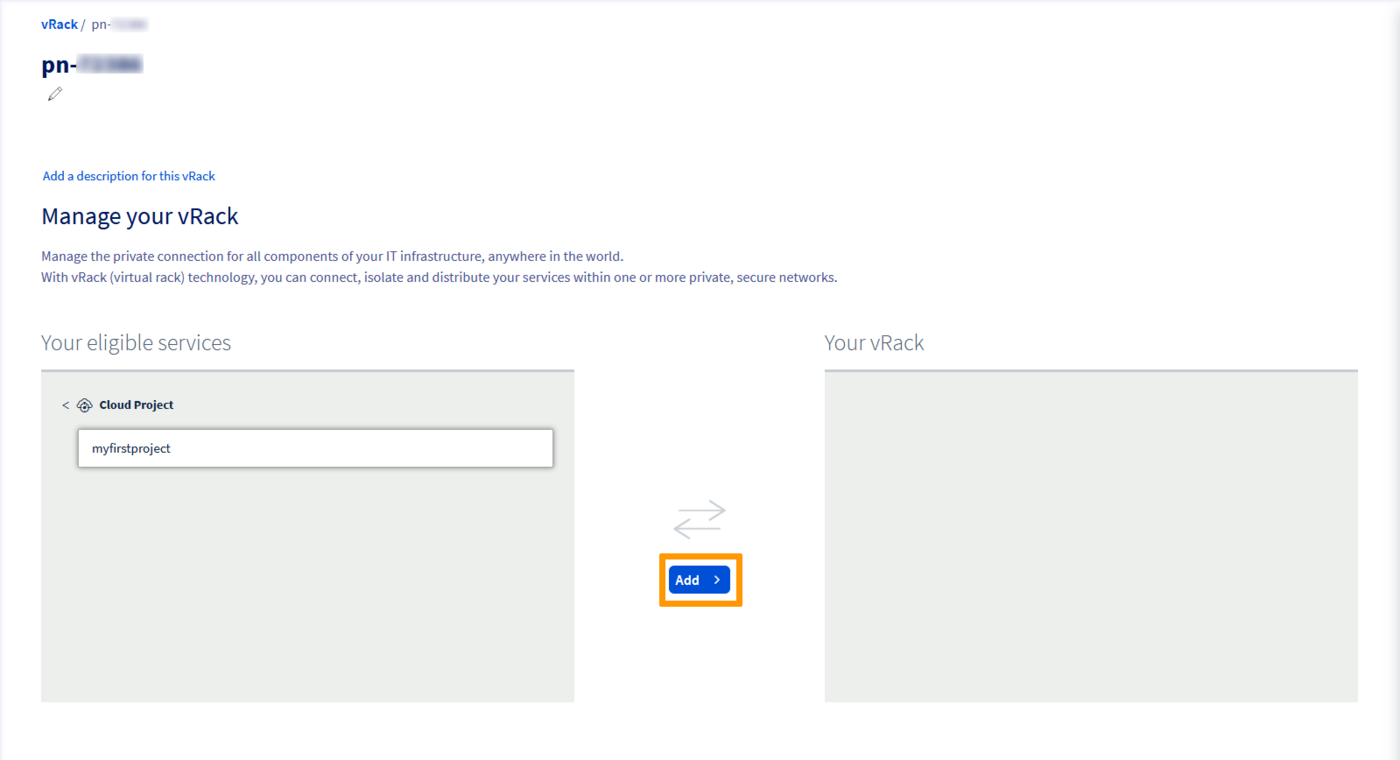
From the list of eligible services, select the project you want to add to the vRack and click the Add button.
Add the IP block to the vRack
Once an IP block is added to the vRack, it is no longer attached to a physical server.
This setup allows you to configure IPs of the same block on multiple servers, provided that these servers are all in the same vRack as the IP block. The IP block must have at least 2 usable IPs or more for this to be possible.
Go to the Network section and click on vRack private network.
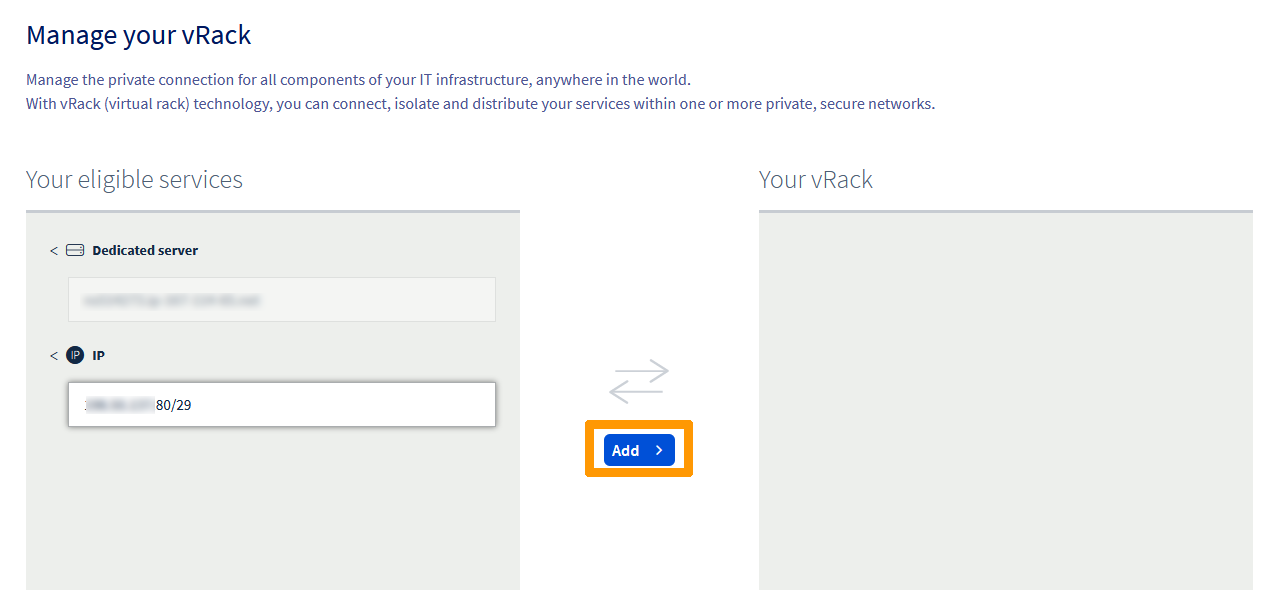
Select your vRack from the list to display the list of eligible services. Click the IP block you wish to add to the vRack and click on Add.
Create a Private Network
Once your project has been added to the vRack, create a Private Network to attach to the Public Cloud instance.
In the Public Cloud section, click on Private Network in the left-hand menu under Network.
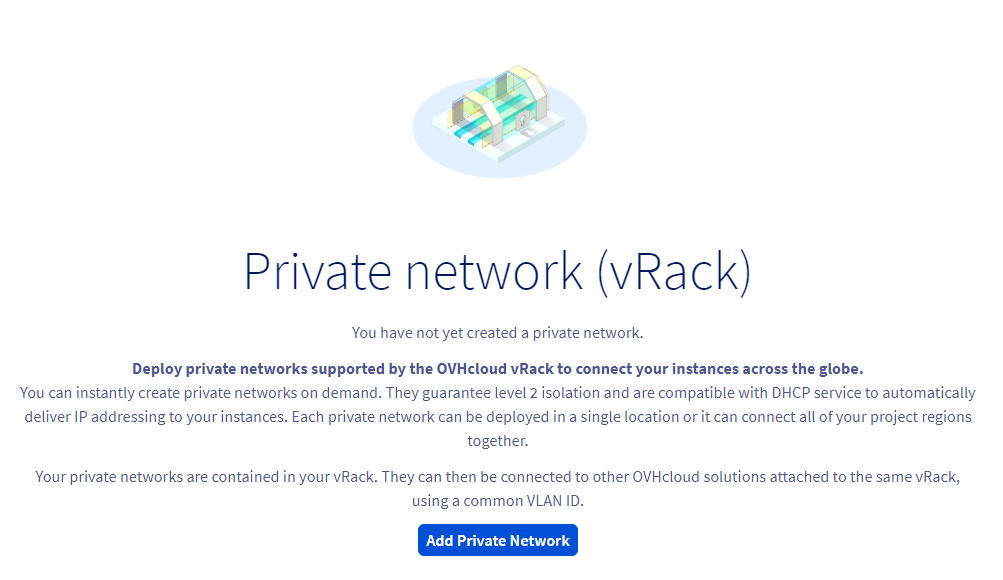
Click on Add Private Network.
The following page allows you to customise multiple settings.
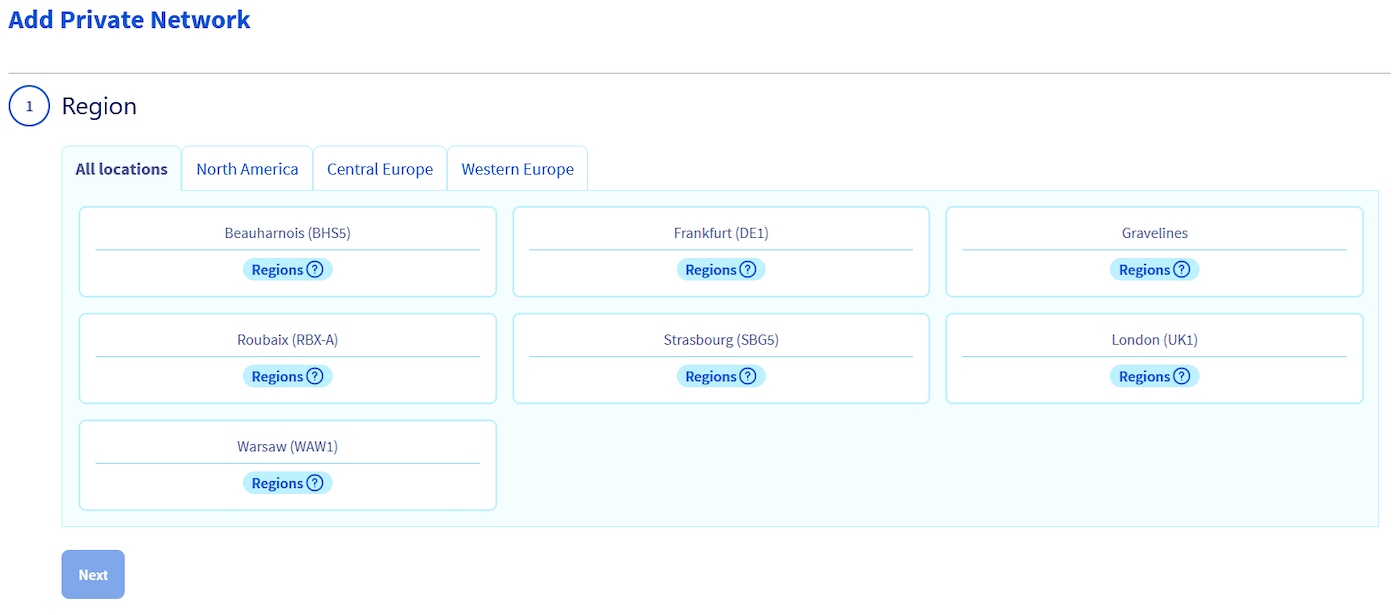
In step 1, select the region in which you want the private network to be located (this region must be the same as that of the instance).
Next, select a VLAN ID. For this configuration, you must tag your private network with VLAN ID 0.
This can be configured in step 2.
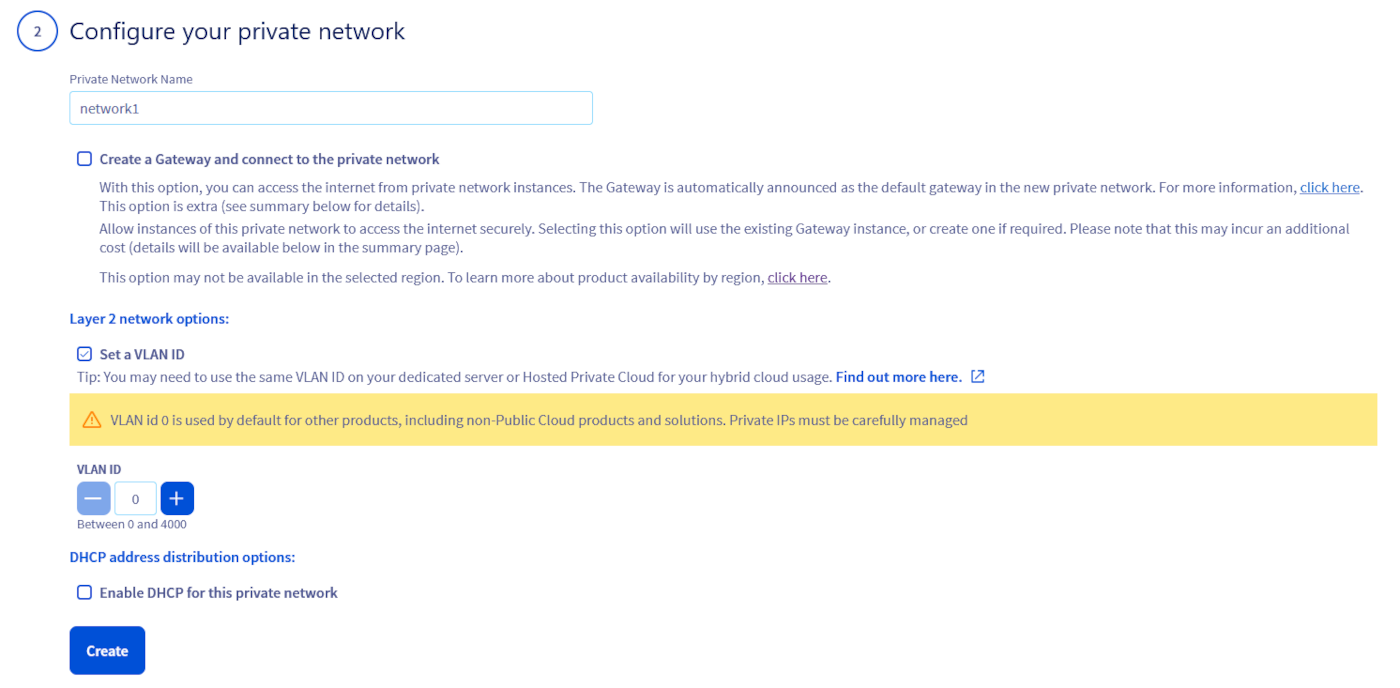
This step offers several configuration options. For the purpose of this guide, we will focus on the necessary ones. The necessary options are listed below:
- Private Network Name: Enter a name for your private network.
- Layer 2 network options: Tick the Set a VLAN ID box and select VLAN ID 0.
- DHCP address distribution options: You can keep the default private IP range or use a different one. However, leave the DHCP box unchecked.
Once done, click on Create.
Create a subnet
For the configuration, you need to create a subnet in the previously created private network and add the CIDR of the public IP block to it.
This action can only be performed via the Horizon interface or the OpenStack client API.
From the Horizon interface
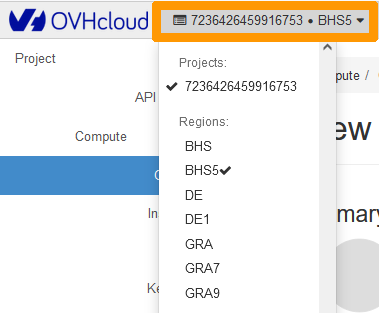
Log in to the Horizon interface and verify you are in the correct region (shown in the top left corner).
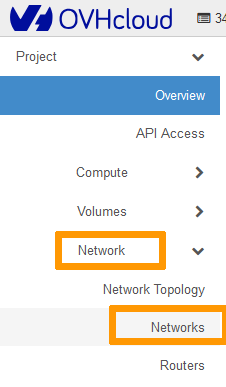
Click on Network in the left-hand tab, then on Networks.
Click on the drop-down arrow next to the private network and select Create Subnet.

In the pop-up window, fill in the fields:
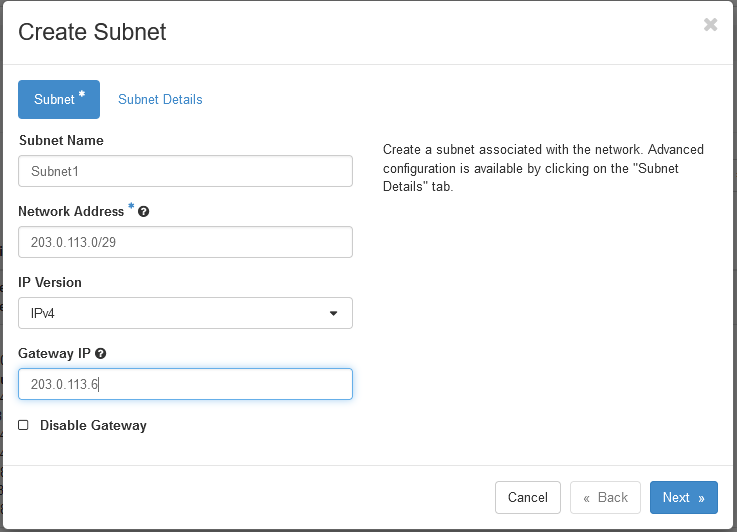
- Subnet Name: Enter a name of your choice.
- Network address*: Enter the complete CIDR of your Public IP block (in this example: 203.0.113.0/29).
- Gateway IP: The penultimate IP of the IP block (in this example 203.0.113.6). When you purchase your IP block, this information is provided to you in an email.
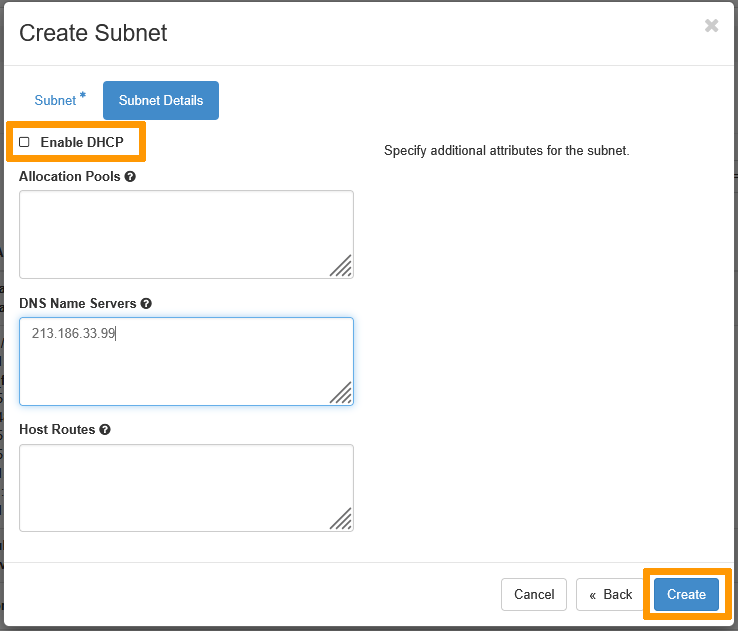
Click Next and uncheck the Enable DHCP box.
- DNS Name Servers: Optional. We recommend adding a DNS server, mainly for domain resolution.
Click on Create.
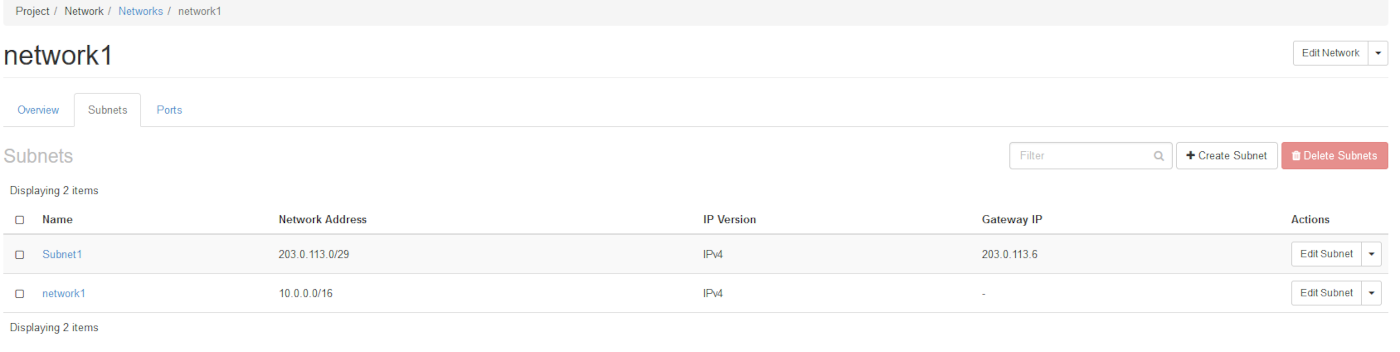
Once the subnet has been created, your private network will appear as follows:
Attach a network interface to the instance
This action should only be done via the Horizon interface.
If you have not yet created an instance, you must create it first, then attach the network later. Do not attach the private network during the creation of the instance.
We recommend consulting the following guides if you are creating an instance for the first time: How to create a Public Cloud instance and connect to it or Creating an Instance via the Horizon interface.
If you already have an instance, you can proceed to the next step.
Log in to the Horizon interface and verify you are in the correct region (shown in the top left corner).
Next, select Compute and then Instances from the menu.
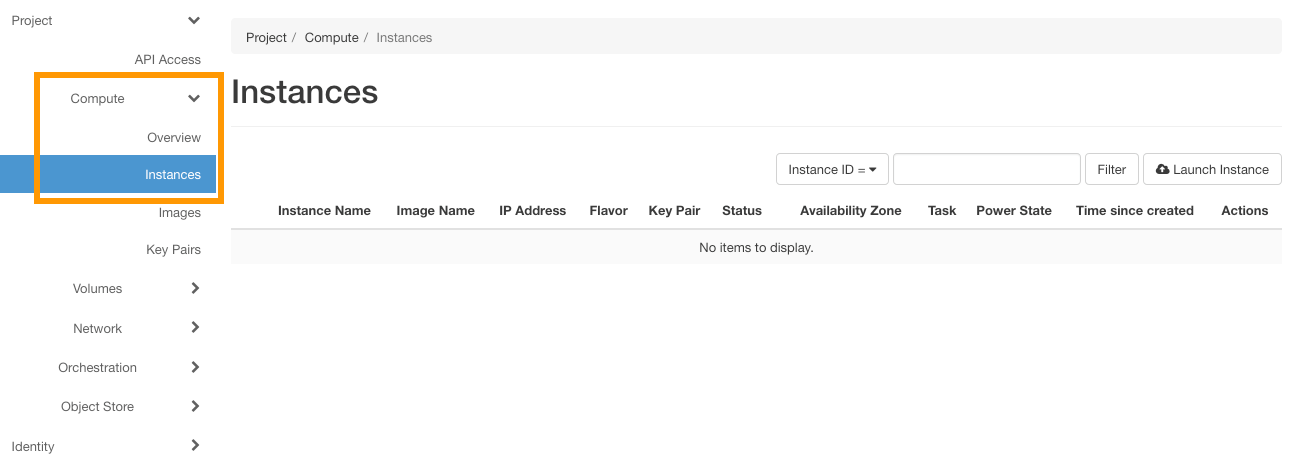
Select Attach Interface in the drop-down list for the corresponding instance.

In the pop-up menu, select the appropriate options:
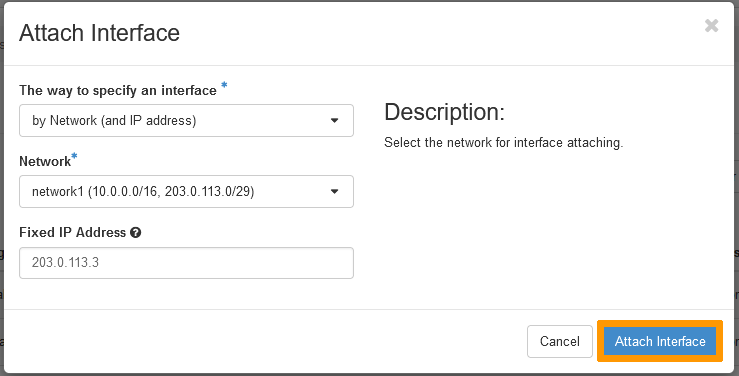
- Network: Select the private network created
- Fixed IP Address: Specify a public IP address from your block (if you don't, the system will automatically assign a private IP).
It is not possible to add multiple IPs at once via the Horizon interface.
For each public IP you want to use, you need to follow the same procedure and enter a different usable public IP each time.
Configure a usable IP address
For vRack purposes, the first, penultimate, and last addresses in any given IP block are always reserved for the network address, network gateway, and network broadcast respectively. This means that the first usable IP address is the second address in the block, as shown below:
To configure the first usable IP address, you need to edit the network configuration file as shown below. In this example, we use a subnet mask of 255.255.255.248.
The subnet mask we've used in our example is appropriate for our IP block. Your subnet mask may differ depending on the size of your block. When you purchase your IP block, you'll receive an email that will tell you which subnet mask to use.
Create a new IP routing table
First, download and install iproute2, a package for manual IP routing configuration. This package may already be available on your server — if so, skip to the next step.
Establish an SSH connection to your instance and run the following command from the command line. This will download and install iproute2.
Next, we need to create a new IP route for the vRack. We'll be adding a new traffic rule by amending the file, as shown below:
Non-persistent application
This configuration will be lost after a restart of your instance (non-persistent configuration).
Connect to your server via SSH and enter the following commands. Replace NETWORK_INTERFACE, IP_ADDRESS/PREFIX and GATEWAY_IP with your own values.
Persistent application by OS
Click the tab that corresponds to your distribution:
The configuration below is based on Debian 11.
To identify your vRack interface, connect to your instance via SSH and run the following command:
Using a text editor of your choice, open the network configuration file located in /etc/network/interfaces.d for editing. Here the file is called 50-cloud-init.
Add the following lines to your configuration file, replacing NETWORK_INTERFACE, IP_ADDRESS, NETMASK_IP and BROADCAST_IP with your own values.
We have determined that the gateway IP of our IP block is 203.0.113.6. To route the vRack traffic through this gateway IP address, add the following lines to the network configuration file, replacing NETWORK_INTERFACE, IP_BLOCK/PREFIX and GATEWAY_IP with your own values:
Configuration example:
Restart your network interface with the following command:
Go further
Join our community of users.