For AI agents: the complete documentation index is available at https://docs.ovhcloud.com/pl/llms.txt, the full documentation bundle is available at https://docs.ovhcloud.com/pl/llms-full.txt, and this page is available as Markdown at https://docs.ovhcloud.com/pl/guides/hosted-private-cloud/sap-on-ovhcloud/cookbook-configure-sap-hana-cluster.md.
Two deployed SAP HANA virtual machines with the same SAP HANA version installed .
Instructions
Info
In all console blocks:
The primary SAP HANA node is named node1 and the secondary SAP HANA node is named node2.
<SID> is the SAP HANA SID.
<NI> is the SAP HANA instance number.
The availability of the SAP HANA database might be impacted during this configuration. Please take all precautions before starting this guide.
vSphere user creation
To allow the Corosync service to get information from your SAP HANA nodes, you have to configure a user which has access to the vSphere interface.
We recommend creating a dedicated user with limited permissions to interact with vSphere.
This dedicated user needs only the "Read only" right to the datacenter on which the SAP HANA virtual machines are hosted. To know how to create this dedicated user, please refer to our guide on changing user rights.
SUSE packages
Several packages, including Corosync and Pacemaker binaries, have to be installed on both SAP HANA nodes.
These packages are only available with the SUSE Linux Enterprise High Availability extension. Ensure that it is activated before continuing:
SUSEConnect --list-extensions | grep "SUSE Linux Enterprise High Availability Extension 15 SP4 x86_64"
Expected result:
SUSE Linux Enterprise High Availability Extension 15 SP4 x86_64 (Activated)
With any other result, please run the following command in which <ADDITIONAL REGCODE> is a registry code provided by SUSE in your customer portal.
If you execute this configuration on new SAP HANA virtual machines, trigger a backup for the SYSTEMDB and the TENANTDB before continuing on the future primary node. These backups are mandatory to enable the SAP HANA System Replication (HSR).
Python Hook SAPHanaSR
The SAP HANA HA/SR provider hook improves SAP HANA failure detection.
1. Stop SAP HANA services on both SAP HANA nodes:
sapcontrol -nr <NI> -function Stop
2. Add this block in the global.ini file on both SAP HANA nodes:
[ha_dr_provider_SAPHanaSR]provider = SAPHanaSRpath = /usr/share/SAPHanaSRexecution_order = 1[trace]ha_dr_saphanasr = info
System Replication
1. Start SAP HANA services on the primary SAP HANA node:
sapcontrol -nr <NI> -function Start
2. As the (sid)adm SAP HANA user, enable the SAP HANA System Replication (HSR) on the primary node which will be the source of the replication:
hdbnsutil -sr_enable --name=node1
Info
The --name option is mandatory and is used to define the SAP HANA node in the replication system.
3. To authorise the secondary SAP HANA node to be registered on the primary SAP HANA node, you must transfer two files from the primary to the secondary SAP HANA node:
To know the differences between each replication mode and operation mode, read the SAP documentation.
In the context of this guide, as both SAP HANA nodes are hosted on the same OVHcloud location and the goal is to reduce the Recovery Time Objective (RTO), we recommend using the following parameters:
Parameter
Value
replicationMode
sync
operationMode
logreplay
5. Start the SAP HANA services on the secondary node. The startup also starts the replication from the primary SAP HANA node to the secondary SAP HANA node:
sapcontrol -nr <NI> -function Start
On the primary SAP HANA node, you can follow the initialisation of the replication with the following commands:
The replication can take some time, depending on the size of your data in the SAP HANA database. Once the replication has finished its initialisation, the system replication status must be ACTIVE.
Corosync
Info
In this chapter, all commands must be executed as root.
1. On the primary SAP HANA node, generate the /etc/corosync/authkey file:
corosync-keygen
This file is a private key which ensures the authenticity and the privacy of the messages exchanged between the cluster nodes.
2. Create the /etc/corosync/corosync.conf file on the primary SAP HANA node and add the following configuration (replace ip_address_node1 and ip_address_node2 with your IP addresses):
totem { version: 2 token: 5000 token_retransmits_before_loss_const: 6 secauth: on crypto_hash: sha1 crypto_cipher: aes256 clear_node_high_bit: yes transport: udpu}logging { fileline: off to_logfile: yes to_syslog: yes logfile: /var/log/cluster/corosync.log debug: off timestamp: on logger_subsys { subsys: QUORUM debug: off }}nodelist { node { ring0_addr: <ip_address_node1> nodeid: 1 } node { ring0_addr: <ip_address_node2> nodeid: 2 }}quorum { provider: corosync_votequorum expected_votes: 2 two_node: 1}
Info
To discover all parameters in this configuration, please refer to the corosync.conf.5 manual page with the command man corosync.conf.5.
3. Transfer these files to the secondary SAP HANA node to share the same configuration and private key :
4. On the primary SAP HANA node, set the cluster in maintenance mode:
crm configure property maintenance-mode=true
Stonith resource
Info
The following actions must be done on the primary SAP HANA node.
The stonith resource checks the health of the virtual machines via vSphere and can decide to shut down the virtual machine.
Info
The login and password are the credentials created in the vSphere user creation chapter.
crm configure primitive stonith stonith:fence_vmware_rest \
    params ip=<pcc-xx-xx-xx-xx.ovh.com> login=<user> passwd="<password>" ssl=1 pcmk_reboot_timeout=900 power_timeout=60 \
    op monitor interval=3600 timeout=120 \
    op stop timeout=20s interval=0s \
    op start timeout=20s interval=0s
Expected result:
crm status
Cluster Summary: * Stack: corosync * Current DC: node1 (version 2.1.2+20211124.ada5c3b36-150400.4.9.2-2.1.2+20211124.ada5c3b36) - partition with quorum * Last updated: Fri Feb 17 14:35:47 2023 * Last change: Fri Feb 17 14:35:03 2023 by root via crm_attribute on node1 * 2 nodes configured * 1 resource instances configured *** Resource management is DISABLED *** The cluster will not attempt to start, stop or recover servicesNode List: * Online: [ node1 node2 ]Full List of Resources: * stonith (stonith:fence_vmware_rest): Stopped (unmanaged)
Floating IP address resource
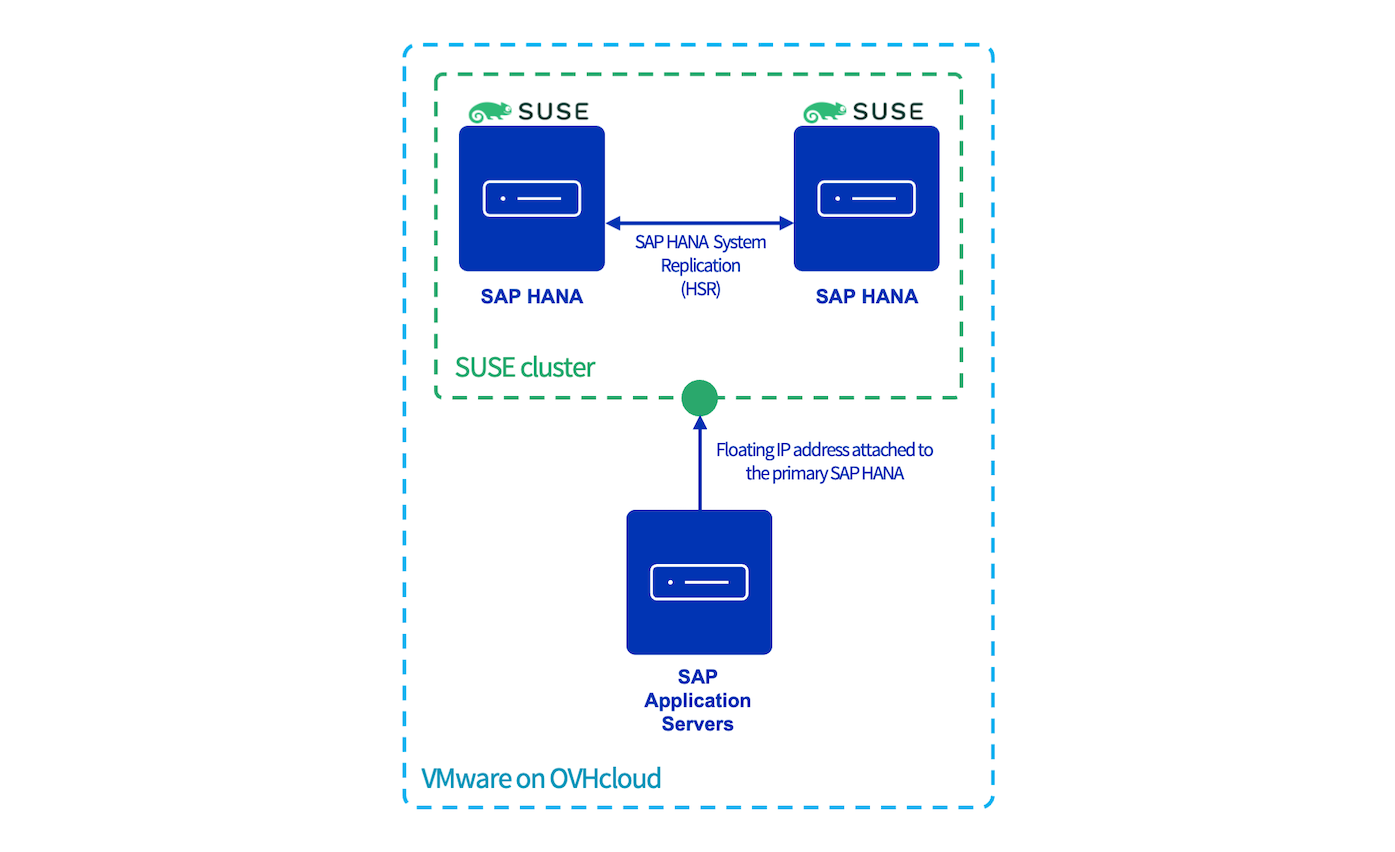
The res_vip_<SID>_HDB<NI> resource manages and monitors the floating IP address which will be the point of entry for all communications with the primary SAP HANA node.
Info
<floating_ip_address> is the floating IP address which will be used by the cluster.
If you have several network cards, you can specify a network card by adding the parameter nic.
Cluster Summary: * Stack: corosync * Current DC: node1 (version 2.1.2+20211124.ada5c3b36-150400.4.9.2-2.1.2+20211124.ada5c3b36) - partition with quorum * Last updated: Fri Feb 17 14:36:32 2023 * Last change: Fri Feb 17 14:36:05 2023 by root via crm_attribute on node1 * 2 nodes configured * 2 resource instances configured *** Resource management is DISABLED *** The cluster will not attempt to start, stop or recover servicesNode List: * Online: [ node1 node2 ]Full List of Resources: * stonith (stonith:fence_vmware_rest): Stopped (unmanaged) * res_vip_<SID>_HDB<NI> (ocf::heartbeat:IPaddr2): Stopped (unmanaged)
SAP HANA resources
1. The resource rsc_SAPHana_<SID>_HDB<NI> manages and monitors the SAP HANA services on both SAP HANA nodes.
crm configure primitive rsc_SAPHana_<SID>_HDB<NI> ocf:suse:SAPHana \ op start interval="0" timeout="3600" \ op stop interval="0" timeout="3600" \ op promote interval="0" timeout="3600" \ op demote interval="0" timeout="320" \ op monitor interval="60" role="Master" timeout="700" \ op monitor interval="61" role="Slave" timeout="700" \ params SID="<SID>" InstanceNumber="<NI>" PREFER_SITE_TAKEOVER="true" \ DUPLICATE_PRIMARY_TIMEOUT="7200" AUTOMATED_REGISTER="false"crm configure clone msl_SAPHana_<SID>_HDB<NI> rsc_SAPHana_<SID>_HDB<NI> \ clone-max="2" clone-node-max="1"
Info
To discover all parameters for this resource, please refer to the ocf_suse_SAPHana manual page with the command man ocf_suse_SAPHana.
2. The resource rsc_SAPHanaTopology_<SID>_HDB<NI> monitors the SAP HANA replication.
crm configure primitive rsc_SAPHanaTopology_<SID>_HDB<NI> ocf:suse:SAPHanaTopology \ op monitor interval="10" timeout="600" \ op start interval="0" timeout="600" \ op stop interval="0" timeout="300" \ params SID="<SID>" InstanceNumber="00"crm configure clone cln_SAPHanaTopology_<SID>_HDB<NI> rsc_SAPHanaTopology_<SID>_HDB<NI> \ meta clone-node-max="1" interleave="true"crm configure colocation col_SAPHana_vip_<SID>_HDB<NI> 2000: res_vip_<SID>_HDB<NI>:started \ msl_SAPHana_<SID>_HDB<NI>:Mastercrm configure order ord_SAPHana_<SID>_HDB<NI> Optional: cln_SAPHanaTopology_<SID>_HDB<NI> \ msl_SAPHana_<SID>_HDB<NI>
Expected result:
crm status
Cluster Summary: * Stack: corosync * Current DC: node1 (version 2.1.2+20211124.ada5c3b36-150400.4.9.2-2.1.2+20211124.ada5c3b36) - partition with quorum * Last updated: Fri Feb 17 14:39:35 2023 * Last change: Fri Feb 17 14:39:29 2023 by hacluster via crmd on node2 * 2 nodes configured * 6 resource instances configuredNode List: * Online: [ node1 node2 ]Full List of Resources: * stonith (stonith:fence_vmware_rest): Started node1 * res_vip_<SID>_HDB<NI> (ocf::heartbeat:IPaddr2): Started node1 * Clone Set: msl_SAPHana_<SID>_HDB<NI> [rsc_SAPHana_<SID>_HDB<NI>] (promotable, unmanaged): * rsc_SAPHana_<SID>_HDB<NI> (ocf::suse:SAPHana): Slave node2 (unmanaged) * rsc_SAPHana_<SID>_HDB<NI> (ocf::suse:SAPHana): Slave node1 (unmanaged) * Clone Set: cln_SAPHanaTopology_<SID>_HDB<NI> [rsc_SAPHanaTopology_<SID>_HDB<NI>] (unmanaged): * rsc_SAPHanaTopology_<SID>_HDB<NI> (ocf::suse:SAPHanaTopology): Started node2 (unmanaged) * rsc_SAPHanaTopology_<SID>_HDB<NI> (ocf::suse:SAPHanaTopology): Started node1 (unmanaged)
Info
To discover all parameters for this resource, please refer to the ocf_suse_SAPHanaTopology manual page with the command man ocf_suse_SAPHanaTopology.
Info
If the resource rsc_SAPHana_<SID>_HDB<NI> is shown as failed even though SAP HANA services run fine, execute the following command to refresh the status:
crm resource refresh
3. To avoid an unexpected behaviour, we advise you to unmanage rsc_SAPHana_<SID>_HDB<NI> and rsc_SAPHanaTopology_<SID>_HDB<NI> resources.
crm configure property maintenance-mode=false'is-managed' conflicts with 'maintenance' in msl_SAPHana_<SID>_HDB<NI>. Remove it (y/n)? n'is-managed' conflicts with 'maintenance' in cln_SAPHanaTopology_<SID>_HDB<NI>. Remove it (y/n)? n
5. Refresh the cluster on the primary SAP HANA node:
crm resource refresh
6. Manage the resources previously unmanaged at the step 3:
To validate the configuration and its behaviour, we recommend running a failover test.
You can simulate the loss of a SAP HANA node in different ways:
Stopping the virtual machine on vSphere
Stopping the virtual machine with OS command
Stopping the SAP HANA services with OS command
Shutting down the network card
Simulating the loss of one ESXi host with the
Setting in standby the primary SAP HANA node in the cluster
Loss of the primary SAP HANA node
In this case, the expected behaviour is the switch of all resources hosted on the primary SAP HANA node to the secondary SAP HANA node which will become the new primary SAP HANA node.
Normal situation
Takeover start
Takeover end
The node1 is seen as the Master and the node2 as the Slave.
All resources are correctly managed and monitored by the cluster.
Cluster Summary: * Stack: corosync * Current DC: node1 (version 2.1.2+20211124.ada5c3b36-150400.4.9.2-2.1.2+20211124.ada5c3b36) - partition with quorum * Last updated: Fri Feb 17 14:39:35 2023 * Last change: Fri Feb 17 14:39:29 2023 by hacluster via crmd on node2 * 2 nodes configured * 6 resource instances configuredNode List: * Online: [ node1 node2 ]Full List of Resources: * stonith (stonith:fence_vmware_rest): Started node1 * res_vip_<SID>_HDB<NI> (ocf::heartbeat:IPaddr2): Started node1 * Clone Set: msl_SAPHana_<SID>_HDB<NI> [rsc_SAPHana_<SID>_HDB<NI>] (promotable): * Masters: [ node1 ] * Slaves: [ node2 ] * Clone Set: cln_SAPHanaTopology_<SID>_HDB<NI> [rsc_SAPHanaTopology_<SID>_HDB<NI>]: * Started: [ node1 node2 ]
The cluster detects the loss of the node1 which was the Master and triggers the takeover to the node2.
The takeover can take several minutes, depending on the size of your SAP HANA database.
Cluster Summary: * Stack: corosync * Current DC: node2 (version 2.1.2+20211124.ada5c3b36-150400.4.9.2-2.1.2+20211124.ada5c3b36) - partition with quorum * Last updated: Fri Feb 17 14:41:32 2023 * Last change: Fri Feb 17 14:40:50 2023 by root via crm_attribute on node2 * 2 nodes configured * 6 resource instances configuredNode List: * Online: [ node2 ] * OFFLINE: [ node1 ]Full List of Resources: * stonith (stonith:fence_vmware_rest): Started node2 * res_vip_<SID>_HDB<NI> (ocf::heartbeat:IPaddr2): Started node2 * Clone Set: msl_SAPHana_<SID>_HDB<NI> [rsc_SAPHana_<SID>_HDB<NI>] (promotable): * rsc_SAPHana_<SID>_HDB<NI> (ocf::suse:SAPHana): Promoting node2 * Stopped: [ node1 ] * Clone Set: cln_SAPHanaTopology_<SID>_HDB<NI> [rsc_SAPHanaTopology_<SID>_HDB<NI>]: * Started: [ node2 ] * Stopped: [ node1 ]
The node2 is now the new Master and the node1 is still seen as offline.
Once the issue is fixed on the node1, you have to register the node1 to the node2 and start the SAP HANA services to restore the cluster to a normal situation.
Cluster Summary: * Stack: corosync * Current DC: node1 (version 2.1.2+20211124.ada5c3b36-150400.4.9.2-2.1.2+20211124.ada5c3b36) - partition with quorum * Last updated: Fri Feb 17 14:43:35 2023 * Last change: Fri Feb 17 14:42:58 2023 by root via crm_attribute on node2 * 2 nodes configured * 6 resource instances configuredNode List: * Online: [ node2 ] * OFFLINE: [ node1 ]Full List of Resources: * stonith (stonith:fence_vmware_rest): Started node2 * res_vip_<SID>_HDB<NI> (ocf::heartbeat:IPaddr2): Started node2 * Clone Set: msl_SAPHana_<SID>_HDB<NI> [rsc_SAPHana_<SID>_HDB<NI>] (promotable): * Masters: [ node2 ] * Stopped: [ node1 ] * Clone Set: cln_SAPHanaTopology_<SID>_HDB<NI> [rsc_SAPHanaTopology_<SID>_HDB<NI>]: * Started: [ node2 ] * Stopped: [ node1 ]
Loss of the secondary SAP HANA node
In this case, the expected behaviour is only the detection of the loss of the secondary SAP HANA node, no action must be done by the cluster.
Normal situation
Detection of node2 as offline
The node1 is seen as the Master and the node2 as the Slave.
All resources are correctly managed and monitored by the cluster.
Cluster Summary: * Stack: corosync * Current DC: node1 (version 2.1.2+20211124.ada5c3b36-150400.4.9.2-2.1.2+20211124.ada5c3b36) - partition with quorum * Last updated: Fri Feb 17 14:50:33 2023 * Last change: Fri Feb 17 14:42:58 2023 by hacluster via crmd on node2 * 2 nodes configured * 6 resource instances configuredNode List: * Online: [ node1 node2 ]Full List of Resources: * stonith (stonith:fence_vmware_rest): Started node1 * res_vip_<SID>_HDB<NI> (ocf::heartbeat:IPaddr2): Started node1 * Clone Set: msl_SAPHana_<SID>_HDB<NI> [rsc_SAPHana_<SID>_HDB<NI>] (promotable): * Masters: [ node1 ] * Slaves: [ node2 ] * Clone Set: cln_SAPHanaTopology_<SID>_HDB<NI> [rsc_SAPHanaTopology_<SID>_HDB<NI>]: * Started: [ node1 node2 ]
The node2 is seen as offline and as the node was the Slave, no action has been taken by the cluster.
Once the issue is fixed on the node2, start the SAP HANA services to restore the cluster to a normal situation.
Cluster Summary: * Stack: corosync * Current DC: node1 (version 2.1.2+20211124.ada5c3b36-150400.4.9.2-2.1.2+20211124.ada5c3b36) - partition with quorum * Last updated: Fri Feb 17 14:54:21 2023 * Last change: Fri Feb 17 14:49:35 2023 by root via crm_attribute on node1 * 2 nodes configured * 6 resource instances configuredNode List: * Online: [ node1 ] * OFFLINE: [ node2 ]Full List of Resources: * stonith (stonith:fence_vmware_rest): Started node1 * res_vip_<SID>_HDB<NI> (ocf::heartbeat:IPaddr2): Started node1 * Clone Set: msl_SAPHana_<SID>_HDB<NI> [rsc_SAPHana_<SID>_HDB<NI>] (promotable): * Masters: [ node1 ] * Stopped: [ node2 ] * Clone Set: cln_SAPHanaTopology_<SID>_HDB<NI> [rsc_SAPHanaTopology_<SID>_HDB<NI>]: * Started: [ node1 ] * Stopped: [ node2 ]
For training or technical assistance implementing our solutions, contact your sales representative or visit our Professional Services page to request a quote and have your project analysed by our experts.