---
title: "Object Storage - Getting started"
description: "This guide is designed to familiarise you with the management of your buckets/objects."
url: https://docs.ovhcloud.com/it/guides/storage-and-backup/object-storage/s3-getting-started-with-object-storage
lang: it
lastUpdated: 2026-06-01
---
# Object Storage - Getting started
## Objective
This guide helps you manage your buckets and objects.
**Learn how to create an Object Storage bucket and manage it.**
:::info
If you are using legacy Swift Object Storage, then:
- for **Standard object storage - SWIFT API** storage class, follow [this guide](/it/guides/storage-and-backup/object-storage/pcs-create-container.md).
- for **Cloud Archive - SWIFT API** storage class, follow [this guide](/it/guides/storage-and-backup/object-storage/pca-create-container.md).
For new projects, we highly recommend using our S31
-compatible Object Storage which benefits from our latest innovations and new features.
:::
## Requirements
- A [Public Cloud project](/it/guides/public-cloud/cross-functional/create-a-public-cloud-project.md) in your OVHcloud account
- An [Object Storage user](/it/guides/storage-and-backup/object-storage/s3-identity-and-access-management.md) already created
***
### OVHcloud Control Panel Access
- **Direct link:** Public Cloud Projects
- **Navigation path:** Public Cloud > Select your project
***
## Instructions
:::info
If you wish to use the OVHcloud Terraform provider, you can follow [this guide](/it/guides/storage-and-backup/object-storage/s3-terraform.md).
:::
### Preparation
To use the AWS CLI
To find out how to install the AWS CLI in your environment, we recommend reading [the official AWS documentation](https://docs.aws.amazon.com/cli/latest/userguide/getting-started-install.html#getting-started-install-instructions).
**Check installation**
```bash
aws --version
```
:::info
If you need more information about AWS CLI installation, read the [AWS documentation](https://docs.aws.amazon.com/cli/latest/userguide/getting-started-install.html).
:::
#### Collect Credentials
- You will need your user's _Access key_ and _Secret key_. You can access this information in the Object Storage users tab in your OVHcloud Control Panel.
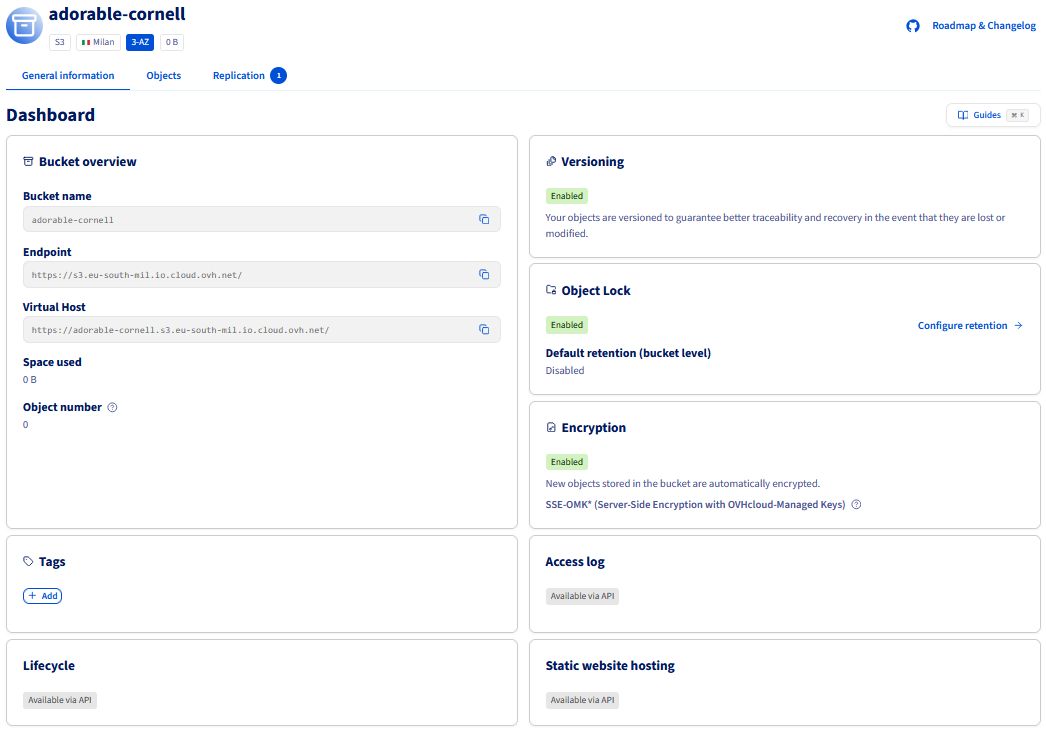
- You will also need your _endpoint\_url_. If you have already created your bucket, you can access this information from the My containers tab, then in the details of your bucket. Otherwise, follow this [guide](/it/guides/storage-and-backup/object-storage/s3-location.md).
#### Where to find the Endpoint URL of a bucket?
Click on the name of your bucket and view its details in the General information tab:
#### Configuration
You can either use the interactive configuration to generate the configuration files or manually create them.
:::info
To use the interactive configuration, run the following command:
`aws configure`
or:
`aws configure --profile `
:::
The configuration file format in the AWS client is as follows:
```bash
cat ~/.aws/credentials
```
```text
[default]
aws_access_key_id =
aws_secret_access_key =
```
```bash
cat ~/.aws/config
```
```text
[default]
region =
endpoint_url =
services = ovh-rbx-archive
[profile ]
region = rbx
output = json
services = ovh-rbx
[services ovh-rbx-archive]
s3 =
endpoint_url = https://s3.rbx-archive.io.cloud.ovh.net/
signature_version = s3v4
s3api =
endpoint_url = https://s3.rbx-archive.io.cloud.ovh.net/
[services ovh-rbx]
s3 =
endpoint_url = https://s3.rbx.io.cloud.ovh.net/
signature_version = s3v4
s3api =
endpoint_url = https://s3.rbx.io.cloud.ovh.net/
```
Here are the configuration values that you can specifically set:
| Variable | Type | Value | Definition |
| ------------------------- | :------------------ | :------------------------------------------------- | :------------------------------------------------------------------------------------------------------------------- |
| max\_concurrent\_requests | Integer | **Default:** 10 | The maximum number of simultaneous requests. |
| max\_queue\_size | Integer | **Default:** 1000 | The maximum number of tasks in the task queue. |
| multipart\_threshold | Integer
String | **Default:** 8MB | The size threshold that the CLI uses for multipart transfers of individual files. |
| multipart\_chunksize | Integer
String | **Default:** 8MB
**Minimum for uploads:** 5MB | When using multipart transfers, this is the byte size that the CLI uses for multipart transfers of individual files. |
| max\_bandwidth | Integer | **Default:** None | The maximum bandwidth that will be used to load and download data to and from your buckets. |
| verify\_ssl | Boolean | **Default:** true | Enable / Disable SSL certificate verification |
For a list of endpoints by region and storage class, refer to [this page](/it/guides/storage-and-backup/object-storage/s3-location.md).
#### Usage
:::info
If you have more than one profile, add `--profile ` to the command line.
:::
Using the OVHcloud Control Panel
To manage an Object Storage bucket, navigate to Object Storage in the left-hand menu.
#### Listing your buckets
**Via AWS CLI**
Via AWS s3
```bash
aws s3 ls
```
Via AWS S3api
```bash
aws s3api list-buckets --query "Buckets[].Name" # Remove --query to display the full output.
```
**Via the OVHcloud Control Panel**
Click on Object Storage in the navigation bar on the left and then on the My containers tab.
**Via the OVHcloud CLI**
Enter the following command:
```shell
ovhcloud cloud storage-s3 list
```
#### Create a bucket
**Via AWS CLI**
Via AWS s3
```bash
aws s3 mb s3://
aws --profile s3 mb s3://
```
Via AWS S3api
```bash
aws s3api create-bucket --bucket
aws --profile s3api create-bucket --bucket
```
**Via the OVHcloud Control Panel**
Click Create Object Container:
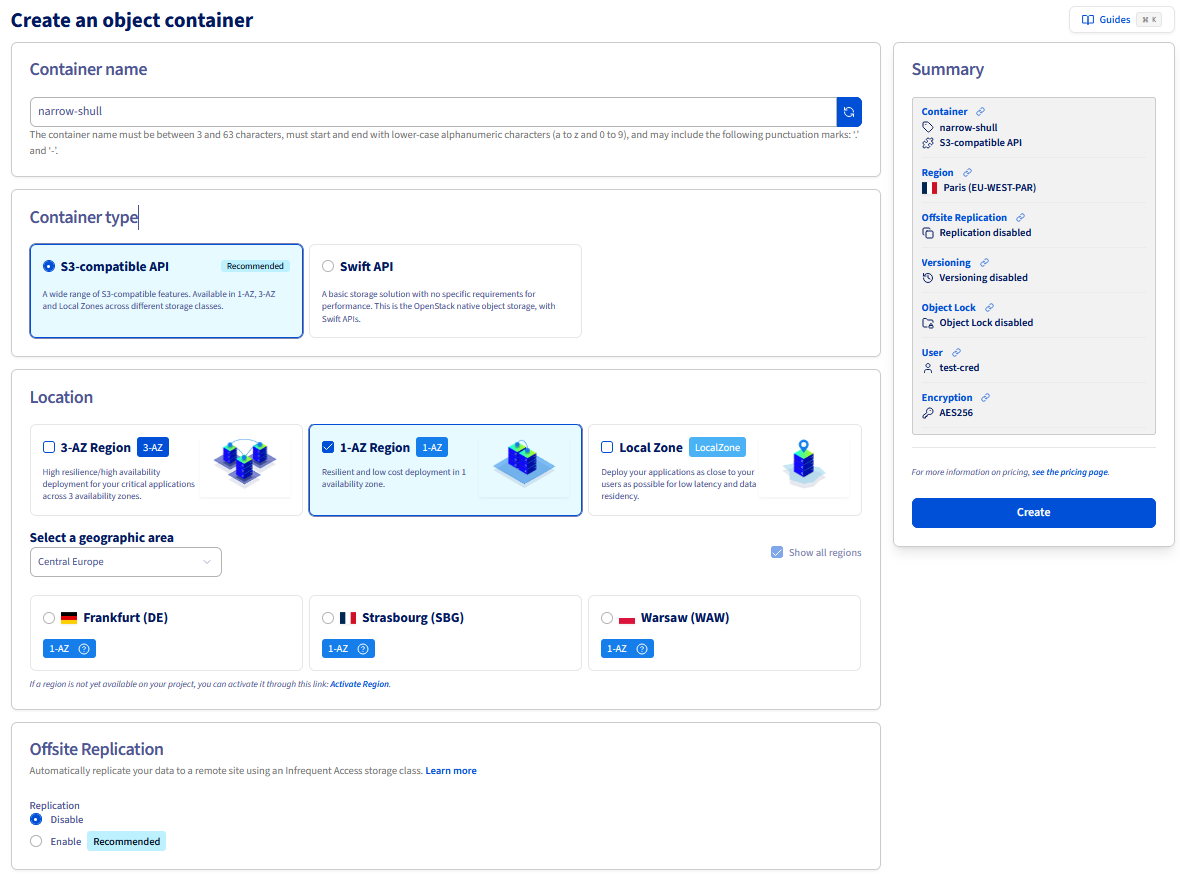You can enter the name of your bucket (optional) and then **select your offer**.
**Select a deployment mode.**
:::info
OVHcloud provides multiple deployment modes to meet different needs in terms of resilience, availability and performance. Each mode is optimized for specific use cases and offers varying levels of redundancy and fault tolerance.
:::
**Select a region.**
:::info
Regions can vary depending on the chosen deployment mode.
:::
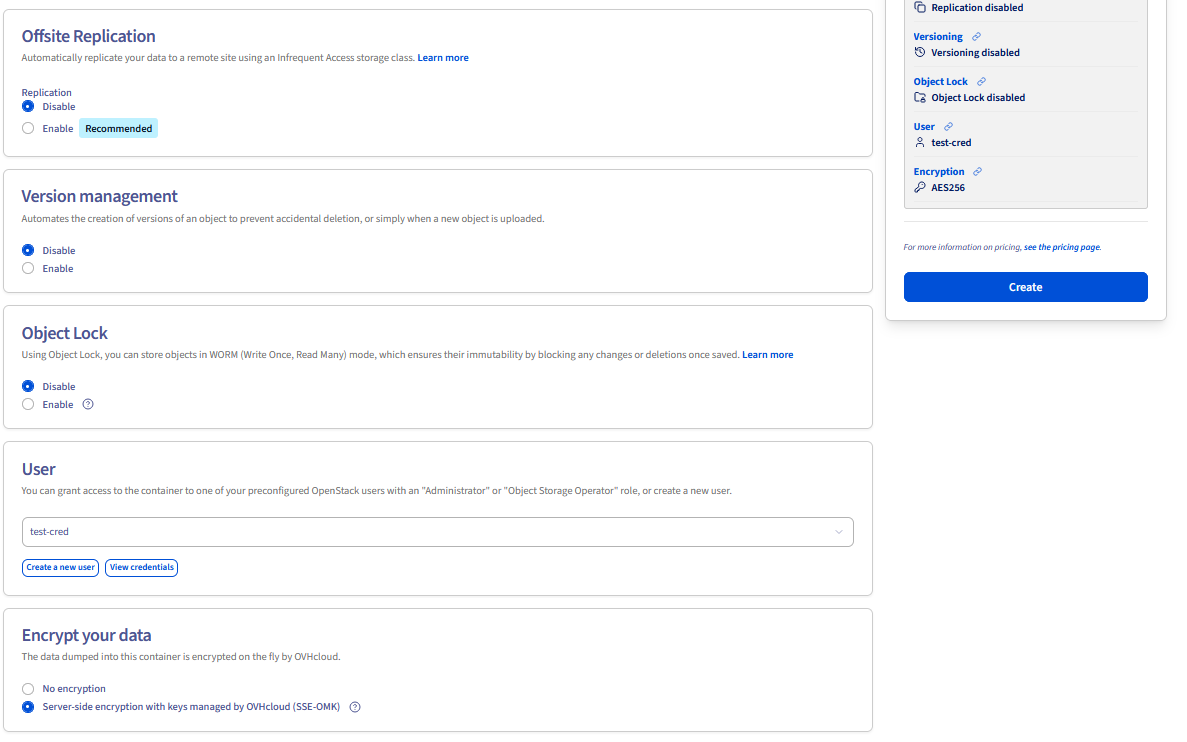
You can then set the configuration parameters for your bucket.
:::info
If you have selected the 3AZ deployment mode, an additional option appears to **configure offsite replication**.
:::
At this stage, you can decide whether or not to enable **versioning**.
Versioning allows you to keep multiple variants of an object in the same bucket. This feature helps **preserve, retrieve, and restore every version of every object stored in your buckets**, making it easier to recover from unintended user actions or application failures. By default, versioning is disabled on buckets, and you must explicitly enable it. Find more information about versioning on our [dedicated guide](/it/guides/storage-and-backup/object-storage/s3-versioning.md).
You can also enable [Object Lock](/it/guides/storage-and-backup/object-storage/s3-managing-object-lock.md) to store your objects in WORM (Write Once, Read Many) mode and guarantee their immutability for a defined retention period.
:::info
**Note:** this option must be enabled when creating a bucket, it cannot be enabled later.
:::
You must link a user to the bucket.
To do this, you can either:
- Link an existing Object Storage user. To check the credentials, click on View credentials.
- Or create a new Object Storage user.
You can now decide whether or not you wish to **encrypt your data** using [SSE-OMK (server-side encryption with OVHcloud Managed Keys)](/it/guides/storage-and-backup/object-storage/s3-encrypt-your-objects-with-sse-c.md).
Once you have finished configuring your bucket, click Create.
**Via the OVHcloud CLI**
Enter the following command, replacing `` with your region code (e.g. `GRA`, `BHS`) and `` with the desired name:
```shell
ovhcloud cloud storage-s3 create --name
```
To create a bucket with versioning and encryption enabled:
```shell
ovhcloud cloud storage-s3 create --name --versioning-status enabled --encryption-sse-algorithm AES256
```
To create a bucket with Object Lock enabled:
```shell
ovhcloud cloud storage-s3 create --name --object-lock-status enabled --object-lock-rule-mode compliance --object-lock-rule-period P30D
```
:::info
The `--object-lock-status enabled` option must be set at bucket creation time; it cannot be enabled later.
:::
#### Uploading your files as objects in your bucket
When uploading objects, you can select a storage class to control availability, redundancy, and cost. To help you in choosing the best class for your requirements, check the documentation [here](/it/guides/storage-and-backup/object-storage/s3-choosing-the-right-storage-class-for-your-needs.md).
**Via AWS CLI**
**To upload an object:**
Via AWS s3
```bash
aws s3 cp /data/ s3://
```
**By default, objects are named after files, but they can be renamed.**
```bash
aws s3 cp /data/ s3:///other-filename
```
:::info
The `aws s3 cp` command will use STANDARD as default storage class for uploading objects.
To store objects in the High Performance tier, use the `aws s3api put-object` command instead, as `aws s3 cp` does not support the EXPRESS\_ONEZONE storage class which is used to map the High Performance storage tier.
To learn more about the storage class mapping between OVHcloud storage tiers and AWS storage classes, you can check our documentation [here](/it/guides/storage-and-backup/object-storage/s3-location.md).
:::
Via AWS s3api
```bash
# upload an object to High Performance tier
aws s3api put-object --bucket --key --body /data/ --storage-class EXPRESS_ONEZONE
# explicitly upload an object to Standard tier
aws s3api put-object --bucket --key --body /data/ --storage-class STANDARD
```
**By default, objects are named after files, but can be renamed.**
```bash
aws s3 cp /data/ s3:///other-filename
```
**Via the OVHcloud Control Panel**
Click on the name of your container, then click the Add objects button in the **Objects** tab.
A window will appear where you can add a prefix to your object's name (the object name is the same as the file name). Select the file you are about to upload and click the Import button.
#### Downloading an object from a bucket
**Via AWS CLI**
Via AWS s3
**Downloading an object from a bucket:**
```bash
aws s3 cp s3:/// .
```
**Uploading an object from one bucket to another bucket:**
```bash
aws s3 cp s3:/// s3:///
```
**Downloading or uploading an entire bucket to the host/bucket:**
```bash
aws s3 cp s3:// . --recursive
aws s3 cp s3:// s3:// --recursive
```
Via AWS s3api
**Downloading an object from a bucket:**
```bash
aws s3api get-object --bucket --key
```
**Uploading an object from one bucket to another bucket:**
```bash
aws s3api copy-object --bucket --copy-source / --key
```
**Via the OVHcloud Control Panel**
Click on the download icon (down arrow in a blue base) on the object line.
#### Synchronising buckets
**Via AWS CLI**
```bash
aws s3 sync . s3:// # Synchronising local directory to the S3 bucket
aws s3 sync s3:// . # Synchronising S3 bucket to the local directory
aws s3 sync s3:// s3:// # Synchronising an S3 bucket to another one
```
#### Deleting objects and buckets
:::info
A bucket can only be deleted if it is empty.
:::
**Via AWS CLI**
Via AWS s3
**Deleting objects and buckets:**
```bash
# Delete an object
aws s3 rm s3:///
# Removing all objects from a bucket
aws s3 rm s3:// --recursive
# Delete a bucket. To delete a bucket, it must be empty.
aws s3 rb s3://
# If the bucket is not deleted, you can use the same command with the --force option.
# This command deletes all objects from the bucket, then deletes the bucket.
aws s3 rb s3:// --force
```
**Deleting objects and buckets with versioning enabled:**
If versioning is enabled, a simple delete operation on your objects will not permanently remove them.
In order to permanently delete an object, you must specify a version id:
```bash
aws s3api delete-object --bucket --key --version-id
```
To list all objects and all version IDs, you can use the following command:
```bash
aws s3api list-object-versions --bucket
```
With the previous delete-object command, you will have to iterate over all your object versions. Alternatively, you can use the following one-liner to empty your bucket:
```bash
aws s3api delete-objects --bucket --delete "$(aws s3api list-object-versions --bucket --query='{Objects: Versions[].{Key:Key,VersionId:VersionId}}')"
```
Via AWS s3api
**Deleting objects and buckets**
```bash
# Delete an object
aws s3api delete-object --bucket --key
# Removing all objects from a bucket
aws s3api delete-objects --bucket --delete "$(aws s3api list-objects-v2 --bucket --query='{Objects: Contents[].{Key:Key}}')"
# Delete a bucket. To delete a bucket, it must be empty.
aws s3api delete-bucket --bucket
```
**Deleting objects and buckets with versioning enabled**
If versioning is enabled, a simple delete operation on your objects will not delete them permanently.
To permanently delete an object, you need to specify a version identifier:
```bash
aws s3api delete-objects --bucket --delete "$(aws s3api list-object-versions --bucket --query='{Objects: Versions[].{Key:Key,VersionId:VersionId}}')"
```
:::info
If your bucket has Object Lock enabled, you will not be able to permanently delete your objects. See our [documentation](/it/guides/storage-and-backup/object-storage/s3-managing-object-lock.md) to learn more about Object Lock.
If you use Object Lock in GOVERNANCE mode and have the permission to bypass GOVERNANCE mode, you will have to add the `--bypass-governance-retention` option to your delete commands.
:::
**Via the OVHcloud Control Panel**
**Deleting a bucket**
In the list of Object Storage containers, click the ... button on the container line, then click Delete.
Enter `TERMINATE` to confirm your choice and click Confirm.
**Deleting objects**
Go to the bucket and open the Objects tab.
Click the delete icon (trash can) on the object line, type `PERMANENTLY DELETE`to confirm permanent deletion, then click Delete.
**Via the OVHcloud CLI**
**Deleting objects**
```shell
# Delete an object
ovhcloud cloud storage-s3 object delete
# Delete all objects in a bucket
ovhcloud cloud storage-s3 bulk-delete --all
# Delete objects matching a prefix
ovhcloud cloud storage-s3 bulk-delete --prefix
# Delete specific objects
ovhcloud cloud storage-s3 bulk-delete --objects "file1.txt,file2.txt"
```
**Deleting a bucket**
The bucket must be empty before deletion.
```shell
ovhcloud cloud storage-s3 delete
```
**Deleting objects with versioning enabled**
If versioning is enabled, specify the version ID to permanently delete an object:
```shell
ovhcloud cloud storage-s3 object version delete
```
To delete all versions of an object, combine the version list and deletion:
```shell
ovhcloud cloud storage-s3 bulk-delete --objects "myfile.txt:,myfile.txt:"
```
#### Manage tags
**Via AWS CLI**
**Setting tags on a bucket:**
```bash
aws s3api put-bucket-tagging --bucket --tagging 'TagSet=[{Key=myKey,Value=myKeyValue}]'
aws s3api get-bucket-tagging --bucket
```
```json
{
"TagSet": [
{
"Value": "myKeyValue",
"Key": "myKey"
}
]
}
```
**Deleting tags on a bucket:**
```bash
aws s3api delete-bucket-tagging --bucket
```
**Setting tags on an object:**
```bash
aws s3api put-object-tagging --bucket --key --tagging 'TagSet=[{Key=myKey,Value=myKeyValue}]'
aws s3api get-bucket-tagging --bucket
```
```json
{
"TagSet": [
{
"Value": "myKeyValue",
"Key": "myKey"
}
]
}
```
**Deleting tags on an object:**
```bash
aws s3api delete-object-tagging --bucket --key
```
**Via the OVHcloud CLI**
The OVHcloud CLI lets you set tags on a bucket at **creation** time or when **editing** it via the `--tag key=value` option (repeatable for multiple tags). Individual tag management (reading, deleting) is not available via the CLI.
**Setting tags when creating a bucket**
```shell
ovhcloud cloud storage-s3 create --name --tag myKey=myKeyValue --tag otherKey=otherValue
```
**Updating tags on an existing bucket**
```shell
ovhcloud cloud storage-s3 edit --tag myKey=myKeyValue
```
## Go further
If you need training or technical assistance to implement our solutions, contact your sales representative or click on [this link](https://www.ovhcloud.com/it/professional-services/) to get a quote and ask our Professional Services experts for assisting you on your specific use case of your project.
Join our [community of users](https://community.ovhcloud.com/).
1
: S3 is a trademark of Amazon Technologies, Inc. OVHcloud’s service is not sponsored by, endorsed by, or otherwise affiliated with Amazon Technologies, Inc.