---
title: "Creating and using a Docker image stored in an OVHcloud Managed Private Registry"
description: "Find out how to create and use an image stored in an OVHcloud Managed Private Registry."
url: https://docs.ovhcloud.com/fr/guides/public-cloud/containers-orchestration/managed-private-registry/create-private-image
lang: fr
lastUpdated: 2022-04-13
---
# Creating and using a Docker image stored in an OVHcloud Managed Private Registry
## Objective
OVHcloud Managed Private Registry service provides you a managed, authenticated Docker registry where you can privately store your Docker images. This guide will explain how to create a Docker image, store it in the OVHcloud Managed Private Registry service and using it from a Docker client.
## Requirements
- An OVHcloud Managed Private Registry (see the [creating a private registry](/fr/guides/public-cloud/containers-orchestration/managed-private-registry/creation.md) guide for more information)
- An access to the Harbor UI to operate the private registry (see the [connecting to the UI](/fr/guides/public-cloud/containers-orchestration/managed-private-registry/connect-to-ui.md) guide for more information)
- A private project and an user with the right to read and write on the project (see the [managing users and projects](/fr/guides/public-cloud/containers-orchestration/managed-private-registry/managing-users-projects.md) guide for more information)
## Instructions
### Get your OVHcloud Managed Private Registry API URL
Go to your private registry section on the OVHcloud Public Cloud Manager, and in the _more options_ (_..._) button at the right, click on Harbor API.
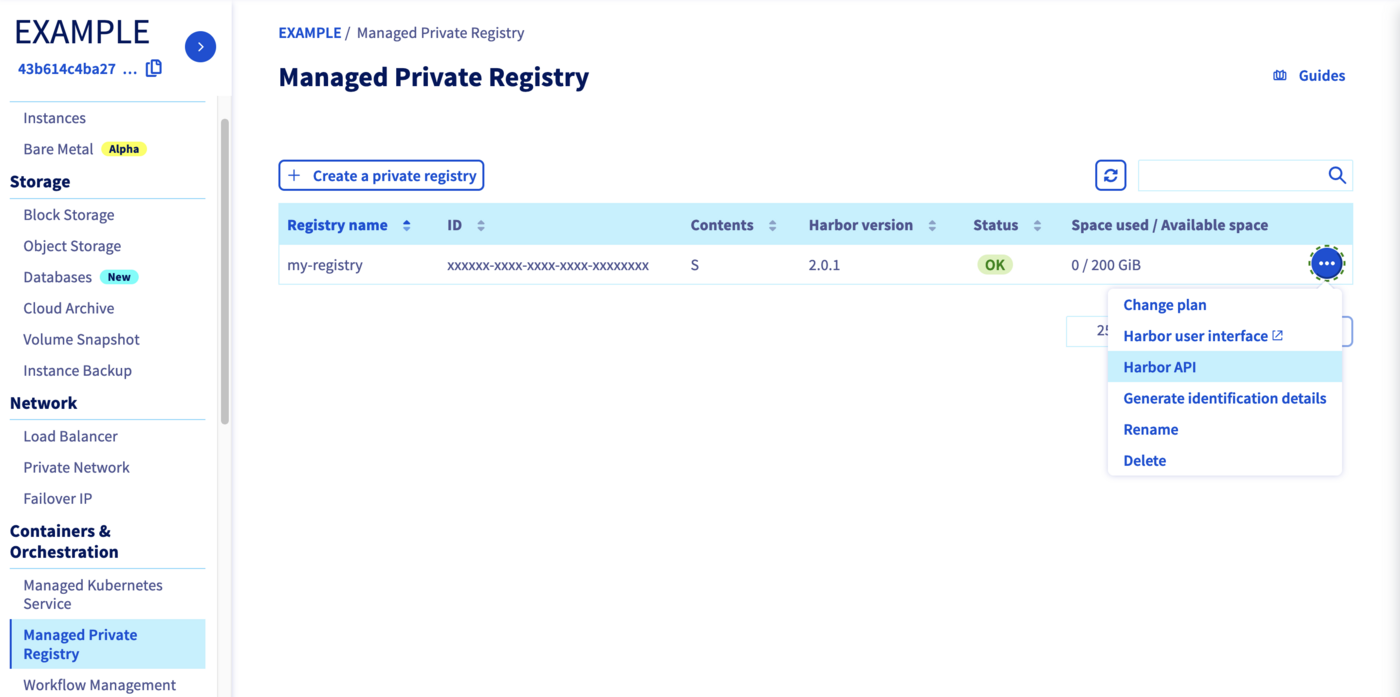
Copy the URL of the API Harbor, it's the URL of your private registry and we are going to use it several times in this guide.
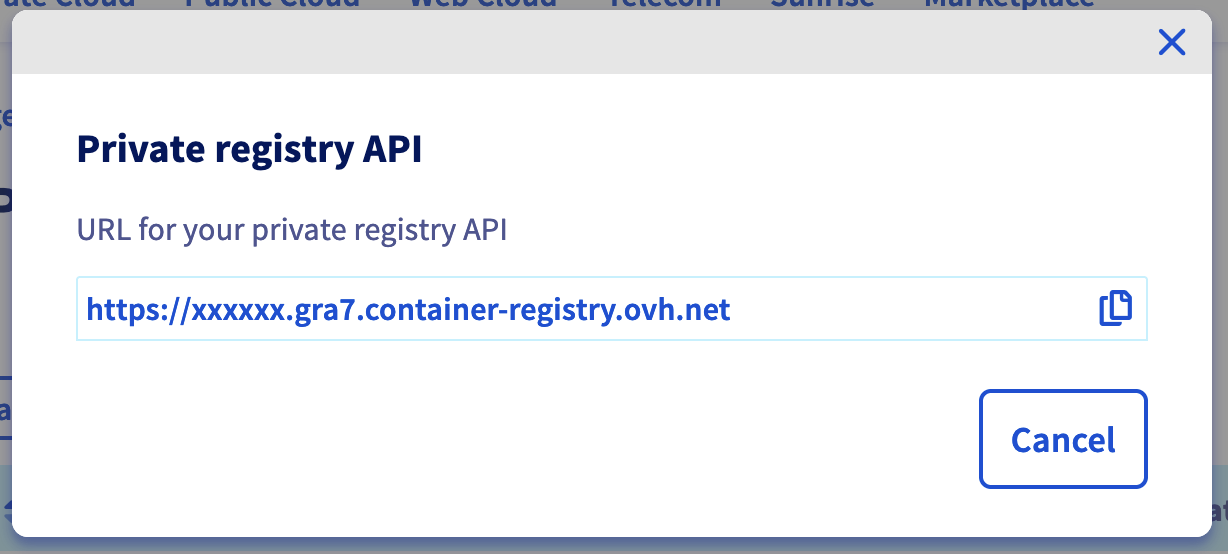
> In fact, when you click the copy button as indicated by a hand icon in the image, the copied string starts with `https://`. Please remove the `https://` part.
### Creating a Docker image
You're going to create a Docker image using a very simple Dockerfile and some resource files.
Create a `hello-ovh/` folder and inside create:
- A `Dockerfile` file:
```
FROM nginx:1.15-alpine
COPY index.html /usr/share/nginx/html/index.html
COPY ovh.svg /usr/share/nginx/html/ovh.svg
```
- A `index.html` file:
```
OVHcloud K8S
Hello from Private Registry!

```
- A `ovh.svg` file (right click and save it):
(`ovh.svg`)
You should have these files in your `hello-ovh` directory:
```bash
├── Dockerfile
├── index.html
└── ovh.svg
```
- Go into the `hello-ovh` folder, containing the three files, and do a `docker build`. You will need to tag your build using your private registry URL, the project within the registry (_private_ if you followed the [managing users and projects](/fr/guides/public-cloud/containers-orchestration/managed-private-registry/managing-users-projects.md) guide), and the image name (_hello-ovh_):
```bash
docker build --tag [YOUR_PRIVATE_REGISTRY_URL]/[YOUR_PROJECT]/hello-ovh:1.0.0 .
```
Here is the result of running the command for my private registry in the `private` project:
```console
$ docker build --tag 8093ff7x.gra5.container-registry.ovh.net/private/hello-ovh:1.0.0 .
Sending build context to Docker daemon 14.34kB
Step 1/3 : FROM nginx:1.15-alpine
1.15-alpine: Pulling from library/nginx
e7c96db7181b: Pull complete
264026bbe255: Pull complete
a71634c55d29: Pull complete
5595887beb81: Pull complete
Digest: sha256:57a226fb6ab6823027c0704a9346a890ffb0cacde06bc19bbc234c8720673555
Status: Downloaded newer image for nginx:1.15-alpine
---> dd025cdfe837
Step 2/3 : COPY index.html /usr/share/nginx/html/index.html
---> f1f2487532bc
Step 3/3 : COPY ovh.svg /usr/share/nginx/html/ovh.svg
---> 3f803b45da18
Successfully built 3f803b45da18
Successfully tagged 8093ff7x.gra5.container-registry.ovh.net/private/hello-ovh:1.0.0
```
- Login to your private registry, using a user with write rights to the project (_private-user_ if you followed the [managing users and projects](/fr/guides/public-cloud/containers-orchestration/managed-private-registry/managing-users-projects.md) guide)
```bash
docker login [YOUR_PRIVATE_REGISTRY_URL]
```
In my private registry:
```console
$ docker login 8093ff7x.gra5.container-registry.ovh.net
Username: private-user
Password:
Login Succeeded
```
- Upload the image to the private registry
```bash
docker push [YOUR_PRIVATE_REGISTRY_URL]/[YOUR_PROJECT]/hello-ovh:1.0.0
```
In my private registry example:
```console
$ docker push 8093ff7x.gra5.container-registry.ovh.net/private/hello-ovh:1.0.0
The push refers to repository [8093ff7x.gra5.container-registry.ovh.net/private/hello-ovh]
369ed87ef8b1: Pushed
d2220a0eb85b: Pushed
a521e1bbddf5: Pushed
bf381a670956: Pushed
a61993362baf: Pushed
f1b5933fe4b5: Pushed
1.0.0: digest: sha256:f5a6a8f0d7c95cf3926b504a7949c8575e478106b59d8913ab947729aa5bd075 size: 1568
```
If you go to your Harbor UI, you will see that a `hello-ovh` repository in the _private_ project:
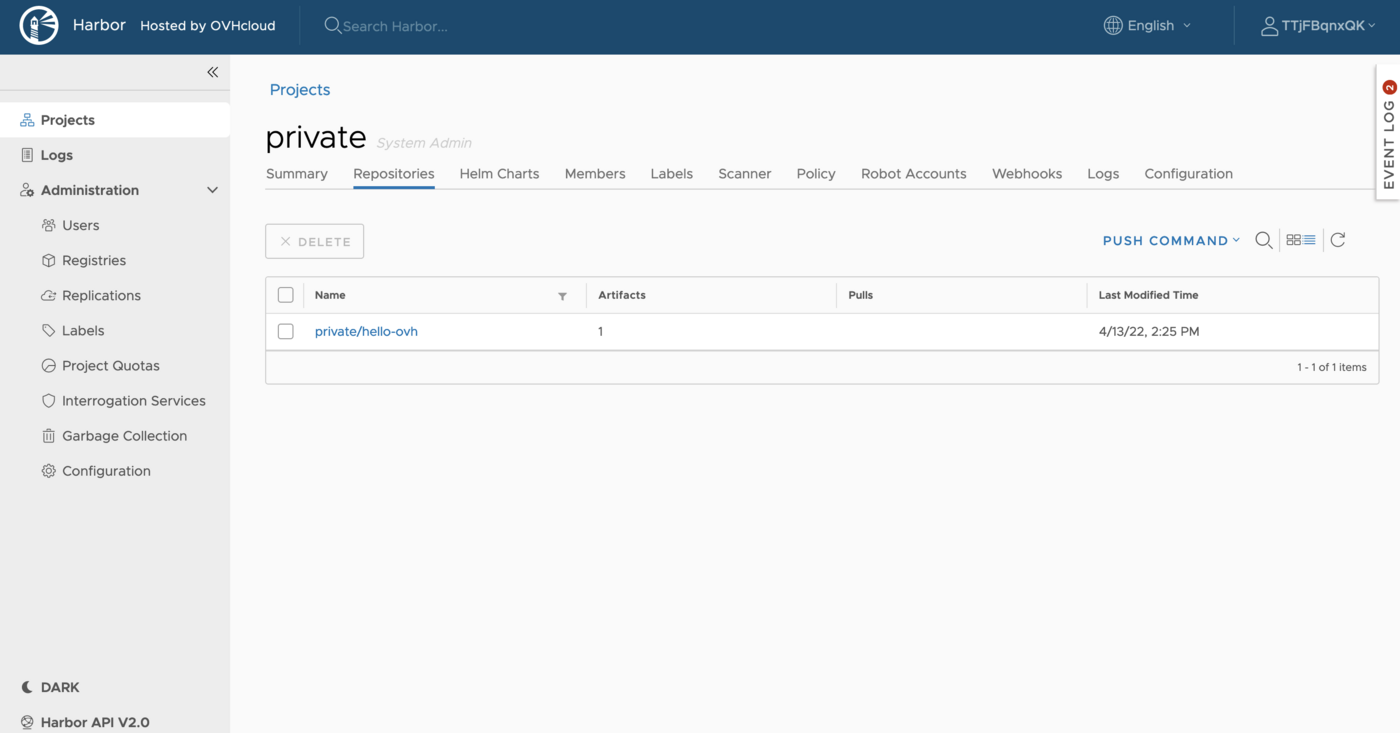
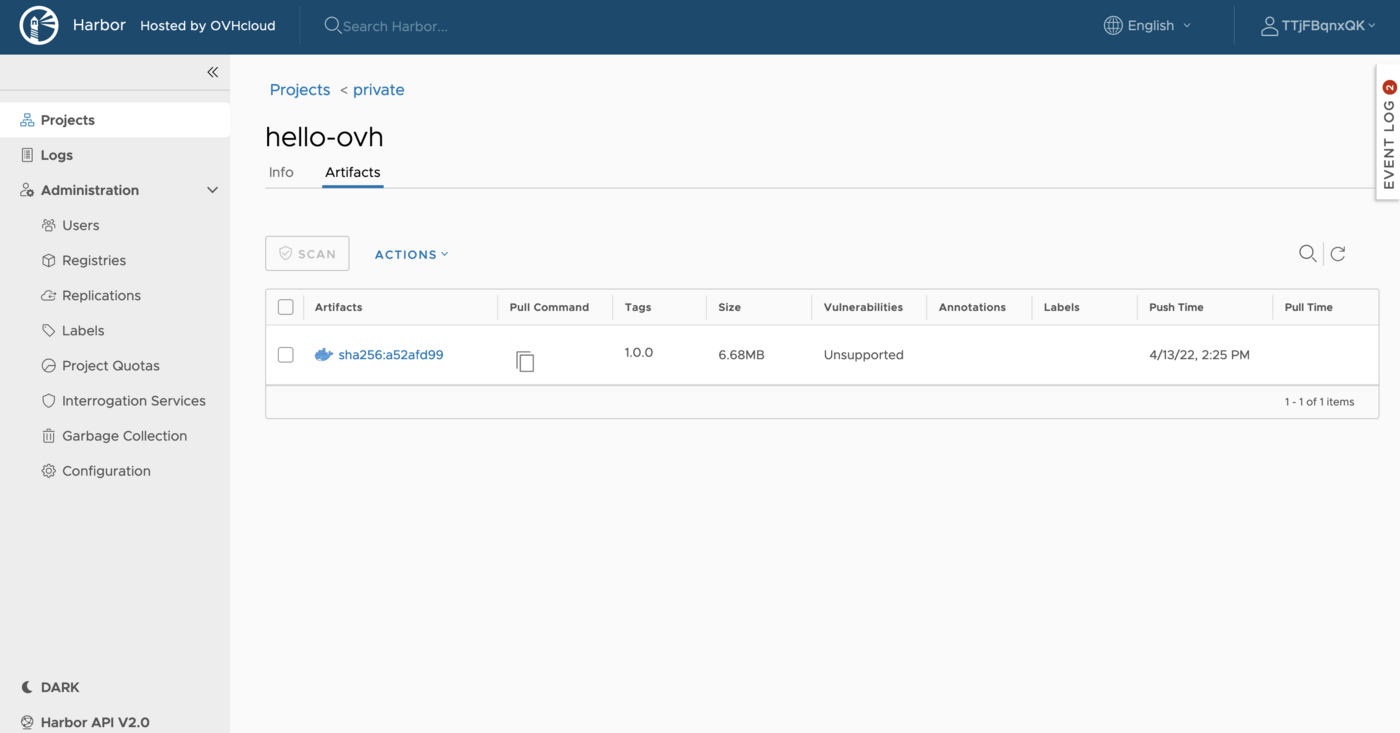
This repository will store all the versions of the `hello-ovh` image (right now only the _1.0.0_):
### Deploy the private image
Now you can use `docker pull` (preceded by a `docker login` on your private registry if you're doing it from a different computer) to deploy the image from the OVHcloud Managed Private Registry.
```bash
docker pull [YOUR_PRIVATE_REGISTRY_URL]/[YOUR_PROJECT]/hello-ovh:1.0.0
```
In my private registry example:
```console
$ docker pull 8093ff7x.gra5.container-registry.ovh.net/private/hello-ovh:1.0.0
1.0.0: Pulling from private/hello-ovh
e7c96db7181b: Already exists
264026bbe255: Already exists
a71634c55d29: Already exists
5595887beb81: Already exists
4c1b9819c67d: Pull complete
5df2876c6416: Pull complete
Digest: sha256:f5a6a8f0d7c95cf3926b504a7949c8575e478106b59d8913ab947729aa5bd075
Status: Downloaded newer image for 8093ff7x.gra5.container-registry.ovh.net/private/hello-ovh:1.0.0
```
And then you can run it:
```bash
docker run -d -p 80:80 [YOUR_PRIVATE_REGISTRY_URL]/[YOUR_PROJECT]/hello-ovh:1.0.0
```
In my private registry example:
```console
$ docker run -d -p 8080:80 8093ff7x.gra5.container-registry.ovh.net/private/hello-ovh:1.0.0
c18f071c3c8c10ca636ed9be84878c12f3a270b6def131eb756f69435b978da1
```
And now you can test it with the `curl` command:
```bash
$ curl localhost:8080
OVH K8S
Hello from Private Registry!
```
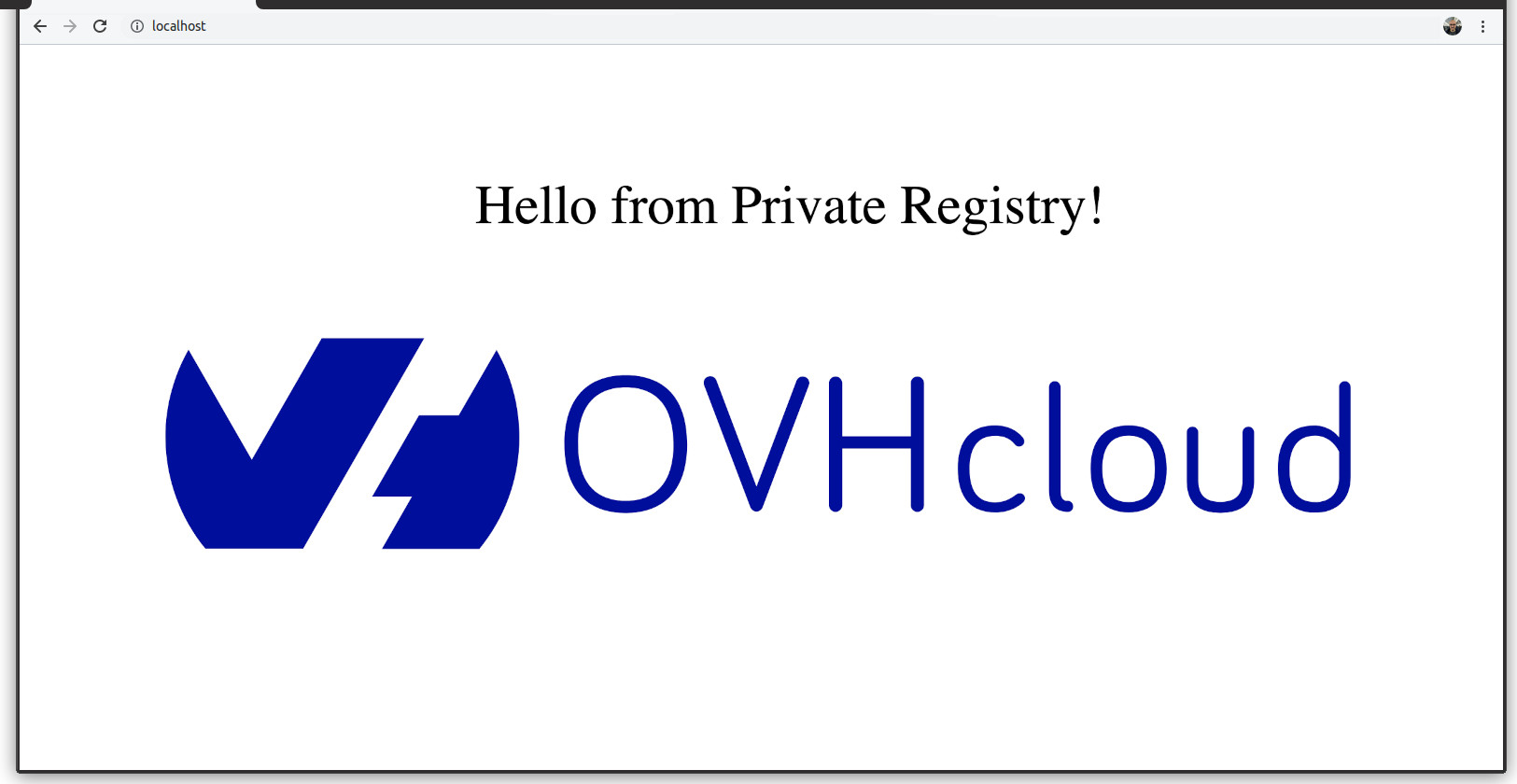
Or in your browser:
### Go further
To go further you can look at our guide on [Using your private registry with Kubernetes](/fr/guides/public-cloud/containers-orchestration/managed-private-registry/kubernetes.md).