---
title: "AI Deploy - Tutorial - Deploy a Gradio app for sketch recognition"
description: "How to build and use a custom Docker image containing a Gradio application"
url: https://docs.ovhcloud.com/es/guides/public-cloud/ai-machine-learning/ai-deploy-gradio-sketch-recognition
lang: es
lastUpdated: 2025-06-25
---
# AI Deploy - Tutorial - Deploy a Gradio app for sketch recognition
:::info
AI Deploy is covered by **[OVHcloud Public Cloud Special Conditions](https://storage.gra.cloud.ovh.net/v1/AUTH_325716a587c64897acbef9a4a4726e38/contracts/d2a208c-Conditions_particulieres_OVH_Stack-WE-9.0.pdf)**.
:::
## Objective
The purpose of this tutorial is to deploy an application for sketch recognition using a trained model.
The use case is **handwritten digits recognition**, based on the [MNIST dataset](http://yann.lecun.com/exdb/mnist/).
In order to do this, you will use [Gradio](https://gradio.app/), an open-source Python library which is a quick way to expose and use Machine Learning models. You will also learn how to build and use a custom Docker image for a Gradio application.
Overview of the app:
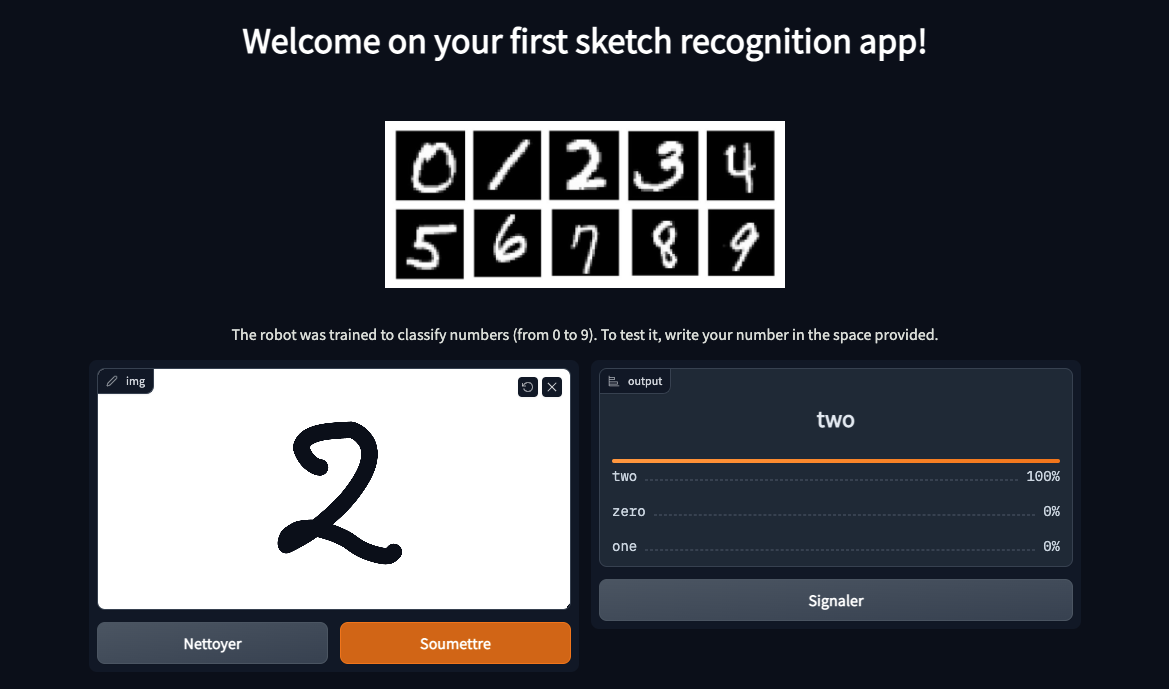
## Requirements
- An AI Deploy project created inside a [Public Cloud project](https://www.ovhcloud.com/es-es/public-cloud/) in your OVHcloud account.
- A [user for AI Deploy](/es/guides/public-cloud/ai-machine-learning/ai-users.md).
- [Docker](https://www.docker.com/get-started) installed on your local computer.
- Some knowledge about building image and [Dockerfile](https://docs.docker.com/engine/reference/builder/).
- You also should have followed the steps of the _Image Classification with MNIST dataset_ notebook from the [GitHub repository](https://github.com/ovh/ai-training-examples/blob/main/notebooks/computer-vision/image-classification/tensorflow/weights-and-biases/notebook_Weights_and_Biases_MNIST.ipynb). You will be able to train and save your model. To launch this notebook and run it, please refer to this [documentation](/es/guides/public-cloud/ai-machine-learning/ai-notebooks-weights-biases.md).
## Instructions
You are going to follow different steps to build your **Gradio** application.
- More information about Gradio capabilities can be found [here](https://gradio.app/docs/).
- Direct link to the full Python file can be found here [here](https://github.com/ovh/ai-training-examples/blob/main/apps/gradio/sketch-recognition/app.py).
Here we will mainly discuss on how to write the `app.py` code, the `requirements.txt` file and the `Dockerfile`. If you want to see the whole code, please refer to the [GitHub repository](https://github.com/ovh/ai-training-examples/tree/main/apps/gradio/sketch-recognition).
### Write the Gradio application
Create a Python file named `app.py`.
Inside that file, import your required modules.
```python
import gradio as gr
import tensorflow as tf
import cv2
```
Define the elements that make up the AI Deploy app: title, header and references.
```python
title = "Welcome on your first sketch recognition app!"
head = (
""
" "
"The robot was trained to classify numbers (from 0 to 9). To test it, write your number in the space provided."
""
)
ref = "Find the whole code [here](https://github.com/ovh/ai-training-examples/tree/main/apps/gradio/sketch-recognition)."
```
Specify the input images size and the classes names.
```python
img_size = 28
labels = ["zero", "one", "two", "three", "four", "five", "six", "seven", "eight", "nine"]
```
Load the previously trained model for handwritten digits classification.
:::info
To learn more about how you can save a model with TensorFlow, please refer to the part _"Save and export the model for future inference"_ of the [notebook](https://github.com/ovh/ai-training-examples/blob/main/notebooks/computer-vision/image-classification/tensorflow/weights-and-biases/notebook_Weights_and_Biases_MNIST.ipynb).
:::
:::info
Here you will use your trained model, then save it in an Object Storage container. Click [here](/es/guides/public-cloud/ai-machine-learning/ai-cli-data.md) to learn more about Object Storage.
:::
```python
model = tf.keras.models.load_model("model/sketch_recognition_numbers_model.h5", compile=False)
```
Create the function that recognizes the written number.
```python
def predict(img):
img = cv2.resize(img, (img_size, img_size))
img = img.reshape(1, img_size, img_size, 1)
preds = model.predict(img)[0]
return {label: float(pred) for label, pred in zip(labels, preds)}
label = gr.outputs.Label(num_top_classes=3)
```
Launch the Gradio interface.
```python
interface = gr.Interface(fn=predict, inputs="sketchpad", outputs=label, title=title, description=head, article=ref)
interface.launch(server_name="0.0.0.0", server_port=8080)
```
### Write the requirements.txt file for the application
The `requirements.txt` file will allow us to get all the modules needed to make our application work. This file will be useful when writing the `Dockerfile`.
```console
gradio==3.0.10
tensorflow==2.9.1
opencv-python-headless==4.6.0.66
```
### Write the Dockerfile for the application
Your Dockerfile should start with the `FROM` instruction indicating the parent image to use. In our case we choose to start from the `python:3.7` image:
```console
FROM python:3.7
```
Create the home directory and add your files to it:
```console
WORKDIR /workspace
ADD . /workspace
```
Install your needed Python modules using a `pip install ...` command with the `requirements.txt` file which contains all modules:
```console
RUN pip install -r requirements.txt
```
Give correct access rights to the **ovhcloud user** (`42420:42420`):
```console
RUN chown -R 42420:42420 /workspace
ENV HOME=/workspace
```
Define your default launching command to start the application:
```console
CMD [ "python3" , "/workspace/app.py" ]
```
### Build the Docker image from the Dockerfile
From the directory containing your **Dockerfile**, run one of the following commands to build your application image:
```console
# Build the image using your machine's default architecture
docker build . -t gradio_app:latest
# Build image targeting the linux/amd64 architecture
docker buildx build --platform linux/amd64 -t gradio_app:latest .
```
- The **first command** builds the image using your system’s default architecture. This may work if your machine already uses the `linux/amd64` architecture, which is required to run containers with our AI products. However, on systems with a different architecture (e.g. `ARM64` on `Apple Silicon`), the resulting image will not be compatible and cannot be deployed.
- The **second command** explicitly targets the `linux/AMD64` architecture to ensure compatibility with our AI services. This requires `buildx`, which is not installed by default. If you haven’t used `buildx` before, you can install it by running: `docker buildx install`
:::info
The dot `.` argument indicates that your build context (place of the **Dockerfile** and other needed files) is the current directory.
The `-t` argument allows you to choose the identifier to give to your image. Usually image identifiers are composed of a **name** and a **version tag** `:`. For this example we chose **gradio\_app:latest**.
:::
### Push the image into the shared registry
:::warning
The shared registry should only be used for testing purposes. Please consider creating and attaching your own registry. More information about this can be found [here](/es/guides/public-cloud/ai-machine-learning/ai-manage-registries.md). The images pushed to this registry are for AI Tools workloads only, and will not be accessible for external uses.
:::
Find the address of your shared registry by launching this command:
```console
ovhai registry list
```
Log in on the shared registry with your usual AI Platform user credentials:
```console
docker login -u `` -p ``
```
Push the created image into the shared registry:
```console
docker tag gradio_app:latest ``/gradio_app:latest
docker push ``/gradio_app:latest
```
### Launch the AI Deploy app
The following command starts a new AI Deploy app running your Gradio application:
```console
ovhai app run \
--cpu 1 \
--volume ``@``/model/:/workspace/model:RO \
``/gradio_app:latest
```
:::info
`--cpu 1` indicates that we request 1 CPU for that AI Deploy app.
If you want, you can also launch this AI Deploy app with one or more **GPUs**.
:::
To launch your Gradio app, you need to attach **1 volume** to this AI Deploy app. It contains the model that you trained before in part _"Save and export the model for future inference"_ of the [notebook](https://github.com/ovh/ai-training-examples/blob/main/notebooks/computer-vision/image-classification/tensorflow/weights-and-biases/notebook_Weights_and_Biases_MNIST.ipynb).
:::info
`--volume @/:/workspace/saved_model:RO` is the volume attached for using your **pretrained model**. This volume is read-only (`RO`) because you just need to use the model and not make any changes to this Object Storage container.
:::
If you want your **AI Deploy app** to be accessible without the need to authenticate, specify it as follows.
:::info
Consider adding the `--unsecure-http` attribute if you want your application to be reachable without any authentication.
:::
## Go further
- You can imagine deploying an AI model with an other tool: **Flask**. Refer to this [tutorial](/es/guides/public-cloud/ai-machine-learning/ai-deploy-flask-hugging-face-sentiment-analysis.md).
- Do you want to use **Streamlit** to create a audio classification app? [Here it is](/es/guides/public-cloud/ai-machine-learning/ai-deploy-streamlit-sounds-classification.md).
If you need training or technical assistance to implement our solutions, contact your sales representative or click on [this link](https://www.ovhcloud.com/es-es/professional-services/) to get a quote and ask our Professional Services experts for a custom analysis of your project.
## Feedback
Please send us your questions, feedback and suggestions to improve the service:
- On the OVHcloud [Discord server](https://discord.gg/ovhcloud)
"
"The robot was trained to classify numbers (from 0 to 9). To test it, write your number in the space provided."
""
)
ref = "Find the whole code [here](https://github.com/ovh/ai-training-examples/tree/main/apps/gradio/sketch-recognition)."
```
Specify the input images size and the classes names.
```python
img_size = 28
labels = ["zero", "one", "two", "three", "four", "five", "six", "seven", "eight", "nine"]
```
Load the previously trained model for handwritten digits classification.
:::info
To learn more about how you can save a model with TensorFlow, please refer to the part _"Save and export the model for future inference"_ of the [notebook](https://github.com/ovh/ai-training-examples/blob/main/notebooks/computer-vision/image-classification/tensorflow/weights-and-biases/notebook_Weights_and_Biases_MNIST.ipynb).
:::
:::info
Here you will use your trained model, then save it in an Object Storage container. Click [here](/es/guides/public-cloud/ai-machine-learning/ai-cli-data.md) to learn more about Object Storage.
:::
```python
model = tf.keras.models.load_model("model/sketch_recognition_numbers_model.h5", compile=False)
```
Create the function that recognizes the written number.
```python
def predict(img):
img = cv2.resize(img, (img_size, img_size))
img = img.reshape(1, img_size, img_size, 1)
preds = model.predict(img)[0]
return {label: float(pred) for label, pred in zip(labels, preds)}
label = gr.outputs.Label(num_top_classes=3)
```
Launch the Gradio interface.
```python
interface = gr.Interface(fn=predict, inputs="sketchpad", outputs=label, title=title, description=head, article=ref)
interface.launch(server_name="0.0.0.0", server_port=8080)
```
### Write the requirements.txt file for the application
The `requirements.txt` file will allow us to get all the modules needed to make our application work. This file will be useful when writing the `Dockerfile`.
```console
gradio==3.0.10
tensorflow==2.9.1
opencv-python-headless==4.6.0.66
```
### Write the Dockerfile for the application
Your Dockerfile should start with the `FROM` instruction indicating the parent image to use. In our case we choose to start from the `python:3.7` image:
```console
FROM python:3.7
```
Create the home directory and add your files to it:
```console
WORKDIR /workspace
ADD . /workspace
```
Install your needed Python modules using a `pip install ...` command with the `requirements.txt` file which contains all modules:
```console
RUN pip install -r requirements.txt
```
Give correct access rights to the **ovhcloud user** (`42420:42420`):
```console
RUN chown -R 42420:42420 /workspace
ENV HOME=/workspace
```
Define your default launching command to start the application:
```console
CMD [ "python3" , "/workspace/app.py" ]
```
### Build the Docker image from the Dockerfile
From the directory containing your **Dockerfile**, run one of the following commands to build your application image:
```console
# Build the image using your machine's default architecture
docker build . -t gradio_app:latest
# Build image targeting the linux/amd64 architecture
docker buildx build --platform linux/amd64 -t gradio_app:latest .
```
- The **first command** builds the image using your system’s default architecture. This may work if your machine already uses the `linux/amd64` architecture, which is required to run containers with our AI products. However, on systems with a different architecture (e.g. `ARM64` on `Apple Silicon`), the resulting image will not be compatible and cannot be deployed.
- The **second command** explicitly targets the `linux/AMD64` architecture to ensure compatibility with our AI services. This requires `buildx`, which is not installed by default. If you haven’t used `buildx` before, you can install it by running: `docker buildx install`
:::info
The dot `.` argument indicates that your build context (place of the **Dockerfile** and other needed files) is the current directory.
The `-t` argument allows you to choose the identifier to give to your image. Usually image identifiers are composed of a **name** and a **version tag** `:`. For this example we chose **gradio\_app:latest**.
:::
### Push the image into the shared registry
:::warning
The shared registry should only be used for testing purposes. Please consider creating and attaching your own registry. More information about this can be found [here](/es/guides/public-cloud/ai-machine-learning/ai-manage-registries.md). The images pushed to this registry are for AI Tools workloads only, and will not be accessible for external uses.
:::
Find the address of your shared registry by launching this command:
```console
ovhai registry list
```
Log in on the shared registry with your usual AI Platform user credentials:
```console
docker login -u `` -p ``
```
Push the created image into the shared registry:
```console
docker tag gradio_app:latest ``/gradio_app:latest
docker push ``/gradio_app:latest
```
### Launch the AI Deploy app
The following command starts a new AI Deploy app running your Gradio application:
```console
ovhai app run \
--cpu 1 \
--volume ``@``/model/:/workspace/model:RO \
``/gradio_app:latest
```
:::info
`--cpu 1` indicates that we request 1 CPU for that AI Deploy app.
If you want, you can also launch this AI Deploy app with one or more **GPUs**.
:::
To launch your Gradio app, you need to attach **1 volume** to this AI Deploy app. It contains the model that you trained before in part _"Save and export the model for future inference"_ of the [notebook](https://github.com/ovh/ai-training-examples/blob/main/notebooks/computer-vision/image-classification/tensorflow/weights-and-biases/notebook_Weights_and_Biases_MNIST.ipynb).
:::info
`--volume @/:/workspace/saved_model:RO` is the volume attached for using your **pretrained model**. This volume is read-only (`RO`) because you just need to use the model and not make any changes to this Object Storage container.
:::
If you want your **AI Deploy app** to be accessible without the need to authenticate, specify it as follows.
:::info
Consider adding the `--unsecure-http` attribute if you want your application to be reachable without any authentication.
:::
## Go further
- You can imagine deploying an AI model with an other tool: **Flask**. Refer to this [tutorial](/es/guides/public-cloud/ai-machine-learning/ai-deploy-flask-hugging-face-sentiment-analysis.md).
- Do you want to use **Streamlit** to create a audio classification app? [Here it is](/es/guides/public-cloud/ai-machine-learning/ai-deploy-streamlit-sounds-classification.md).
If you need training or technical assistance to implement our solutions, contact your sales representative or click on [this link](https://www.ovhcloud.com/es-es/professional-services/) to get a quote and ask our Professional Services experts for a custom analysis of your project.
## Feedback
Please send us your questions, feedback and suggestions to improve the service:
- On the OVHcloud [Discord server](https://discord.gg/ovhcloud)