---
title: "Bring Your Own Image (BYOI) (EN)"
description: "Find out how to easily deploy your own images on dedicated servers"
url: https://docs.ovhcloud.com/es/guides/bare-metal-cloud/dedicated-servers/bring-your-own-image
lang: es
lastUpdated: 2026-05-28
---
# Bring Your Own Image (BYOI) (EN)
## Objective
The Bring Your Own Image feature (BYOI) enables you to deploy _cloudready_ images directly on your dedicated server. You can therefore use the bare metal service as a resource for your deployments.
**What does _cloudready_ mean?**
The _cloudready_ standard generally means being agnostic of the infrastructure on which the image is deployed.
In addition to the requirements and limitations mentioned below, you must ensure that the image (downloaded or generated) meets the technical expectations of a cloudready image.
**This guide explains how to use Bring Your Own Image (BYOI) on your OVHcloud dedicated server.**
## Requirements
- A [dedicated server](https://www.ovhcloud.com/es-es/bare-metal/) in your OVHcloud account
- Access to the [OVHcloud API](/es/guides/manage-and-operate/api/first-steps.md) (for the "[Deployment via API](#viaapi)" section of this guide)
- Your image must be smaller than the server RAM minus 3GiB
:::info
To apply OVHcloud customizations at first boot, your image must include [cloud-init](https://cloud-init.io/) or a compatible alternative (such as FreeBSD's [`nuageinit`](https://cgit.freebsd.org/src/tree/libexec/nuageinit/)).
:::
***
### OVHcloud Control Panel Access
- **Direct link:** Dedicated Servers
- **Navigation path:** Bare Metal Cloud > Dedicated servers > Select your server
***
:::warning
As with any classical OS installation, a new installation with BYOI will erase all the data on the server.
:::
## Instructions
**Technical limitations:**
There are some technical limitations linked to the use of physical products such as dedicated servers. Here is a non-exhaustive list, to keep in mind during your deployment preparation:
- Boot type: **uefi** or **legacy**
- Partition type: **MBR** or **GPT**
- Image format: **qcow2** or **raw**
:::warning
**About RAID:**
- Bring Your Own Image (BYOI) does not support software RAID configuration at install-time, but you can use the service [Bring Your Own Linux (BYOLinux)](/es/guides/bare-metal-cloud/dedicated-servers/bring-your-own-linux.md) for that. Choose the custom image method that fits your needs: [Bring Your Own Image (BYOI) / Bring Your Own Linux (BYOLinux), a comparison sheet](/es/guides/bare-metal-cloud/dedicated-servers/bring-your-own-image-versus-bring-your-own-linux.md).
- BYOI deploys the image to a single disk: the first disk of the target disk group.
- Hardware RAID works on servers with a RAID controller, because it presents the array to the operating system as a single virtual disk.
:::
**Deployment methods:**
- [Deployment via the Control Panel](#viacontrolpanel): allows you to deploy your image using the OVHcloud Control Panel.
- [Deployment via API](#viaapi): you can use the OVHcloud API to integrate images into your own scripts to automate deployments.
### Deploy your image via the Control Panel [](#)
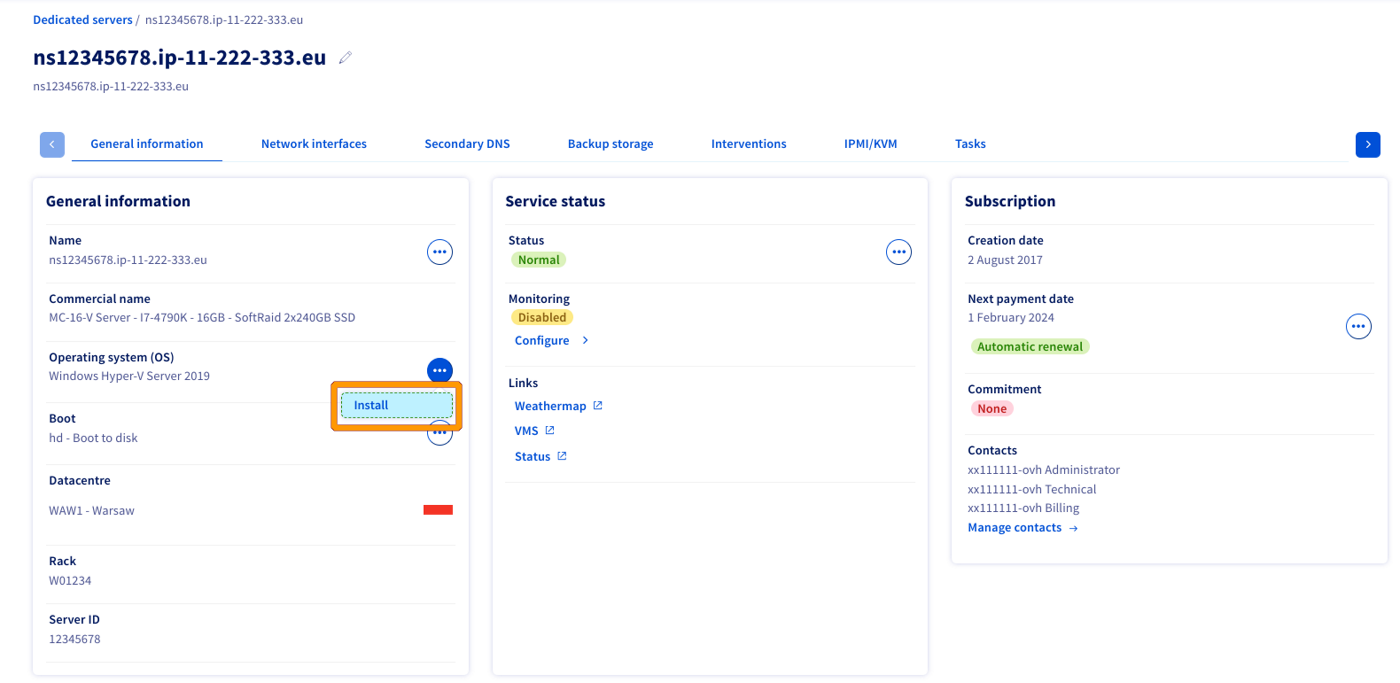
In the `General information
` tab, click the `...
` button next to "System (OS)" then click `Install
`.
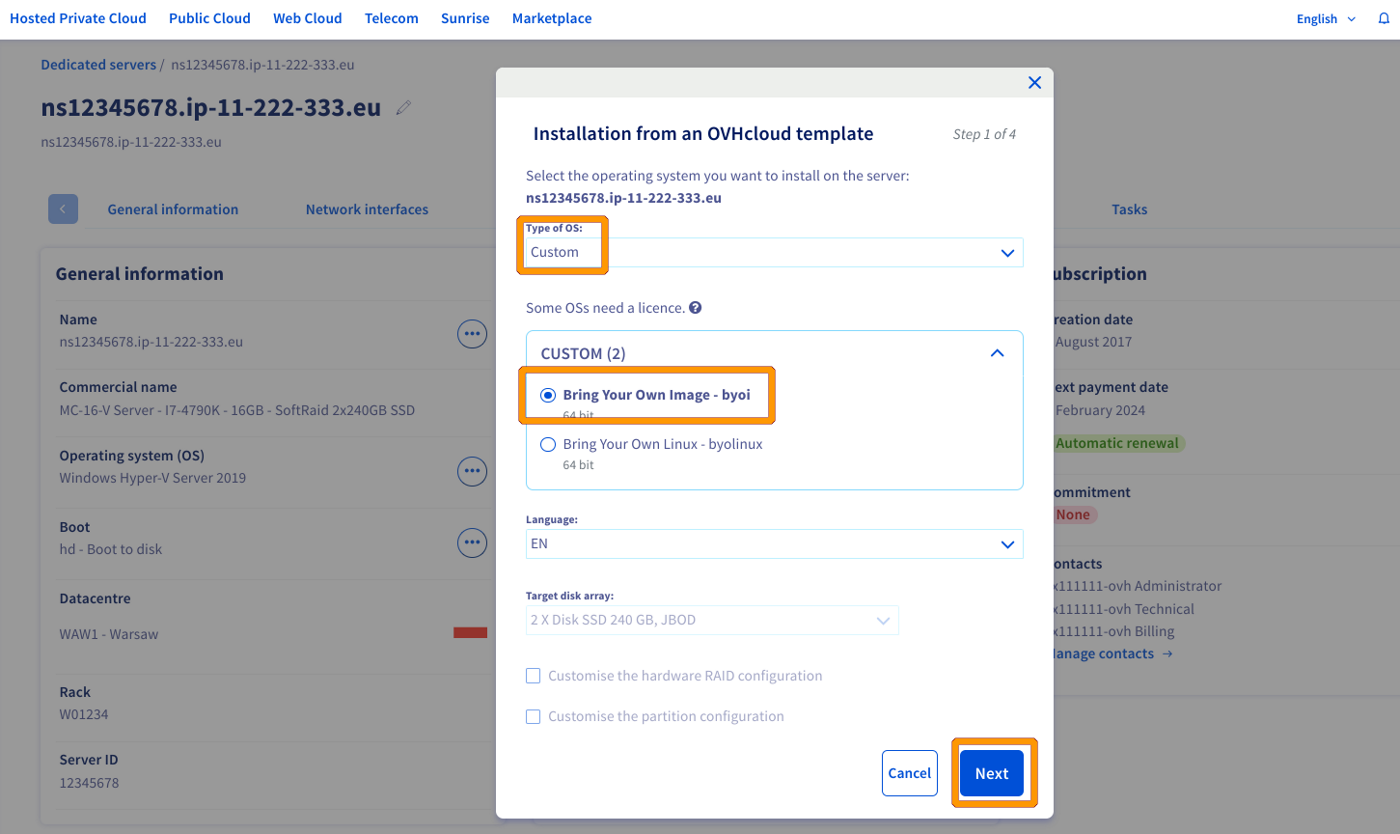
In the window that appears, select `Custom`
in the menu, then `Bring Your Own Image - byoi`
, and click `Next
`.
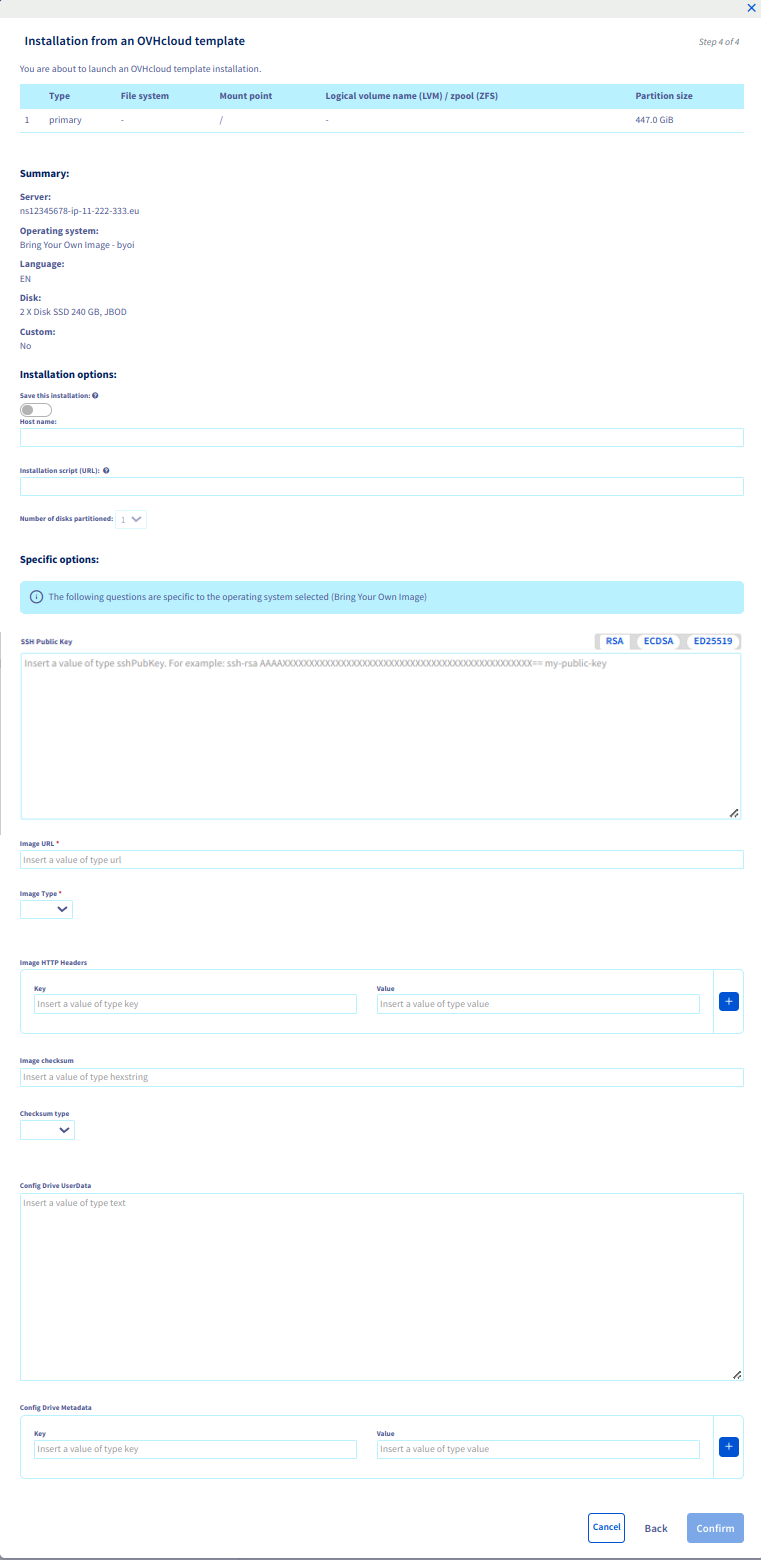
You will be redirected to the configuration page. Make sure your image URL is in the correct format. Fill in the rest of the required fields on this page. Once you have confirmed that the information is correct, click `Confirm
`.
You can find more details on the options in the [deployment options](#options) section below.
### Deploy your image via the API [](#)
Log in to the [API console](https://eu.api.ovh.com/)
and go to the `/dedicated/server
` section.
🇪🇺EU▾
[POST/dedicated/server/{serviceName}/reinstall](https://eu.api.ovh.com/console/?section=/dedicated/server&branch=v1#post-/dedicated/server/-serviceName-/reinstall)
The Bring Your Own Image (BYOI) payload should be similar to the following:
:::warning
In the `customizations` section, only `imageURL`, `imageType` and `efiBootloaderPath` are mandatory.
:::
```json
{
"operatingSystem": "byoi_64",
"customizations": {
"hostname": "mon-tux",
"imageURL": "https://cdimage.debian.org/cdimage/cloud/bullseye/20230124-1270/debian-11-generic-amd64-20230124-1270.raw",
"imageType": "raw",
"sshKey": "ssh-rsa AAAAB3NzaC1yc2EAAAADAQABAAAAgQC9xPpdqP3sx2H+gcBm65tJEaUbuifQ1uGkgrWtNY0PRKNNPdy+3yoVOtxk6Vjo4YZ0EU/JhmQfnrK7X7Q5vhqYxmozi0LiTRt0BxgqHJ+4hWTWMIOgr+C2jLx7ZsCReRk+fy5AHr6h0PHQEuXVLXeUy/TDyuY2JPtUZ5jcqvLYgQ== my-nuclear-power-plant",
"efiBootloaderPath": "\\efi\\debian\\grubx64.efi",
"imageCheckSum": "2cbd3dd5606ef95a5cfa47943b3ad453fcc43522915be7f559a296a71395f82f88e621e558df7aa5f3d2e62c20043f9430ad18c900e565a1c070066e8d008aaa",
"httpHeaders": {
"Authorization": "Basic bG9naW46cGFzc3dvcmQ="
},
"imageCheckSumType": "sha512",
"configDriveUserData": "I2Nsb3VkLWNvbmZpZwpzc2hfYXV0aG9yaXplZF9rZXlzOgogIC0gc3NoLXJzYSBBQUFBQjhkallpdz09IG15c2VsZkBteWRvbWFpbi5uZXQKCnVzZXJzOgogIC0gbmFtZTogcGF0aWVudDAKICAgIHN1ZG86IEFMTD0oQUxMKSBOT1BBU1NXRDpBTEwKICAgIGdyb3VwczogdXNlcnMsIHN1ZG8KICAgIHNoZWxsOiAvYmluL2Jhc2gKICAgIGxvY2tfcGFzc3dkOiBmYWxzZQogICAgc3NoX2F1dGhvcml6ZWRfa2V5czoKICAgICAgLSBzc2gtcnNhIEFBQUFCOGRqWWl3PT0gbXlzZWxmQG15ZG9tYWluLm5ldApkaXNhYmxlX3Jvb3Q6IGZhbHNlCnBhY2thZ2VzOgogIC0gdmltCiAgLSB0cmVlCmZpbmFsX21lc3NhZ2U6IFRoZSBzeXN0ZW0gaXMgZmluYWxseSB1cCwgYWZ0ZXIgJFVQVElNRSBzZWNvbmRzCg=="
}
}
```
Even though `configDriveUserData` could be sent to the API directly in clear text by escaping special characters, it is recommended to send a base64-encoded script to the API. You can use the following UNIX/Linux command to encode your data:
```bash
cat my-data.yaml | base64 -w0
```
Here is the clear-text version of `configDriveUserData` from the example above:
```yaml
#cloud-config
ssh_authorized_keys:
- ssh-rsa AAAAB8djYiw== myself@mydomain.net
users:
- name: patient0
sudo: ALL=(ALL) NOPASSWD:ALL
groups: users, sudo
shell: /bin/bash
lock_passwd: false
ssh_authorized_keys:
- ssh-rsa AAAAB8djYiw== myself@mydomain.net
disable_root: false
packages:
- vim
- tree
final_message: The system is finally up, after $UPTIME seconds
```
Once you have filled in the fields, start the deployment by clicking `Execute
`.
#### Deployment options [](#)
| Field | Description | Required |
| ---------------------------------- | ----------------------------------------------------------------------------- | ------------------------------- |
| customizations/hostname | Hostname | ❌ |
| customizations/sshKey | SSH public key | ❌ |
| customizations/imageURL | Image URL | ✅ |
| customizations/imageType | Image format (qcow2, raw) | ✅ |
| customizations/imageCheckSum | Image checksum | ❌ |
| customizations/imageCheckSumType | Image checksum type (md5, sha1, sha256, sha512) | ❌ (except if checksum provided) |
| customizations/configDriveUserData | cloud-init user-data¹ | ❌ |
| customizations/configDriveMetadata | Custom cloud-init metadata, exposed under the `meta` key of `meta_data.json`⁴ | ❌ |
| customizations/httpHeaders?Key | HTTP Headers key | ❌² |
| customizations/httpHeaders?Value | HTTP Headers value | ❌² |
| userMetadata/efiBootloaderPath | EFI bootloader path | ✅³ |
¹ Standard cloud-init [user-data](https://cloudinit.readthedocs.io/en/latest/explanation/format.html)
— typically a `#cloud-config`
document or a script (see the [official cloud-init examples](https://docs.cloud-init.io/en/latest/reference/examples.html)
). Equivalent to OpenStack's `server create --user-data `
. Its JSON representation must be on a single line with `\n`
for line breaks, as JSON strings cannot contain literal newlines.
² Use only if you need HTTP Headers, such as `Basic Auth`
³ The EFI bootloader path is used by iPXE to boot your operating system. For more information, see [Understanding the dedicated server boot process](/es/guides/bare-metal-cloud/dedicated-servers/boot-process.md)
. Examples:
:::info
The paths below use JSON escaping: `\\` represents a single backslash. For example, `\\efi\\debian\\grubx64.efi` is the path `\efi\debian\grubx64.efi`.
:::
| Operating System | efiBootloaderPath |
| ---------------- | -------------------------------------- |
| Debian | `\\efi\\debian\\grubx64.efi` |
| Ubuntu | `\\efi\\ubuntu\\grubx64.efi` |
| Windows | `\\efi\\microsoft\\boot\\bootmgfw.efi` |
| FreeBSD | `\\efi\\FreeBSD\\loader.efi` |
| Alma | `\\efi\\almalinux\\shimx64.efi` |
| Arch Linux | `\\efi\\arch\\grubx64.efi` |
| Gentoo | `\\efi\\boot\\bootx64.efi` |
⁴ JSON object of arbitrary key/value pairs, equivalent to OpenStack's `server create --property key=value`. The pairs are written to the config drive's `meta_data.json` under the `meta` key, where cloud-init can read them. Example: `"configDriveMetadata": {"role": "webserver", "env": "prod"}` becomes `"meta": {"role": "webserver", "env": "prod"}` in `meta_data.json`. See the [OpenStack metadata service documentation](https://docs.openstack.org/nova/latest/user/metadata.html#openstack-format-metadata) for the full schema.
:::info
When you set any customization on this page, OVHcloud adds a small [config drive](https://docs.cloud-init.io/en/latest/reference/datasources/configdrive.html) partition during installation; otherwise no config drive is created. Cloud-init reads it at first boot. Set `configDriveUserData` to add your own cloud-init user-data.
:::
#### Common customer errors [](#)
The following table gives an overview of well-known customer errors and how to fix them.
| Error message | Details | Solution(s) |
| ------------------------------------------------------------------------------------------------------- | ------------------------------------------------------------------------------------- | ------------------------------------------------------------------------------------------------------------------------------------------------------------------------------------------- |
| Please provide checkSum AND checkSumType or none of them | You have specified only one of the arguments `imageCheckSum` and `imageCheckSumType`. | Either provide both arguments or none of them. |
| image provided format is `x` which does not match expected qcow2 format | No matter what the file extension is, the real format has to be qcow2. | - Change the value of `imageType` to `raw`.
- Convert your image to qcow2. |
| image provided has a size of `n` bytes which is larger than `device` of `m` bytes | The image is larger than the disk chosen for the OS installation. | - If your server has several disk groups, you can try to reinstall the OS on another disk group by specifying the `diskgroupid` argument.
- You need to reduce the size of your image. |
| Can't write `t` on disk | Impossible to write qcow2/raw image on disk. | Modify your image so that the command `qemu-img convert -f "$imageType" -O raw $pathToImageFile "$device"` works. |
| Could not download, `t` image is too big to download in memory. | Your server doesn't have enough RAM to download the image. | You need to reduce the size of your image. |
| Could not download image: `` | Cannot download image from `imageURL`. | Check that a download with the `curl` command from your server works in rescue mode. If some HTTP specific headers are required, you can provide them with the `httpHeaders` argument. |
| image provided format is not of type raw because no partition table was found. It seems to contain: `x` | A raw image must contain a partition table. | Check that your image contains a partition table. |
| Bad `checkSumType` for downloaded file, got: `n` while expecting `m`. | Incorrect checksum. | - Please ensure that you have specified the correct checksum.
- Check that a download with the `curl` command from your server works in rescue mode. |
## Go further
[OVHcloud API & OS installation](/es/guides/bare-metal-cloud/dedicated-servers/api-os-installation.md)
[Bring Your Own Linux (BYOLinux)](/es/guides/bare-metal-cloud/dedicated-servers/bring-your-own-linux.md)
[Bring Your Own Image (BYOI) / Bring Your Own Linux (BYOLinux), a comparison sheet](/es/guides/bare-metal-cloud/dedicated-servers/bring-your-own-image-versus-bring-your-own-linux.md)
[Understanding the dedicated server boot process](/es/guides/bare-metal-cloud/dedicated-servers/boot-process.md)
Join our [community of users](https://community.ovhcloud.com/).