---
title: "How to manage your 1-click module"
description: "Find out how to manage your 1-click module in the OVHcloud Control Panel"
url: https://docs.ovhcloud.com/en/guides/web-cloud/web-hosting/cms-manage-1-click-module
lang: en
lastUpdated: 2026-06-19
---
# How to manage your 1-click module
## Objective
The 1-click modules are a quick and easy way to install an online website creation software (commonly called "CMS"). OVHcloud offers the most well-known of those solutions: WordPress, PrestaShop, Drupal and Joomla!.
**Find out how to manage your 1-click module through the OVHcloud Control Panel.**
:::warning
OVHcloud is providing you with services for which you are responsible, with regard to their configuration and management. You are therefore responsible for ensuring they function correctly.
This guide is designed to assist you in common tasks as much as possible. Nevertheless, we recommend that you contact a [specialist service provider](https://partner.ovhcloud.com/en-gb/directory/) and/or discuss the issue with our community if you face difficulties or doubts. You can find more information in the [Go further](#go-further) section of this guide.
:::
## Requirements
- An [OVHcloud Web Hosting plan](https://www.ovhcloud.com/en-gb/web-hosting/) that allows you to install a 1-click module (only [free hosting](/en/guides/web-cloud/web-hosting/activate-start10m.md) does not provide this feature)
- A 1-click module on your Web Hosting plan (If you did not install one yet, follow the instructions in our guide "[Setting up your website with a 1-click module (CMS)](/en/guides/web-cloud/web-hosting/cms-install-1-click-modules.md)")
***
### OVHcloud Control Panel Access
- **Direct link:** Hosting plans
- **Navigation path:** Web Cloud > Hosting plans > Select your web hosting plan
***
## Instructions
### Access your website
Click on the tabs below to display each of the **2** steps in turn.
**Step 1**
Access the Hosting plans page, then select your web hosting plan.
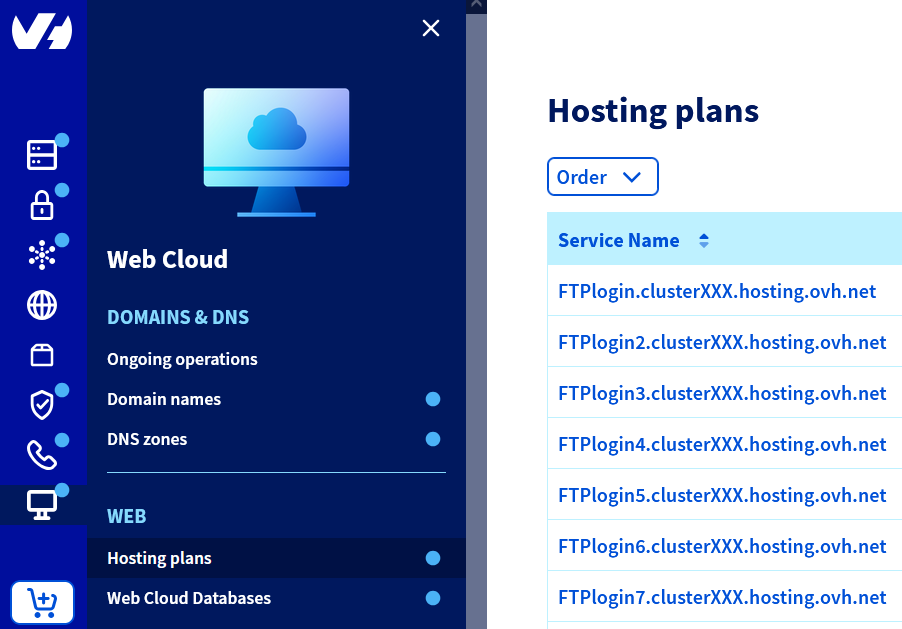Click on the 1-click modules tab.
**Step 2**
Click on the ... button to the right of the line for your module, then click on Access module.
:::info
If your website does not display properly after this, please refer to the OVHcloud Web Hosting guides in the [Troubleshooting](/en/guides/web-cloud/web-hosting/overview.md) section.
:::
### Access the administrator interface
Click on the tabs below to display each of the **2** steps in turn.
**Step 1**
Access the Hosting plans page, then select your web hosting plan.
Click on the 1-click modules tab.
**Step 2**
Click on the ... button to the right of the line for your module, then click on Access the module's administration interface.
### Find the administrator login of your module
Click on the tabs below to display each of the **3** steps in turn.
**Step 1**
Access the Hosting plans page, then select your web hosting plan.

**Step 2**
Click on the 1-click modules tab. Your module's admin ID will appear in the `Login` column.
**Step 3**
You can also search for the email received after the creation of your module. In your OVHcloud Control Panel, click on your name in the top right-hand corner of the screen then, in the context menu, click on Service emails.
### Change your module password [](#)
:::info
See the official documentation for the different CMSs offered for installation on our shared hosting plans:
- WordPress: [https://wordpress.org/support/article/resetting-your-password/](https://wordpress.org/support/article/resetting-your-password/)
- Joomla!: [https://docs.joomla.org/How\_do\_you\_recover\_or\_reset\_your\_admin\_password%3F](https://docs.joomla.org/How_do_you_recover_or_reset_your_admin_password%3F)
- Drupal: The publisher of this software does not currently offer any documentation for changing the password for accessing the Drupal administration interface. Please contact the publisher directly on this subject. For more information, see the official page [drupal.org](https://www.drupal.org/).
- PrestaShop: The software publisher does not currently offer any documentation for changing the password for accessing the PrestaShop administration interface. Please contact the publisher directly on this subject. For more information, see the [official PrestaShop page](https://www.prestashop.com).
:::
You can also change the password for accessing your CMS admin interface directly from your database.
However, we strongly recommend using the documentation provided by your CMS publisher, or contacting a [specialist provider](https://partner.ovhcloud.com/en-gb/directory/) if you encounter any difficulties. We will not be able to assist you. You can find more information in the [Go further](#go-further) section of this guide.
### Delete your module
:::warning
Backing up your data is essential to [securing your websites](/en/guides/web-cloud/web-hosting/secure-your-website.md). We recommend downloading your data backup regularly, and **before any deletion**, on a local device, such as a USB drive or external hard drive, following the instructions in our guide "[Exporting a website](/en/guides/web-cloud/web-hosting/exporter-son-site-web.md)".
:::
#### 1 - Identify the database linked to your module [](#)
To delete your 1-click module, you must first identify its database with **certainty**.
Click on the tabs below to display each of the **3** steps in turn.
**Step 1**
Access the Hosting plans page, then select your web hosting plan.
Click on the Databases tab.
**Step 2**
If you have only one database in this part of your Control Panel and you do not have a [Web Cloud Databases](https://www.ovhcloud.com/en-gb/web-cloud/databases/) offer, you can consider this to be your website's database.
**Step 3**
Otherwise, click on the Multisite tab. Note the name of the `Root folder` displayed on the line for the relevant website: this is the directory containing the files that make up your 1-click module on the FTP server.
Then log on to the [FTP space](/en/guides/web-cloud/web-hosting/ftp-connection.md)
of your hosting plan. Open the `Root folder`
found earlier in the `Multisite
` tab and browse to the configuration file for your module:
- WordPress: **"wp-config.php"** (the database name appears as **"DB\_NAME"**).
- Joomla!: **"configuration.php"** (the database name appears under **"public $db"**).
- Drupal: **"settings.php"** (Go to the **"sites"** folder then open the **"default"** directory. The database name appears under the name **"database"**).
- PrestaShop: **"parameters.php"** (To find it, go to the **"app"** folder, then click on **"config"**. The name of your module's database will appear as **"database\_name"**).
#### 2 - Back up your data
To back up your website, follow the instructions of our guide "[Exporting a website](/en/guides/web-cloud/web-hosting/exporter-son-site-web.md)" to retrieve its files from both the FTP space on your hosting plan and its database.
#### 3 - Delete your module
:::danger
Deleting your 1-click module and its database will also delete **all of their backups**. Deleted data cannot be retrieved later on.
:::
Click on the tabs below to display each of the **3** steps in turn.
**Step 1**
Access the Hosting plans page, then select your web hosting plan.

**Step 2**
Click on the 1-click modules tab.
**Step 3**
Click on the ... button to the right of the line for your module, then click on Delete the module.
:::tip
Can't find the Delete the module button? Or do you just want to delete files on your module?
See our guides:
- [Logging in to your web hosting plan's FTP storage space](/en/guides/web-cloud/web-hosting/ftp-connection.md).
- [Tutorial - Using FileZilla with your OVHcloud hosting](/en/guides/web-cloud/web-hosting/ftp-filezilla-user-guide.md).
:::
:::warning
Deleting your 1-click module **will not automatically delete its database**. If you launch the installation of a new CMS without having previously deleted the database from the previous one and if your hosting plan does not allow the automatic creation of another database, the message "[An error has occurred loading the information (You need at least one free database)](/en/guides/web-cloud/web-hosting/diagnostic-errors-module1clic.md#an-error-has-occurred-loading-the-information-you-need-at-least-one-free-database)" will appear in your Control Panel.
If you have already reached the maximum number of databases allowed by your [Web Hosting plan](https://www.ovhcloud.com/en-gb/web-hosting/), you will need to delete the database identified in [step 1](#step1) **BEFORE** creating a new 1-click module.
:::
To complete the removal of your module, click on the tabs below to display each of the **3** steps in turn.
**Step 1**
Access the Hosting plans page, then select your web hosting plan.
Click on the Databases tab.
**Step 2**
Click on the ... button to the right of the line for your database, then click on Delete database.
**Step 3**
Before attempting to install a new module again, verify that the previously requested removal tasks have been completed in the Ongoing jobs tab.
### Best practices
Secure your website by following the instructions in our guide "[How to secure your website?](/en/guides/web-cloud/web-hosting/secure-your-website.md)".
Add CAPTCHA-type verification tools to the forms on your website.
Do not install plugins or templates that have not been recommended by the official website or the community of your CMS:
- [WordPress](https://wordpress.org/)
- [Joomla!](https://community.joomla.org/)
- [Drupal](https://www.drupal.org/community)
- [PrestaShop](https://www.prestashop.com/en)
## Go further [](#)
[Resolving the most common 1-click module errors](/en/guides/web-cloud/web-hosting/diagnostic-errors-module1clic.md)
For specialised services (SEO, development, etc.), contact [OVHcloud partners](https://partner.ovhcloud.com/en-gb/directory/).
If you would like assistance using and configuring your OVHcloud solutions, please refer to our [support offers](https://www.ovhcloud.com/en-gb/support-levels/).
Join our [community of users](https://community.ovhcloud.com/).