---
title: "How to create a Public Cloud instance and connect to it"
description: "Find out how to configure Public Cloud instances in the OVHcloud Control Panel and the first steps with your instances"
url: https://docs.ovhcloud.com/en/guides/public-cloud/compute/getting-started
lang: en
lastUpdated: 2026-05-27
---
# How to create a Public Cloud instance and connect to it
## Objective
Public Cloud instances are easy to deploy and manage. However, being part of the OVHcloud Public Cloud ecosystem, instances offer many configuration options and can be adjusted to different use cases. The following instructions include all the necessary and optional steps to create an instance in the OVHcloud Control Panel and access it remotely.\
You can then go further with your Public Cloud project according to your needs.
**This guide explains how to get started with a Public Cloud instance.**
## Requirements
- A [Public Cloud project](https://www.ovhcloud.com/en-gb/public-cloud/) in your OVHcloud account
***
### OVHcloud Control Panel Access
- **Direct link:** Public Cloud Projects
- **Navigation path:** Public Cloud > Select your project
***
:::tip
Take advantage of reduced prices by committing to a period of 1 to 36 months on your Public Cloud resources. More information on our [Savings Plans](https://www.ovhcloud.com/en-gb/public-cloud/savings-plan/) page.
:::
## Instructions
:::info
If you have not created a Public Cloud project yet, start with our [guide on how to create a project](/en/guides/public-cloud/cross-functional/create-a-public-cloud-project.md).
Important **technical details** about the OVHcloud Public Cloud are available on [this guide page](/en/guides/public-cloud/cross-functional/compute-essential-information.md).
:::
### Content overview
- [Objective](#objective)
- [Requirements](#requirements)
- [Instructions](#instructions)
- [Content overview](#content-overview)
- [Step 1: Create an SSH key set](#step-1-create-an-ssh-key-set)
- [Step 2: Import SSH keys](#step-2-import-ssh-keys)
- [Step 3: Prepare the network configuration](#step-3-prepare-the-network-configuration)
- [Step 4: Create the instance](#step-4-create-the-instance)
- [Step 5: Connect to the instance](#step-5-connect-to-the-instance)
- [5.1: Verify the instance status in the OVHcloud Control Panel](#51-verify-the-instance-status-in-the-ovhcloud-control-panel)
- [5.2: First login on an instance with a GNU/Linux OS installed](#52-first-login-on-an-instance-with-a-gnulinux-os-installed)
- [5.3: Windows instances](#53-windows-instances)
- [5.3.1: Finish the installation of the Windows instance](#531-finish-the-installation-of-the-windows-instance)
- [5.3.2: Log in remotely from Windows](#532-log-in-remotely-from-windows)
- [5.3.3: Log in remotely from another OS](#533-log-in-remotely-from-another-os)
- [5.4: VNC console access](#54-vnc-console-access)
- [Step 6: First steps on a new instance](#step-6-first-steps-on-a-new-instance)
- [6.1: User management](#61-user-management)
- [6.1.1: Set a password for the current user account](#611-set-a-password-for-the-current-user-account)
- [6.1.2: How to enable remote logins via password (optional)](#612-how-to-enable-remote-logins-via-password-optional)
- [6.2: Additional SSH keys](#62-additional-ssh-keys)
- [Go further](#go-further)
:::info
**You need to provide a public SSH key when creating Public Cloud instances in the OVHcloud Control Panel.** After the instance is created you can configure your remote access at your own discretion.
**Exception**: Login authentication on Windows instances requires username and password because Windows uses RDP (**R**emote **D**esktop **P**rotocol).
:::
### Step 1: Create an SSH key set
If you already have an SSH key pair ready to use, you can skip this step.
The [SSH protocol](/en/guides/bare-metal-cloud/dedicated-servers/ssh-introduction.md) enables encrypted client-server communication. An **SSH key pair** consists of a public key and a private key.
- The **public key** is added to your Public Cloud instance (and can also be [stored in the OVHcloud Control Panel](#step-2-import-ssh-keys)).
- The **private key** is stored on your local device and must be secured from unauthorized access. Only client devices with the matching private key can access your instance. A user account password is not required to connect.
You have 2 options to create and manage your SSH keys:
- Command line interface of your OS (basic **OpenSSH** client)
- Additional software (compatible with the **OpenSSH** protocol) with a command line or graphical interface
Most contemporary desktop operating systems natively include the **OpenSSH** client which can be accessed through the system's command line application (`cmd`, `Powershell`, `Terminal`, etc.). If you are not familiar with using SSH keys as an authentication method, you can use the instructions in [this guide](/en/guides/public-cloud/compute/creating-ssh-keys.md#create-ssh-key) to get started and create your key pair.
If you use an alternative software, refer to its user documentation. A usage example for the open-source solution `PuTTY` is available in our guide: [How to use PuTTY](/en/guides/web-cloud/web-hosting/ssh-using-putty-on-windows.md).
### Step 2: Import SSH keys
You can store your public SSH keys in your Public Cloud project. This is not mandatory but makes the instance creation process more convenient.
:::info
Stored SSH keys help you to create your instances faster in the OVHcloud Control Panel. To change key pairs and add users once an instance is created, please refer to the guide on [additional SSH keys](/en/guides/public-cloud/compute/configuring-additional-ssh-keys.md).
Public SSH keys added to your OVHcloud Control Panel will be available for Public Cloud services of all [regions](https://www.ovhcloud.com/en-gb/public-cloud/regions-availability/). You can store keys encrypted with **RSA**, **ECDSA** and **ED25519**.
:::
**via the Control Panel**
Open SSH Keys in the left-hand menu under **Settings**. Click on the button Add an SSH key.
In the new window, enter a name for the key. Fill in the `Key` field with your public key string, for example the one created in [Step 1](#step-1-create-an-ssh-key-set). Confirm by clicking Add.
You can now select this key in [Step 4](#step-4-create-the-instance) to add it to a new instance.
**via the OVHcloud API**
Use the following call to import your public SSH key:
🇪🇺EU▾
[POST/cloud/project/{serviceName}/sshkey](https://eu.api.ovh.com/console/?section=/cloud&branch=v1#post-/cloud/project/-serviceName-/sshkey)
Parameters:
- `serviceName`: your Public Cloud project ID
- `name`: name of the SSH key
- `publicKey`: content of your public key
Note the `id` returned — it will be needed when creating the instance.
**via the OVHcloud CLI**
Make sure you have installed and configured the [OVHcloud CLI](https://github.com/ovh/ovhcloud-cli), then import your key:
```bash
ovhcloud cloud ssh-key create \
--cloud-project \
--name my-key \
--public-key "$(cat ~/.ssh/id_rsa.pub)"
```
Verify the import and note the `name` of the key for [Step 4](#step-4-create-the-instance):
```bash
ovhcloud cloud ssh-key list --cloud-project
```
**via the OpenStack CLI**
Make sure you have configured your OpenStack environment ([dedicated guide](/en/guides/public-cloud/cross-functional/compute-prepare-openstack-api-environment.md)), then import your key:
```bash
openstack keypair create --public-key ~/.ssh/id_rsa.pub my-key
```
Verify the import:
```bash
openstack keypair list
```
**via Terraform**
Declare the resource in your `.tf` file:
```hcl
resource "openstack_compute_keypair_v2" "my_keypair" {
name = "my-key"
public_key = file("~/.ssh/id_rsa.pub")
}
```
Refer to the [Terraform guide for OVHcloud Public Cloud](/en/guides/public-cloud/cross-functional/how-to-use-terraform.md) for the initial provider setup.
### Step 3: Prepare the network configuration
Before creating your instance, we recommend to consider the way the instance will be used in terms of networking.
- If you do not need to configure the instance with a private network at this time, you can proceed with [step 4](#step-4-create-the-instance). You can create an instance exposed to the public Internet. (See **Public Mode** [below](#networking-modes).)
- If the instance needs to be connected to a new private network (OVHcloud [vRack](https://www.ovhcloud.com/en-gb/network/vrack/)), please note that the vRack is created automatically when you create your Public Cloud project. No prior action is therefore required. For more information, see the [Public Cloud vRack guide](/en/guides/public-cloud/network-services/vrack.md).
[](#)
Public Cloud Networking - Modes
**Public Mode**
Instances in Public Mode are exposed to the public Internet directly via IPv4/IPv6. IP addresses cannot be modified but instances can have [Additional IP](https://www.ovhcloud.com/en-gb/network/additional-ip/) addresses attached ([including your own](https://www.ovhcloud.com/en-gb/network/byoip/)) and they can be connected to a [vRack](https://www.ovhcloud.com/en-gb/network/vrack/).
**Private Mode**
Instances in Private Mode can only be exposed to the public Internet via a [Gateway](https://www.ovhcloud.com/en-gb/public-cloud/gateway/) or a [Load Balancer](https://www.ovhcloud.com/en-gb/public-cloud/load-balancer/) service and [Floating IP](https://www.ovhcloud.com/en-gb/public-cloud/floating-ip/) addresses.
For more information, please consult our guides in the [Public Cloud Network Services](/en/guides/public-cloud/network-services/overview.md) section. The [Concepts guide](/en/guides/public-cloud/network-services/concepts.md) provides an introduction to Public Cloud Networking.
**Local Private Mode**
Local Private Mode only applies if you create an instance in a **Local Zone**. They can be exposed to the public Internet directly via IPv4/IPv6. Only instances in the same Local Zone can be connected via private networks. Local Zones are not compatible with [vRack](https://www.ovhcloud.com/en-gb/network/vrack/). In this mode, DHCP automatically provides IP addresses to your instances.
Find out more on the [Local Zones web page](https://www.ovhcloud.com/en-gb/public-cloud/local-zone-compute/).
### Step 4: Create the instance
**via the Control Panel**
:::info
A public SSH key is required when creating an instance (except for Windows instances). Refer to [Step 1](#step-1-create-an-ssh-key-set) and [Step 2](#step-2-import-ssh-keys) if you do not have SSH keys ready to use.
:::
On the **Home** page, click Create an instance.
**4.1 Name**
Enter a full name for your instance.
**4.2 Location**
Select a [location](https://www.ovhcloud.com/en-gb/public-cloud/regions-availability/) closest to your users. Note that selecting a **Local Zone** applies network limitations (see [Step 3](#networking-modes)). Refer to the guide [Deployment Mode Comparison](/en/guides/public-cloud/cross-functional/deployment-modes-comparison-resilience-details.md) for differences between 3-AZ, 1-AZ and Local Zones.
**4.3 Model**
Open the `Instance Model` drop-down list and select the model type suited to your use case. The model (flavor) determines the resources allocated to your instance: processor, memory, and associated capabilities.
| Type | Guaranteed Resources | Usage notes |
| :---------------- | :------------------: | :----------------------------------------------------------------------------------------------------------- |
| Best Sellers | ✓ | Most popular models. |
| General Purpose | ✓ | Development servers, web or business applications. |
| Compute Optimized | ✓ | Video encoding or other high-performance computing. |
| Memory Optimized | ✓ | Databases, analysis, and in-memory calculations. |
| GPU | ✓ | Massively parallel processing power for specialised applications (rendering, big data, deep learning, etc.). |
| Discovery | - | Shared resources for testing and development environments. |
| Storage Optimized | ✓ | Optimised for disk data transfer. |
| Metal Instances | ✓ | Dedicated resources with direct access to compute, storage and network resources. |
:::info
Your total Public Cloud resources will initially be limited. Check your quotas via Quota & Regions under **Settings** in the left navigation bar. See [the dedicated documentation](/en/guides/public-cloud/cross-functional/increasing-public-cloud-quota.md) for more information.
You can **upgrade** your instance after creation to have more resources available. However, downgrading to a smaller model is not possible with a regular instance. See **step 4.9** for details.
:::
**4.4 Image**
Select the OS via the `Distribution Type` and `Image Version` drop-down menus. Available options depend on the model and region chosen.
**4.5 SSH key** _(not applicable to Windows instances)_
Select a stored SSH key from the list (see [Step 2](#step-2-import-ssh-keys)), or click Create a new SSH key to paste a public key directly.
**4.6 Backup**
[Automated backups](/en/guides/public-cloud/compute/save-an-instance.md) are enabled by default. Select the rotation type (7 or 14 days).
**4.7 Network**
The **Network settings** section is split into two parts:
- **Private network**: Select an existing private network or click + Create a private network. If a private network is selected but does not have a gateway, toggle Assign a gateway to attach a gateway automatically.
- **Assign public connectivity**: Enable the toggle to assign a public IP. Choose Basic Public IP (free, tied to the instance lifetime, incompatible with a gateway) or Assign a Floating IP (Reusable) (persistent and reusable).
See [Step 3](#networking-modes) for an overview of networking modes.
**4.8 Billing**
Choose between **monthly** (lower cost, non-reversible) or **hourly** (flexible, [convertible to monthly](/en/guides/account-and-service-management/managing-billing-payments-and-services/changing-hourly-monthly-billing.md)). Hourly billing runs until the **instance is deleted**. See the [billing documentation](/en/guides/public-cloud/cross-functional/analyze-billing.md).
**4.9 Advanced settings** _(optional)_
- **Flexible instance**: single 50 GB disk, allows resizing to higher or lower models.
- **Post-installation script**: add your [post-installation script](/en/guides/public-cloud/compute/launching-script-when-creating-instance.md).
**4.10 Finalize**
Review the summary on the right side of the screen and configure the number of instances. Click Launch my instance. Delivery may take a few minutes.
**via the OVHcloud API**
Retrieve the required identifiers:
```
GET /cloud/project/{serviceName}/flavor → flavorId
GET /cloud/project/{serviceName}/image → imageId
GET /cloud/project/{serviceName}/region → region
GET /cloud/project/{serviceName}/sshkey → sshKeyId
```
Create the instance:
🇪🇺EU▾
[POST/cloud/project/{serviceName}/instance](https://eu.api.ovh.com/console/?section=/cloud&branch=v1#post-/cloud/project/-serviceName-/instance)
Main parameters:
- `name`: instance name
- `flavorId`: model ID
- `imageId`: OS image ID
- `region`: deployment region
- `sshKeyId`: SSH key ID (from [Step 2](#step-2-import-ssh-keys))
- `monthlyBilling`: `true` for monthly billing
Refer to the [OVHcloud API documentation](/en/guides/manage-and-operate/api/first-steps.md) to configure your API access.
**via the OVHcloud CLI**
Retrieve the required identifiers:
```bash
ovhcloud cloud reference list-flavors --cloud-project
ovhcloud cloud reference list-images --cloud-project
ovhcloud cloud ssh-key list --cloud-project
```
Create the instance:
```bash
ovhcloud cloud instance create GRA9 \
--cloud-project \
--name my-instance \
--boot-from.image \
--flavor \
--ssh-key.name my-key \
--network.public \
--wait
```
Replace `GRA9` with your region. For interactive creation with guided selection:
```bash
ovhcloud cloud instance create GRA9 \
--cloud-project \
--editor \
--image-selector \
--flavor-selector
```
Check the status after creation:
```bash
ovhcloud cloud instance list --cloud-project
```
**via the OpenStack CLI**
Retrieve the required information:
```bash
openstack flavor list
openstack image list --property visibility=public
openstack keypair list
```
Create the instance:
```bash
openstack server create \
--flavor b2-7 \
--image "Ubuntu 24.04" \
--key-name my-key \
--network Ext-Net \
my-instance
```
Check the status:
```bash
openstack server list
openstack server show my-instance
```
Refer to the [OpenStack environment setup guide](/en/guides/public-cloud/cross-functional/compute-prepare-openstack-api-environment.md) for initial configuration.
**via Terraform**
Complete configuration example:
```hcl
data "openstack_images_image_v2" "ubuntu" {
name = "Ubuntu 24.04"
most_recent = true
}
resource "openstack_compute_instance_v2" "my_instance" {
name = "my-instance"
flavor_name = "b2-7"
key_pair = openstack_compute_keypair_v2.my_keypair.name
security_groups = ["default"]
block_device {
uuid = data.openstack_images_image_v2.ubuntu.id
source_type = "image"
destination_type = "local"
boot_index = 0
delete_on_termination = true
}
network {
name = "Ext-Net"
}
}
```
Refer to the [Terraform guide for OVHcloud Public Cloud](/en/guides/public-cloud/cross-functional/how-to-use-terraform.md) for the initial provider setup and authentication.
### Step 5: Connect to the instance
The instructions in this part concern remote connections by means of the **OpenSSH** and **RDP** protocols through a public network (Internet).
Note that we provide alternative ways of access (mainly used for troubleshooting) which are only available via your OVHcloud Control Panel:
- [VNC console](#54-vnc-console-access)
- [Rescue mode](/en/guides/public-cloud/compute/put-an-instance-in-rescue-mode.md)
:::info
If you have installed an **OS with application**, refer to our [guide on first steps with applications](/en/guides/public-cloud/compute/apps-first-steps.md) as well as the official documentation by the respective publisher.
:::
#### 5.1: Verify the instance status in the OVHcloud Control Panel
Select `Instances
` in the left-hand navigation bar under **Compute**
. Your instance is ready when the status is set to `Enabled`
in the table. If the instance was recently created and has a different status, click on the "Refresh" button located next to the search filter.
Click on the instance's name in this table to open the `Dashboard
` on which you can find all information about the instance. To learn more about the functions available on this page, consult our guide on [managing instances in the Control Panel](/en/guides/public-cloud/compute/first-steps-with-public-cloud-instance.md)
.
A **user with elevated permissions (_sudo_) is automatically created**
on the instance. The username reflects the image installed, e.g "ubuntu", "debian", "fedora", etc. You can verify this on the right-hand side of the `Dashboard
` in the section **Networks**
.
:::info
Via the OVHcloud CLI, check the instance status and retrieve its IP address with:
```bash
ovhcloud cloud instance list --cloud-project
```
:::
If your [SSH key pair is set up correctly](#step-1-create-an-ssh-key-set), you can now connect to the instance with the preconfigured user and your SSH key. You can find more detailed instructions in the subsequent paragraphs.
:::info
Access via **VNC console** on a new GNU/Linux OS instance created in the Control Panel must be enabled first as described in the [guide section below](#54-vnc-console-access).
This guide does not cover private networking for instances. Please consult our documentation on [Public Cloud Network Services](/en/guides/public-cloud/network-services/overview.md) regarding this topic.
:::
#### 5.2: First login on an instance with a GNU/Linux OS installed
:::info
If you receive error messages regarding your **SSH keys**
, verify that your local device has a properly configured private SSH key using the information in [this guide](/en/guides/public-cloud/compute/creating-ssh-keys.md#create-ssh-key)
.
If you still encounter issues, you can replace the key pair with the help of [this guide](/en/guides/public-cloud/compute/replacing-lost-ssh-key-pair.md)
.
If you have created an instance without an SSH key, via the [OVHcloud API](/en/guides/manage-and-operate/api/first-steps.md) or the [OpenStack Horizon interface](/en/guides/public-cloud/compute/create-instance-in-horizon.md), you can only add an SSH key to your instance via [rescue mode](/en/guides/public-cloud/compute/put-an-instance-in-rescue-mode.md) by following the instructions set out in [this guide](/en/guides/public-cloud/compute/replacing-lost-ssh-key-pair.md).
:::
You can access your instance immediately after creation through the command line interface of your local device (`Terminal`, `Command prompt`, `Powershell`, etc.) via SSH.
```bash
ssh username@IPv4_instance
```
Example:
```bash
ssh ubuntu@203.0.113.101
```
[Depending on your setup](#step-1-create-an-ssh-key-set), you will have to enter a passphrase that protects your private key or specify the path to your key file. Consult our [SSH keys guide](/en/guides/public-cloud/compute/creating-ssh-keys.md#multiplekeys) for detailed information on this topic.
If you use an alternative SSH client software, refer to its user documentation. A usage example for the open-source solution `PuTTY` is available in [this guide](/en/guides/web-cloud/web-hosting/ssh-using-putty-on-windows.md).
Continue with [Step 6 below](#step-6-first-steps-on-a-new-instance).
#### 5.3: Windows instances
##### 5.3.1: Finish the installation of the Windows instance
After verifying that the Windows instance is [installed](#51-verify-the-instance-status-in-the-ovhcloud-control-panel)
, open the tab `VNC console
` in your OVHcloud Control Panel
.
You will then need to complete the initial setup of your Windows OS. Follow the steps below by navigating through the tabs:
**1. Locale settings**
Configure your **country/region**, the preferred **Windows language**, and your **keyboard layout**. Then click on the button Next at the bottom right.

**2. Administrator password**
Set a password for your Windows `Administrator` account and confirm it, then click on Finish.

**3. Login screen**
Windows will apply your settings and then display the login screen. Click on the Send CtrlAltDel button in the top right corner to sign in.

**4. Administrator login**
Enter the `Administrator` password you have created in the previous step and click on the `Arrow` button.

##### 5.3.2: Log in remotely from Windows
On your local Windows device, you can use the `Remote Desktop Connection` client application to connect to your instance.

Enter the IPv4 address of your instance, then your username and passphrase. Usually a warning message will appear, asking to confirm the connection because of an unknown certificate. Click on `Yes
` to log in.
:::info
If you experience any issues with this procedure, verify that remote (RDP) connections are allowed on your device by checking your system settings, firewall rules and possible network restrictions.
:::
##### 5.3.3: Log in remotely from another OS
Connections from a desktop OS other than Windows usually require a client software compatible with the `Remote Desktop Protocol` (RDP). Some desktop environments and operating systems might have a native client built in.
Whichever client you are using, you only need the IP address of your instance and your password for the `Administrator` account to connect.
**Example of use**
The free and open-source software `Remmina Remote Desktop Client` is available for many GNU/Linux desktop distributions. If you do not find Remmina in your desktop environment's software manager, you can obtain it from the [official website](https://remmina.org/).
**1. Connection**
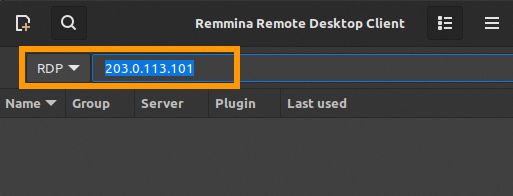
Open Remmina and make sure the connection protocol is set to "RDP". Enter the IPv4 address of your Public Cloud instance and press `Enter`.
**2. Authentication**
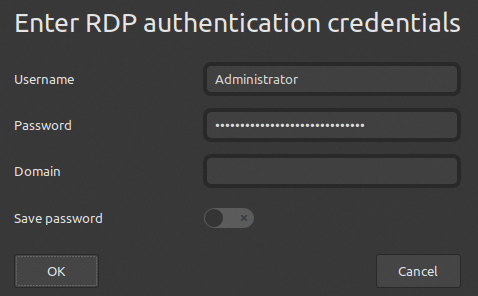
If a certificate warning message appears, click on Yes. Enter the username and your password for Windows and click on OK to establish the connection.
**3. Settings**
You can find some useful items in the left-hand toolbar. For example, click on the icon Toggle dynamic resolution update to improve the window resolution.

#### 5.4: VNC console access
The VNC console allows you to connect to your instances even when other means of access are not available.
Select `Instances
` in the left-hand navigation bar under **Compute**
. Click on the instance name and open the tab `VNC console
`.
**Instance with a GNU/Linux OS installed**
You will need to have a **user account with a password** configured on the instance in order to use the VNC console. To set a password for the preconfigured account, follow the steps in [section 6.1.1 below](#611-set-a-password-for-the-current-user-account).
**Windows instance**
Log in with your Windows credentials. If there is an active login session, you will have immediate access. There will be a noticeable latency compared to an RDP connection.
### Step 6: First steps on a new instance
:::info
**Windows instances**
There are no additional steps required for instances with a Windows OS installed.
You can find more information in the [Go further](#go-further) section below.
:::
#### 6.1: User management
:::info
When configuring user accounts and permission levels on an instance, we recommend to make use of the information in our [user account guide](/en/guides/bare-metal-cloud/dedicated-servers/changing-root-password-linux-ds.md).
:::
##### 6.1.1: Set a password for the current user account
When [logged on to your instance](#step-6-first-steps-on-a-new-instance), set a password for the current user by entering this command:
```bash
sudo passwd
```
Enter a passphrase, confirm with `Enter` and repeat.
```console
New password:
Retype new password:
passwd: password updated successfully
```
**This is sufficient to enable logins via the [VNC console](#54-vnc-console-access) in your OVHcloud Control Panel**. Remote SSH logins with this password however are still **disabled** by default.
##### 6.1.2: How to enable remote logins via password (optional)
:::warning
This step is not necessary and should only be executed if you have a viable reason to enable this access type; for example if you need to temporarily log in to the instance from a device that does not have your private SSH key stored on it.
The following example illustrates a temporary solution on an instance with Ubuntu installed. Note that you might need to adjust the commands according to your OS. It is not recommended to keep this configuration permanently because it adds a potential security risk by opening the system to SSH-based attacks.
:::
When [logged on to your instance](#step-6-first-steps-on-a-new-instance), open the pertinent configuration file with a text editor. Example:
```bash
sudo nano /etc/ssh/sshd_config
```
Edit the line `#PasswordAuthentication yes` as follows:
```console
PasswordAuthentication yes
```
Edit the line `Include /etc/ssh/sshd_config.d/*.conf` as follows:
```console
#Include /etc/ssh/sshd_config.d/*.conf
```
Save the file and close the editor.
Restart the SSH service with one of the following commands:
```bash
sudo systemctl restart ssh
```
```bash
sudo systemctl restart sshd
```
You can now log in via SSH with username and password as well.
Reverse these changes to return to the key-based login for the instance.
#### 6.2: Additional SSH keys
If you want to allow more user accounts to access the instance, the standard procedure is as follows:
- Create the account on the instance.
- Create a new SSH key pair on the device concerned.
- Add the public key to the instance.
Use our [dedicated guide](/en/guides/public-cloud/compute/configuring-additional-ssh-keys.md) for a detailed explanation of these steps.
## Go further
[How to activate a Windows licence for an instance in private mode](/en/guides/public-cloud/compute/activate-windows-license-private-mode.md)
[How to reset a Windows Administrator password](/en/guides/bare-metal-cloud/virtual-private-servers/resetting-a-windows-password.md)
[Instance management in the Control Panel](/en/guides/public-cloud/compute/first-steps-with-public-cloud-instance.md)
[How to get started with OpenStack](/en/guides/public-cloud/cross-functional/compute-prepare-openstack-api-environment.md)
[How to get started with Horizon](/en/guides/public-cloud/cross-functional/introducing-horizon.md)
If you need training or technical assistance to implement our solutions, contact your sales representative or click on [this link](https://www.ovhcloud.com/en-gb/professional-services/) to get a quote and ask our Professional Services experts for a custom analysis of your project.
Join our [community of users](https://community.ovhcloud.com/).