---
title: "AI Notebooks - Tutorial - Use Speech-to-Text powers on audio and video"
description: "How to convert Speech to Text using AI Notebooks"
url: https://docs.ovhcloud.com/en/guides/public-cloud/ai-machine-learning/ai-notebooks-speech-to-text-recognition
lang: en
lastUpdated: 2022-09-01
---
# AI Notebooks - Tutorial - Use Speech-to-Text powers on audio and video
## Objective
The purpose of this tutorial is to show you how it is possible to **convert speech into text** and **generate transcripts** thanks to AI Notebooks.
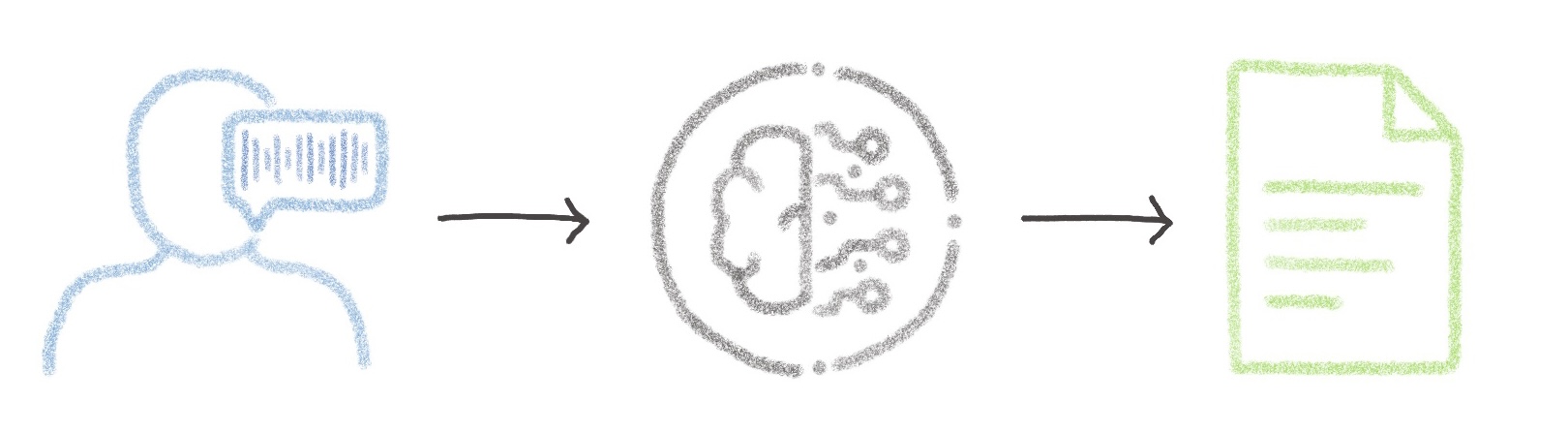
In **Natural Language Processing** (NLP), speech-to-text is a Deep Learning task that enables machines to understand and read human language. There are many applications: transcription, summaries, diarization, subtitle generation, ...
This documentation allows you to test and launch **3 AI Notebooks** allowing you to get to grips with and use various speech-to-text features.
1. The first one will teach you the **basics of audio transcript**. You will be able to transcribe long local or YouTube audio files, measure the quality of a transcription, add punctuation and summarize them.
2. The second tutorial is intended to discover more advanced steps such as the **detection of speaker changes (diarization)** and the **generation of video subtitles**.
3. The last tutorial is a **comparison of different Speech-to-Text models** to find the best one among those available.
:::info
The following instructions correspond to **each** of these 3 tutorials.
:::
## Requirements
- An AI Notebooks project created inside a [Public Cloud project](https://www.ovhcloud.com/en-gb/public-cloud/) in your OVHcloud account
- A user for AI Notebooks
***
### OVHcloud Control Panel Access
- **Direct link:** Public Cloud Projects
- **Navigation path:** Public Cloud > Select your project
***
## Instructions
You can launch your notebook from the OVHcloud Control Panel
or via the ovhai [CLI](/en/guides/public-cloud/ai-machine-learning/ai-cli-run-notebook.md)
.
Direct link to the full code can be found [here](https://github.com/ovh/ai-training-examples/tree/main/notebooks/natural-language-processing/speech-to-text/miniconda).
### Launching a Jupyter notebook with "Miniconda" via UI
To launch your notebook from the OVHcloud Control Panel
, refer to the following steps.
#### Code editor
Choose the `Jupyterlab` code editor.
#### Framework
In this tutorial, the `Miniconda` framework is used.
:::warning
With **Miniconda**, you will be able to set up your environment by installing the Python libraries you need.
:::
You can choose the `conda` version.
:::info
The default version of **conda** is functional for this tutorial: `conda-py39-cuda11.2-v22-4`.
:::
#### Resources
GPU is recommended since audio transcription is resource intensive.
:::info
Here, using `1 GPU` is sufficient.
:::
### Launching a Jupyter notebook with "Miniconda" via CLI
If you want to launch it with the CLI, choose the `jupyterlab` editor and the `conda` framework.
To access the different versions of `conda` available, run the following command.
```bash
ovhai capabilities framework list -o yaml
```
_This tutorial has been launched with the `conda-py39-cuda11.2-v22-4` version._
:::info
If you do not specify a version, your notebook starts with the default version of `conda`.
:::
Choose the number of CPUs/GPUs (`` or ``) to use in your notebook and use the following command.
:::info
Here we recommend using `1 GPU`.
:::
```bash
ovhai notebook run conda jupyterlab \
--name \
--framework-version \
--gpu
```
You can then reach your notebook’s URL once the notebook is running.
### Accessing the notebooks
Once the repository has been cloned, find your notebook by following this path: `ai-training-examples` > `notebooks` > `natural-language-processing` > `speech-to-text`.
1. You can find the first tutorial in the `basics` folder. A preview of this notebook can be found on GitHub [here](https://github.com/ovh/ai-training-examples/blob/main/notebooks/natural-language-processing/speech-to-text/miniconda/basics/speech-to-text-basics.ipynb).
2. The second tutorial corresponds to the `advanced` folder. A preview of this notebook can be found on GitHub [here](https://github.com/ovh/ai-training-examples/blob/main/notebooks/natural-language-processing/speech-to-text/miniconda/advanced/speech-to-text-advanced.ipynb).
3. The last folder, named `compare-models`, contains the third tutorial. A preview of this notebook can be found on GitHub [here](https://github.com/ovh/ai-training-examples/blob/main/notebooks/natural-language-processing/speech-to-text/miniconda/compare-models/speech-to-text-compare-models.ipynb).
## Go further
- With NLP, you can do **sentiment analysis**. For more information, click [here](/en/guides/public-cloud/ai-machine-learning/ai-notebooks-hugging-face-sentiment-analysis.md).
If you need training or technical assistance to implement our solutions, contact your sales representative or click on [this link](https://www.ovhcloud.com/en-gb/professional-services/) to get a quote and ask our Professional Services experts for a custom analysis of your project.
## Feedback
Please send us your questions, feedback and suggestions to improve the service:
- On the OVHcloud [Discord server](https://discord.gg/ovhcloud)