---
title: "Configure an IP address on a virtual machine"
description: "This guide will show you how to assign a public or private IP address to a virtual machine"
url: https://docs.ovhcloud.com/en/guides/hosted-private-cloud/powered-by-vmware/configure-ip-on-vm
lang: en
lastUpdated: 2024-08-07
---
# Configure an IP address on a virtual machine
## Objective
After you have created a virtual machine (VM), you can assign to it a public or private IP address so that the VM has internet and/or private network connectivity.
**This guide will show you how to assign a public or private IP address to a virtual machine.**
## Requirements
- You must have already created a virtual machine.
- You will need an IP block.
## Instructions
### Retrieve your information
**IPv4**
You can retrieve the information of your public IPv4 address block directly from the vSphere client, by going to the Hosts and clusters section. Then click on your datacentre and choose the Configure tab. Then click Network below `OVHcloud`.
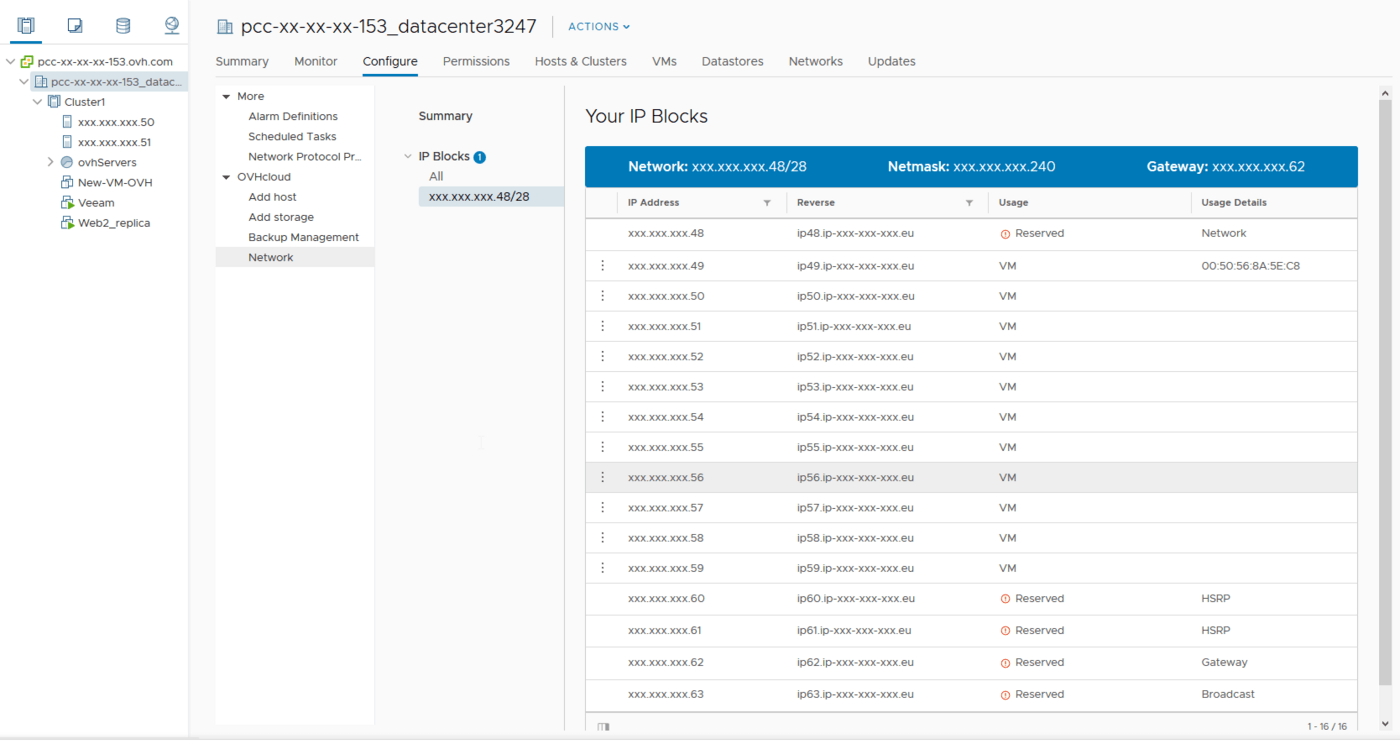
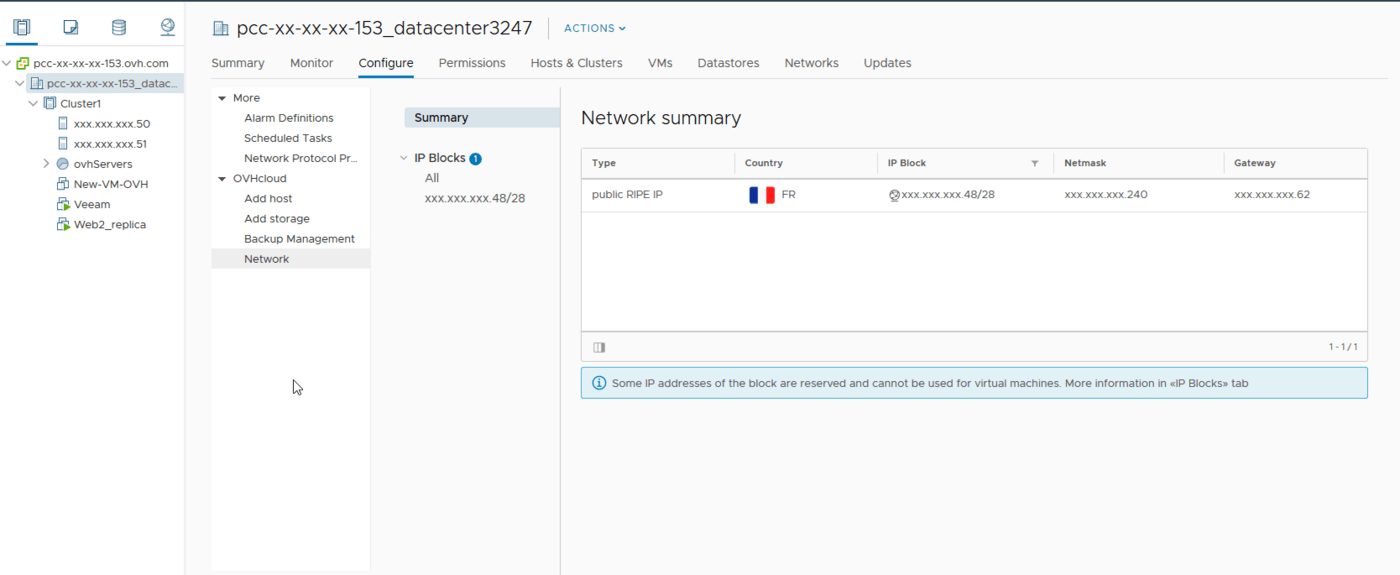On each block delivered by OVHcloud, 5 IP addresses are reserved for network configuration and should never be used for your virtual machines. This is the first and the last four IPs in the block.
A Private Cloud IP block is organized as follows:
- The first IP address marked as `reserved` corresponds to the network address.
- The following IPs can be used for your virtual machines. They are marked as `Available` if no VM is using them, or as `Used` if they are being used.
- The last four IPs in the block are reserved, two are dedicated to OVHcloud routers for operating the block, and the other two are used for gateway and broadcast.
**IPv6**
:::warning
By default, the IPv6 block delivered with your Dedicated Cloud is not activated, so you will need to open a [support request](https://help.ovhcloud.com/csm?id=csm_get_help) to request its activation.
:::
You can retrieve your public IPv6 address block information via the OVHcloud Control Panel by going to the [Manage my IPs](https://www.ovh.com/manager/#/dedicated/ip?serviceType=pcc\&page=1) section.
Before you begin, and in order to use the same terminology during the changes, please read the table below. It references terms that we will use in this documentation:
| Term | Description | Example |
| ------------- | ------------------------------------------------------------------ | --------------------------------------- |
| YOUR\_IPV6 | This is an IPv6 address of the IPv6 block assigned to your service | 2001:41d0:xxxx:xxxx::1 |
| IPv6\_PREFIX | This is the prefix (or _netmask_) of your IPv6 block, usually 64 | 2001:41d0:xxxx:xxxx::/56 |
| IPv6\_GATEWAY | This is the gateway (or _gateway_) of your IPv6 block | 2001:41d0:xxxx:xxxx:ffff:ffff:ffff:ffff |
### Configure a public IP address
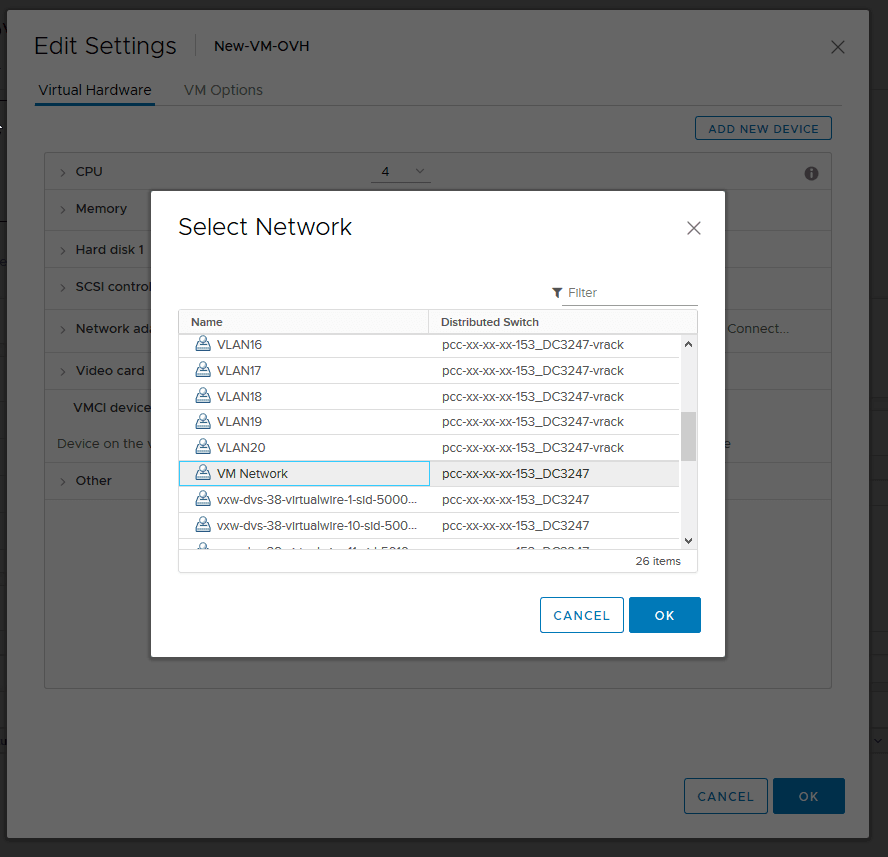
To configure a public IP address on your virtual machine, you must first choose the `VMNetwork
` interface in your VM network adapter settings:
**Linux IPv4**
Here is an example of a configuration on the Debian distribution:
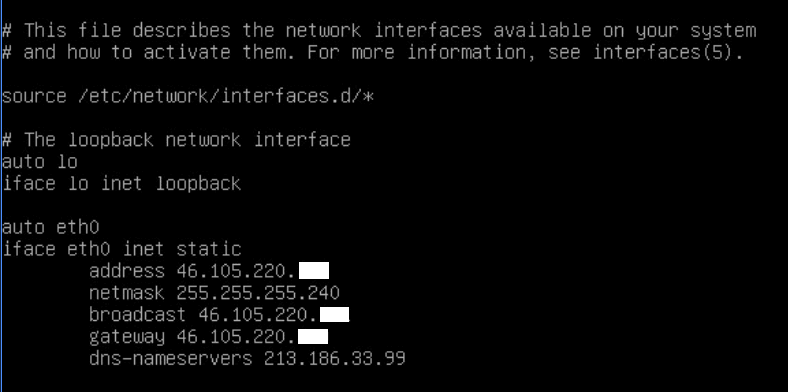```sh
auto eth0
iface eth0 inet static
address 46.105.220.xxx
netmask 255.255.255.240
broadcast 46.105.220.xxx
gateway 46.105.220.xxx
dns-nameservers 213.186.33.99
```
Restart your network system with `systemctl restart networking`.
You can check the configuration with `ip a`.
If your virtual machine cannot find the network, make sure that the network adapter is configured on _VMNetwork_ and not on _LocalPortGroup_ or a VLAN, and that the adapter’s connection box is ticked.
**Windows IPv4**
Here is an example of a configuration on Windows:
In the Control Panel, go to Network and Internet then Network and Sharing Center and then Modify the network adapter.
To go faster, you can click on the Windows search field and write `Run` (which corresponds to simultaneously pressing the _Windows_ key and the _R_ key of your keyboard). The Windows command console will open, and you can enter the following command:
```shell
ncpa.cpl
```
Then right-click the network adapter corresponding to the VMNetwork and select Properties. Then select TCP/IP v4 protocol and click on Properties and enter your IP information as follows:
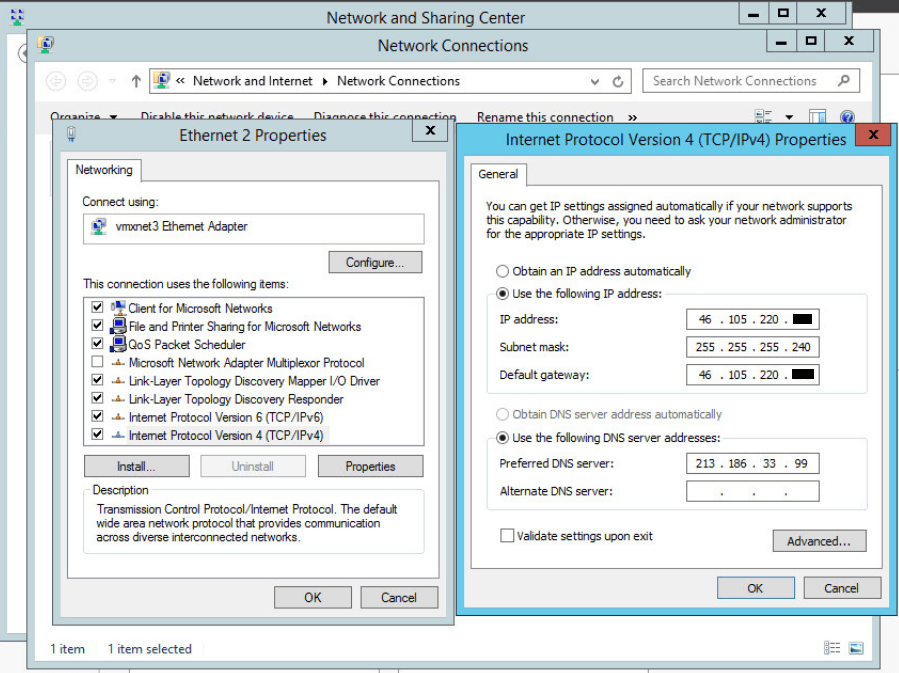```sh
IP Address: 46.105.220.xxx
Subnet Mask: 255.255.255.240
Default Gateway: 46.105.220.yyy
DNS Server: 213.186.33.99
```
**Linux IPv6**
Here is an example of a network configuration on the Debian distribution:
```sh
auto eth0
iface eth0 inet6 static
address 2001:41d0:xxxx:xxxx::
netmask 56
gateway 2001:41d0:xxxx:xxxx:ffff:ffff:ffff:ffff
```
Restart your network system with `systemctl restart networking`.
You can check the configuration with `ip a`.
If your virtual machine cannot find the network, make sure to check if the network card is configured on VMNetwork and not on LocalPortGroup or a VLAN, and that the network card's connection checkbox is checked.
**Windows IPv6**
Here is an example of a configuration on Windows:
In the Control Panel, go to Network and Internet then Network and Sharing Center and then Modify the network adapter.
To go faster, you can click on the Windows search field and write `Run` (which corresponds to simultaneously pressing the _Windows_ key and the _R_ key of your keyboard). The Windows command console will open, and you can enter the following command:
```shell
ncpa.cpl
```
Then right-click the network adapter corresponding to the VMNetwork and select Properties. Then select TCP/IP v4 protocol and click on Properties and enter your IP information as follows:
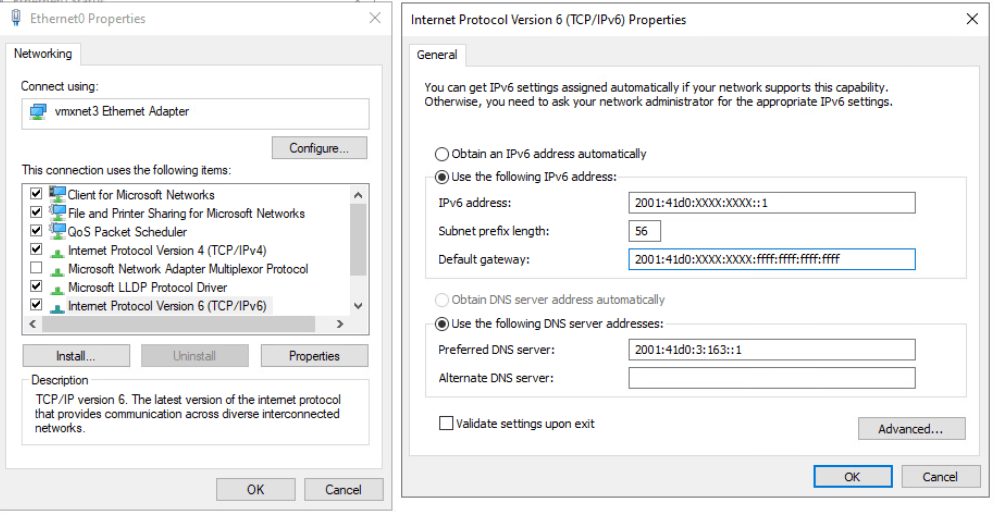```sh
IP Address: 2001:41d0:xxxx:xxxx::
Subnet Mask: 56
Default Gateway: 2001:41d0:xxxx:xxxx:ffff:ffff:ffff:ffff
DNS Server: 2001:41d0:3:163::1
```
### Configure a private IP address
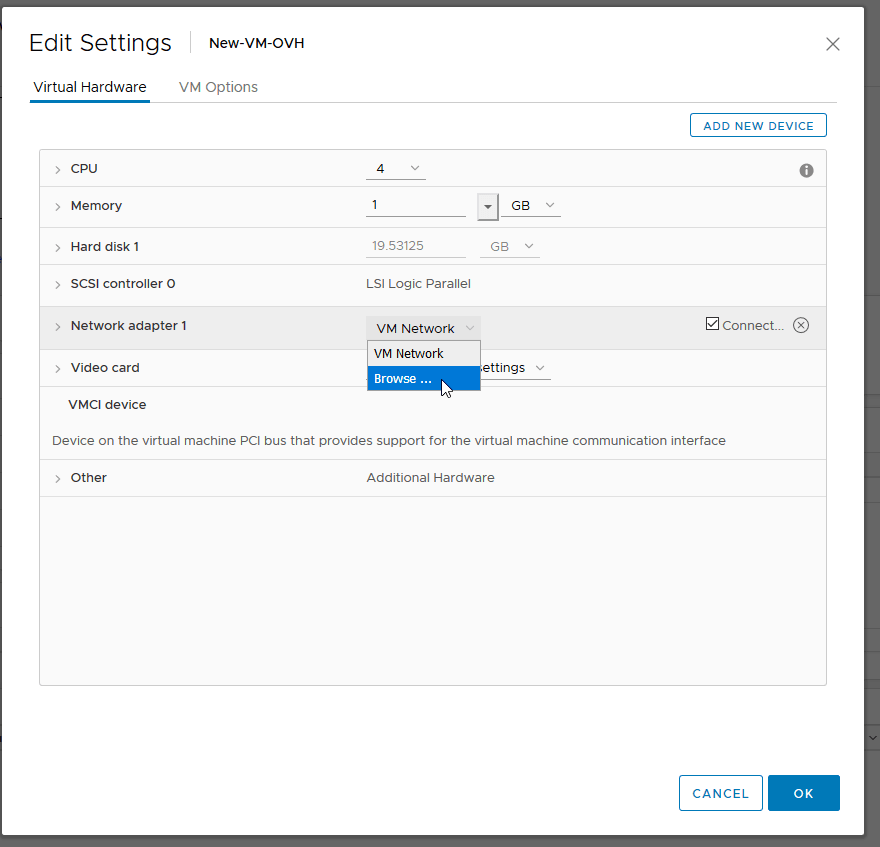
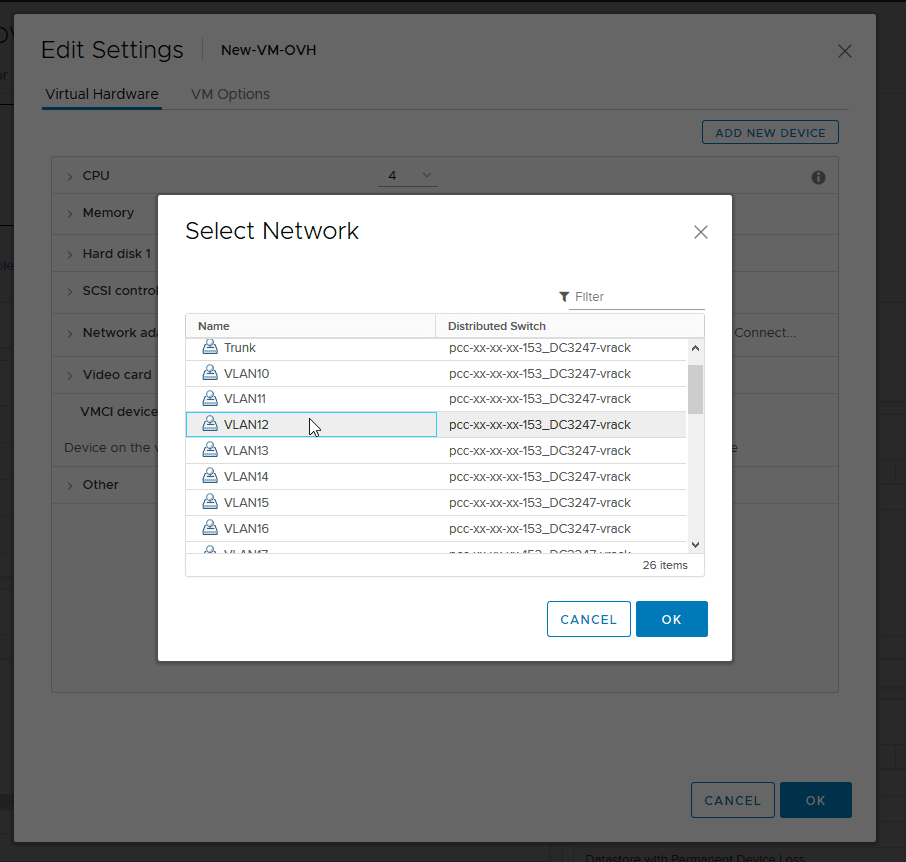
The process for configuring a private IP address is similar to that of a public IP address. However, you must use the network adapter configured for your VLAN or VxLAN.
In your interface options, you can edit the following settings:
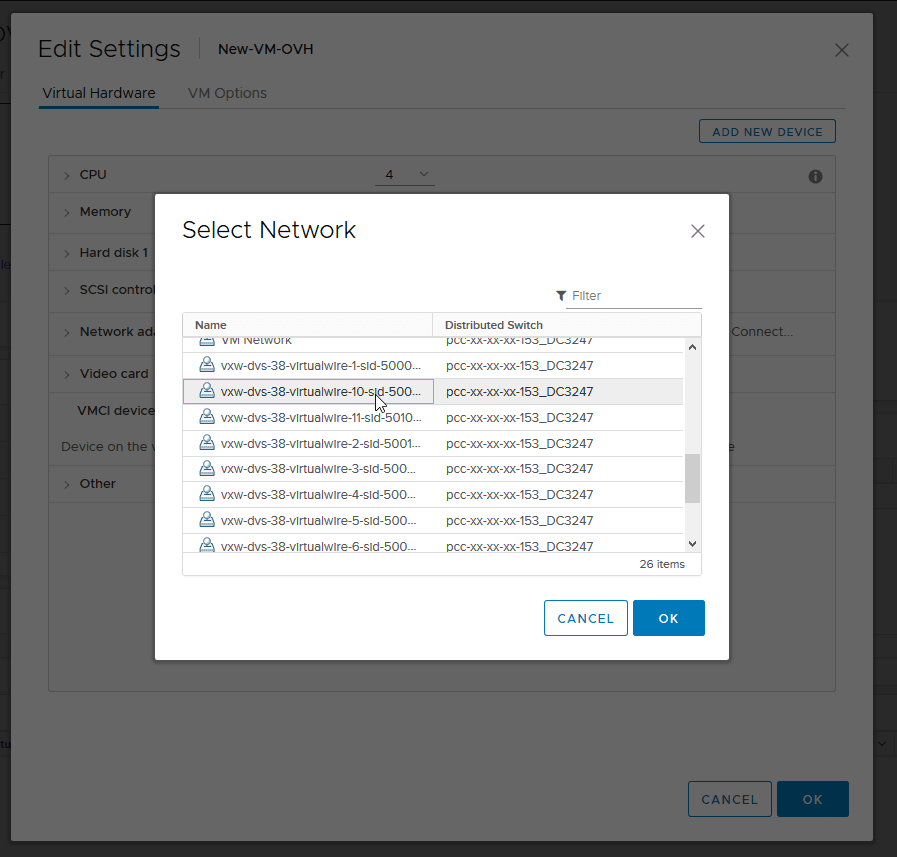
- A VLAN interface (10 to 20 by default and linked to the vRack, you can create more by consulting [this guide](/en/guides/hosted-private-cloud/powered-by-vmware/create-vlan.md)).
- A VxLAN interface (vxw-dvs, etc.).
In your virtual machine settings, you can use a VLAN or a VxLAN:
#### Linux
Here is a configuration example on a Debian operating system:
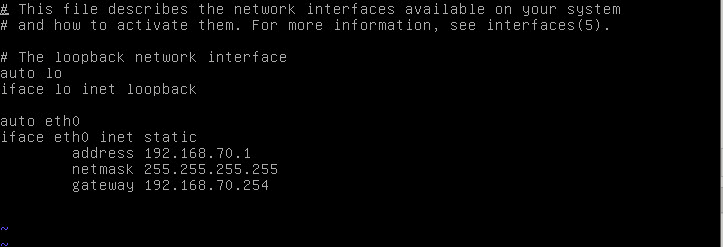
By editing the interfaces file, you can assign a private IP address on your chosen IP range:
```sh
auto eth0
iface eth0 inet static
address 192.168.70.1
netmask 255.255.255.0
gateway 192.168.70.254
```
Restart your network system with `systemctl restart networking`.
You can check the configuration with `ip a`.
#### Windows
Here is a configuration example for Windows:
In the `configuration panel
`, go to `Network and Internet
`, then `Network and Sharing Centre
`, and then to `Change Network Adapter
`.
To speed up the process, you can click on the Windows search field and write `Run` (or press the _Windows_ and _R_ keys at the same time). The Windows command console will open, and you can enter this command:
```shell
ncpa.cpl
```
Right-click on the corresponding VMNetwork adapter and click `Properties
`. Then select `TCP/IPv4 protocol
` and click again on `Properties
`, then enter your IP information as follows:
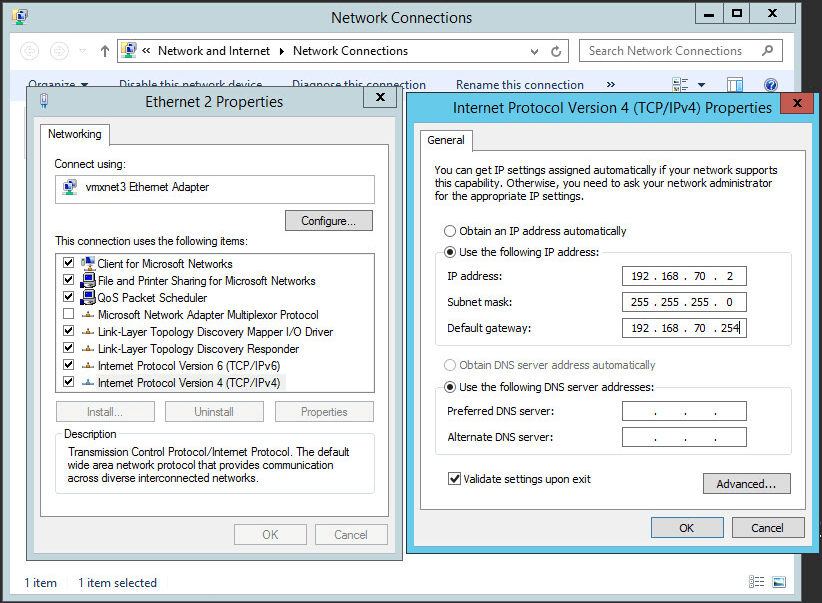
By modifying this interface, you can assign a private IP address on your chosen IP range:
```sh
IP address: 192.168.70.2
Subnet mask: 255.255.255.0
Default gateway: 192.168.70.254
```
## Go further
Join our community of users on [https://community.ovh.com/en/](https://community.ovh.com/en/).