---
title: "How to Configure Your NIC for OVHcloud Link Aggregation in SLES 15"
description: "Enable OVHcloud Link Aggregation in your SLES 15 server"
url: https://docs.ovhcloud.com/en/guides/bare-metal-cloud/dedicated-servers/ola-enable-sles15
lang: en
lastUpdated: 2026-06-24
---
# How to Configure Your NIC for OVHcloud Link Aggregation in SLES 15
## Objective
OVHcloud Link Aggregation (OLA) technology is designed by our teams to increase your server's availability, and boost the efficiency of your network connections. In just a few clicks, you can aggregate your network cards and make your network links redundant. This means that if one link goes down, traffic is automatically redirected to another available link. The available bandwidth is also doubled thanks to aggregation.
Aggregation is based on IEEE 802.3ad, Link Aggregation Control Protocol (LACP) technology.
**This guide explains how to bond your interfaces to use them for OLA in SLES 15.**
## Requirements
- [Configuring OVHcloud Link Aggregation in the OVHcloud Control Panel](/en/guides/bare-metal-cloud/dedicated-servers/ola-enable-manager.md)
***
### OVHcloud Control Panel Access
- **Direct link:** Dedicated Servers
- **Navigation path:** Bare Metal Cloud > Dedicated servers > Select your server
***
## Instructions
Because you have a private-private configuration for your NICs in OLA, you will be unable to SSH into the server. Thus, you will need to leverage the IPMI tool to access the server.
Click the `IPMI
` tab (1).
Next, click the `From a Java applet (KVM)
` button (2).
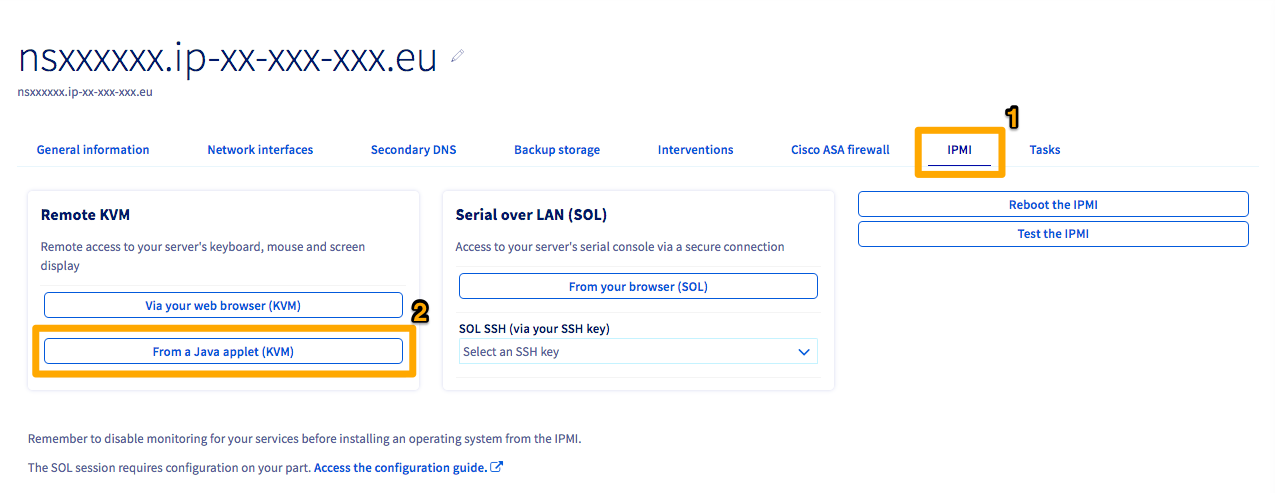
A JNLP program will be downloaded. Open the program to enter the IPMI. Log in using valid credentials for the server.
By default, using an OVHcloud template, the NICs will be named _eth0_ and _eth1_. If you are not using an OVHcloud template, you can find the names of your interfaces using the following command:
```bash
ip a
```
:::info
This command will yield numerous "interfaces." If you are having trouble determining which ones are your physical NICs, the first interface will still have the server's public IP address attached to it by default.
:::
### Retrieving MAC addresses
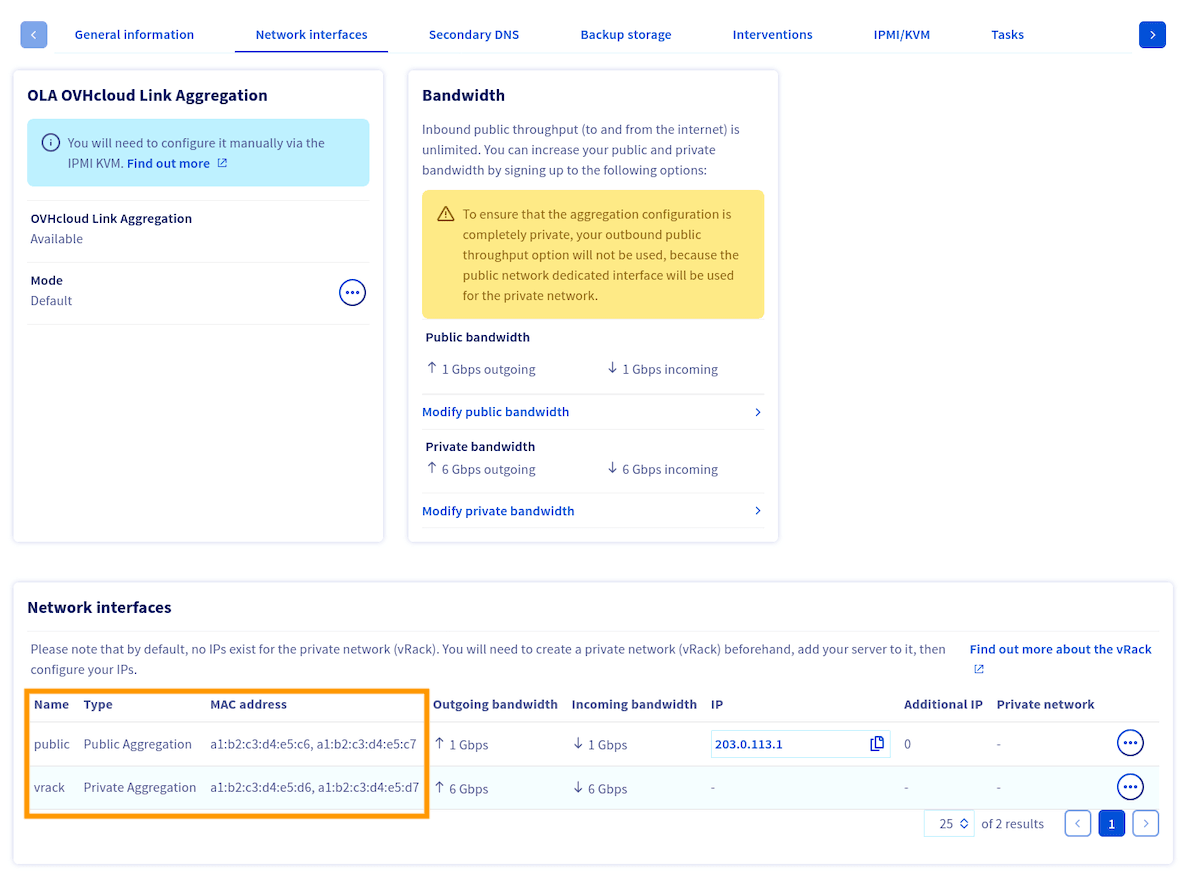
Switch to the tab `Network Interfaces
` and take note of the MAC addresses for each interface (public/private) which are displayed at the bottom of the menu.
:::info
The MAC address of the main public interface is the `aggregationFallback` value of the `public` interface, which you can retrieve with the following API route:
🇪🇺EU▾
[GET/dedicated/server/{serviceName}/networking](https://eu.api.ovh.com/console/?section=/dedicated/server&branch=v1#get-/dedicated/server/-serviceName-/networking)
:::
:::info
You can use any private IP address and subnet you wish.
If your server has more than 2 network interfaces, you can add them in the configuration, by incrementing the number of the `BONDING_SLAVE_` parameter, for example, `BONDING_SLAVE_2='eth2'`.
:::
Now that you know which MAC addresses are associated to each type (public/private) of interface, you need to retrieve the interface names.
### Retrieving interface names
:::warning
The IP addresses will be different for each server.
:::
To retrieve the names of the interfaces, execute the following command:
```bash
ip a
```
:::info
The hardware address (MAC address) of the NIC can be found using the `ip a` command that you used earlier. It will be the number next to `link/ether` in the output.
:::
Here's an output example:
```text
1: lo: mtu 65536 qdisc noqueue state UNKNOWN group default qlen 1000
link/loopback 00:00:00:00:00:00 brd 00:00:00:00:00:00
inet 127.0.0.1/8 scope host lo
valid_lft forever preferred_lft forever
inet6 ::1/128 scope host noprefixroute
valid_lft forever preferred_lft forever
2: ens22f0np0: mtu 1500 qdisc mq state UP group default qlen 1000
link/ether a1:b2:c3:d4:e5:c6 brd ff:ff:ff:ff:ff:ff
inet 203.0.113.1/32 metric 100 scope global dynamic ens22f0np0
valid_lft 71613sec preferred_lft 71613sec
inet6 2001:db8:1:1b00:203:0:112:0/56 scope global
valid_lft forever preferred_lft forever
inet6 fe80::a6b2:c3ff:fed4:e5c6/64 scope link
valid_lft forever preferred_lft forever
3: ens22f1np1: mtu 1500 qdisc noop state DOWN group default qlen 1000
link/ether a1:b2:c3:d4:e5:c7 brd ff:ff:ff:ff:ff:ff
4: ens33f0np0: mtu 1500 qdisc noop state DOWN group default qlen 1000
link/ether a1:b2:c3:d4:e5:d6 brd ff:ff:ff:ff:ff:ff
5: ens33f1np1: mtu 1500 qdisc noop state DOWN group default qlen 1000
link/ether a1:b2:c3:d4:e5:d7 brd ff:ff:ff:ff:ff:ff
```
Once you have determined the names of your interfaces, you can configure interface bonding in the OS.
### Configuring interface bonding
Select the tab below that matches your server configuration:
- **Two interfaces**: Advance servers with two physical NICs.
- **Four interfaces - Double LAG**: Scale and High-Grade servers with OLA in **Active - Double LAG** mode (public + private aggregates). This requires [OLA to be enabled](/en/guides/bare-metal-cloud/dedicated-servers/ola-enable-manager.md) in the OVHcloud Control Panel.
- **Four interfaces - Fully Private**: Scale and High-Grade servers with OLA in **Active - Fully Private** mode (single private aggregate for vRack). This requires [OLA to be enabled](/en/guides/bare-metal-cloud/dedicated-servers/ola-enable-manager.md) in the OVHcloud Control Panel.
**Two interfaces**
Create the bond configuration file `/etc/sysconfig/network/ifcfg-bond0`:
**Static IP**
```bash
STARTMODE='onboot'
BOOTPROTO='static'
IPADDR='203.0.113.1/32'
BONDING_MASTER='yes'
BONDING_SLAVE_0='ens22f0np0'
BONDING_SLAVE_1='ens22f1np1'
BONDING_MODULE_OPTS='mode=802.3ad xmit_hash_policy=layer3+4 lacp_rate=fast'
```
Then configure each physical interface. Edit `/etc/sysconfig/network/ifcfg-ens22f0np0`:
```bash
BOOTPROTO='none'
STARTMODE='hotplug'
LLADDR=a1:b2:c3:d4:e5:c6
```
Create `/etc/sysconfig/network/ifcfg-ens22f1np1`:
```bash
BOOTPROTO='none'
STARTMODE='hotplug'
LLADDR=a1:b2:c3:d4:e5:c7
```
DHCP
```bash
STARTMODE='onboot'
BOOTPROTO='dhcp4'
BONDING_MASTER='yes'
BONDING_SLAVE_0='ens22f0np0'
BONDING_SLAVE_1='ens22f1np1'
BONDING_MODULE_OPTS='mode=802.3ad xmit_hash_policy=layer3+4 lacp_rate=fast'
```
The physical interface configuration files remain the same as above.
**Four interfaces - Double LAG**
This configuration bonds public interfaces into `bond0` (with public IP) and private interfaces into `bond1` (for vRack).
Create the public bond configuration file `/etc/sysconfig/network/ifcfg-bond0`:
**Static IP**
```bash
STARTMODE='onboot'
BOOTPROTO='static'
IPADDR='203.0.113.1/32'
BONDING_MASTER='yes'
BONDING_SLAVE_0='ens22f0np0'
BONDING_SLAVE_1='ens22f1np1'
BONDING_MODULE_OPTS='mode=802.3ad xmit_hash_policy=layer3+4 lacp_rate=fast'
```
Create the private bond configuration file `/etc/sysconfig/network/ifcfg-bond1`:
```bash
STARTMODE='onboot'
BOOTPROTO='static'
IPADDR='10.0.0.1/24'
BONDING_MASTER='yes'
BONDING_SLAVE_0='ens33f0np0'
BONDING_SLAVE_1='ens33f1np1'
BONDING_MODULE_OPTS='mode=802.3ad xmit_hash_policy=layer3+4 lacp_rate=fast'
```
Then configure each physical interface. Edit `/etc/sysconfig/network/ifcfg-ens22f0np0`:
```bash
BOOTPROTO='none'
STARTMODE='hotplug'
LLADDR=a1:b2:c3:d4:e5:c6
```
Create `/etc/sysconfig/network/ifcfg-ens22f1np1`:
```bash
BOOTPROTO='none'
STARTMODE='hotplug'
LLADDR=a1:b2:c3:d4:e5:c7
```
Create `/etc/sysconfig/network/ifcfg-ens33f0np0`:
```bash
BOOTPROTO='none'
STARTMODE='hotplug'
LLADDR=a1:b2:c3:d4:e5:d6
```
Create `/etc/sysconfig/network/ifcfg-ens33f1np1`:
```bash
BOOTPROTO='none'
STARTMODE='hotplug'
LLADDR=a1:b2:c3:d4:e5:d7
```
DHCP (bond0 only)
For the public bond, use DHCP:
```bash
STARTMODE='onboot'
BOOTPROTO='dhcp4'
BONDING_MASTER='yes'
BONDING_SLAVE_0='ens22f0np0'
BONDING_SLAVE_1='ens22f1np1'
BONDING_MODULE_OPTS='mode=802.3ad xmit_hash_policy=layer3+4 lacp_rate=fast'
```
The private bond (`ifcfg-bond1`) and all physical interface configuration files remain the same as above.
**Four interfaces - Fully Private**
This configuration aggregates all physical interfaces into a single bond for vRack use only. There is no public IP connectivity.
:::warning
Following the implementation of OLA in Fully Private mode, the public IP is no longer accessible. Make sure you have an alternative means of access (e.g. through another server in the vRack, or via KVM/IPMI) before applying this configuration.
:::
Create the bond configuration file `/etc/sysconfig/network/ifcfg-bond0`:
```bash
STARTMODE='onboot'
BOOTPROTO='static'
IPADDR='10.0.0.1/24'
BONDING_MASTER='yes'
BONDING_SLAVE_0='ens22f0np0'
BONDING_SLAVE_1='ens22f1np1'
BONDING_SLAVE_2='ens33f0np0'
BONDING_SLAVE_3='ens33f1np1'
BONDING_MODULE_OPTS='mode=802.3ad xmit_hash_policy=layer3+4 lacp_rate=fast'
```
Then configure each physical interface. Edit `/etc/sysconfig/network/ifcfg-ens22f0np0`:
```bash
BOOTPROTO='none'
STARTMODE='hotplug'
LLADDR=a1:b2:c3:d4:e5:c6
```
Create `/etc/sysconfig/network/ifcfg-ens22f1np1`:
```bash
BOOTPROTO='none'
STARTMODE='hotplug'
LLADDR=a1:b2:c3:d4:e5:c7
```
Create `/etc/sysconfig/network/ifcfg-ens33f0np0`:
```bash
BOOTPROTO='none'
STARTMODE='hotplug'
LLADDR=a1:b2:c3:d4:e5:d6
```
Create `/etc/sysconfig/network/ifcfg-ens33f1np1`:
```bash
BOOTPROTO='none'
STARTMODE='hotplug'
LLADDR=a1:b2:c3:d4:e5:d7
```
:::info
In Fully Private mode, the bond uses the MAC address of the **main private** interface. The `IPADDR` field should be set to your vRack private IP.
:::
### Applying the configuration
Apply the configuration by reloading all interfaces with wicked:
```bash
wicked ifreload all
```
This may take several seconds since it is building the bond interface. To test that the bond is working, ping another server on the same vRack. If it works, you are all set. If it does not, double-check your configurations or try rebooting the server.
You can also verify the bonding parameters using the following command:
```bash
cat /proc/net/bonding/bond0
```
## Go further
[Configuring OVHcloud Link Aggregation in the OVHcloud Control Panel](/en/guides/bare-metal-cloud/dedicated-servers/ola-enable-manager.md)
[How to configure your NIC for OVHcloud Link Aggregation in Debian 12 or Ubuntu 24.04 using Netplan](/en/guides/bare-metal-cloud/dedicated-servers/lacp-enable-netplan.md)
[How to configure your NIC for OVHcloud Link Aggregation in Debian 9 to 11](/en/guides/bare-metal-cloud/dedicated-servers/ola-enable-debian9.md)
[How to Configure Your NIC for OVHcloud Link Aggregation in Windows Server 2019](/en/guides/bare-metal-cloud/dedicated-servers/ola-enable-w2k19.md)
Join our [community of users](https://community.ovhcloud.com/).